
percussion patches?
@porres Sound On Sounds Synth Secrets has some, it is widely available on the web as a PDF and I think they have also have it all on their website. The name of the series is rather misleading, it is more Synth Standards. Are you looking for particular sounds or just the general way various sounds were made?
The standard drum sound was almost always just a resonating filter fed a trigger or a decay envelope. These often had issues with feed through and the trigger would cause a thump or click throwing in an impact sound for free, sometimes they would send the trigger through a simple RC lowpass so they could tune the impact sound separate of the shell resonance tone created by the oscillating filter. Add in a white noise generator and it is a snare, many classics used just filtered noise for the snare. The standard circuit used by most of the classic drum machines was just Twin-Tee or Bridged-Tee bandpass stuck in the feedback loop of a gain element, should not be too difficult to mimic in PD, PAiA gives a decent run down on the circuit https://paia.com/syndrum/. That is most of the classic drum sounds right there, they got a little more complex by the time of the 808, but not much and much of the added complexity is just to deal with the less than ideal world of electronics. The other sounds tend to be multiple oscillators and/or white noise through differently tuned filters.
I can not give much in the way of resources, I learned from the schematics. For many of the more popular sounds like anything from an 808 or 909 and many others, you should be able to just search for something like "808 kick drum circuit analysis" and get a write on it that will lay out the signal flow and tuning and timing of the various parts, just need to read around all the electronics non-sense.
 posted in technical issues
Using PD in a complex commercial hardware groovebox project
@whale-av Surely starting a business in the field of electronics is entailed with risks. I think your points are all valid.
But the specific question if Pd is suited for such a project if the general market risks can be mitigated can probably answered with yes, as the Organelle proves that it can be done using Pd. 
Of course the Organelle uses Pd as a special feature to support custom patches. If Pd together with a single board computer is cheaper with the same quality of sound as using electronics may be another question that i cannot answer.
 posted in I/O hardware diy
ELSE 1.0 Beta 30 with live electronics tutorial released (Needs Pd 0.51-1)
ELSE 1.0 Beta 30 with live electronics tutorial is out! This needs Pd 0.51-1 and the highlight is a new abstraction called [batch.rec~] that records your patches into a sound file in batch mode. In this way you can render whatever amount of audio as fast as possible in your computer. This is possible with the new 'fast-forward' message to Pd, available in Pd 0.51-1. The cool thing about this object is that it has multichannel support.
You can download it directly via "Pd => Find Externals", just search for 'else'! Note that the "Live Electronics Tutorial" is part of the package (it relies on the ELSE library). Find the "Live Electronics Tutorial" folder inside the 'else' folder. The tutorial also provides an example on how to use this new 'fast-forward' feature. Check "Vol.1/Introduction-Pd.Quickstart/2.Syntax/4.fast-forward.pd".
Find detailed changelogs at:
 posted in news
ELSE 1.0 beta 29 with live electronics tutorial
ELSE 1.0 beta 29 with live electronics tutorial is out. This library version needs at Pd version 0.51-0 or above! Most importantly, I fixed a bug in [dir] where it couldn't load absolute paths in windows. I also made nice improvements to [keyboard] and included a new GUI object for text input (messbox), which is like an atom box (where you can insert data while in run mode) but for any kind of message.
There's other stuff and breaking changes as usual as this is still a beta project, so check the detailed changelog at https://github.com/porres/Live-Electronic-Music-Tutorial/releases/tag/v1.0-beta-29 - where you can download this and earlier versions. You can also get else directly via Pd (in Help => Find Externals). This download also contains the "Live Electronics Tutorial", in a version compatible to this version of ELSE. Find the "Live Electronics Tutorial" folder inside the 'else' folder.
cheers
posted in news
BlurPD - digital logic framework system for Pure Data [v3]
@Jona The system is design to be as simple as possible. It is like a lego system combine with real elements from electronics and computer science (bitwise logic). Prior knowledge about computer architecture is good to know to use the system well, but it is not necessary. The system can be use to create entire CPU's but you can just play like a kid with it. Each module has an exact behavior (lego block) that you can learn and then you can combine them to make something new. Your idea of using the system for sound is just one of the key points of the system. Pure Data is made for sound processing (DSP) but digital logic is different and not present in Pure Data. You can view BlurPD as a lego bridge that colours Pure Data with digital electronics. The idea of musical structures in BlurPD is not implemented but i have this idea of yours under my radar. I just have to figure it out an interesting way to do that..
 posted in patch~
controlling Korg Volca's with PD
@aurimas_g This........
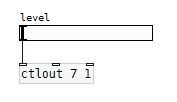
should control the level (control cc message 7) on midi channel 1.
The slider has output 0 to 127.
In the first link you posted there is a note that "*1: Received when global parameter MIDI RX ShortMessage is set to ON."
That must be a setting within "Volka" I think.
Probably here...... http://filipe-teixeira.com/electronic-music/volca-resources/volca-sample-tutorial-7/
David.
 posted in technical issues
Easy resonant lp filter?
I actually meant to show this example where you can have a look at the frequency response of [vcf~] : https://github.com/porres/Live-Electronic-Music-Tutorial/blob/master/Examples/Vol.2/Part.05-Filters(Basic)/22-Filters.types/2.Filter.Types/2.Resonant/2.Bandpass/2.[vcf~].pd
why the help patch doesn't claim that it's lowpass
cause miller seems to consider it a lowpass, but I wouldn't consider it a proper one. You can see in that example that you have a constant zero dB, which is not how lowpass filters usually work.
it's "like [bp~]" and refers to center frequency, but it seems to attenuate high frequencies
more sharply than low, so I'm not sure if it really is bandpass, classically, or not.
yeah, it does attenuate more the high frequencies, the previous example to the one I posted above shows that too. I wouldn't consider it a proper bandpass as well.
Both [bp~] and [vcf~] are just pretty cheap filters. You'd need a biquad (with 2 poles and 2 zeros) to make a proper bandpass and a lowpass.
posted in technical issues
ELSE 1.0 beta 24 is out along with Live electronics tutorial 1.0 beta 14!
Quite a few new objects in the update of ELSE (16 new ones for a total of 458), highlighting here: a group of multichannel objects ([out1~], [out4~], [out8~], [meter4~], [meter8~] and [pan8~]), a general binary operator: [op~], a [gui] object with the functionality that didn't make into [pdcontrol], a new [canvas.mouse] object that gets mouse interaction with the patch window. I also fixed bugs in [dir] and added a new functionality to [mtx.ctl] to get the value of the cells. Check more details and binaries at: https://github.com/porres/pd-else/releases/tag/v1.0-beta24 - wait a bit for raspberry pi binaries and for all of them to show up in deken.
Some objects here were included by request for Jose Ignacio Lopez Ramírez-Gastón and Mark Edward Grimm. So yeah, I take requests... just saying...
My live electronics tutorial has also received updates to the latest version of ELSE and is available at: https://github.com/porres/Live-Electronic-Music-Tutorial
posted in news
getting started with pure data: any book, pdf, tutorial recommendations?
@emens ; https://github.com/porres/Live-Electronic-Music-Tutorial/releases
"Live Electronic Music Tutorial with examples in Pure Data and the ELSE Library By Alexandre Torres Porres
This tutorial presents theory and practice of Live Electronics topics without any prerequisite. It's aimed at newbies, dummies, enthusiasts and also experts. Pure Data is adopted in the examples for its accessibility and for being a powerful didactic tool. Nonetheless, this work relies heavily in the ELSE library for Pure Data, also developed by Alexandre Torres Porres, the author of this tutorial => check about the ELSE library here: https://github.com/porres/pd-else"
posted in tutorials
EN-1 granular sampling synthesizer
@Jona it's hard to gauge how difficult something would be, that can be very subjective! However I would say that connecting some pots and switches to a micro controller is relatively straightforward. In my teaching experience I've noticed that the thing that people find most challenging is soldering components and figuring out the best logistical way to connect things and then mount them in a nice way. The soldering is a major hurdle and there's not much way around it, apart from lots of practice!
But as a word of encouragement: I personally don't have any formal electronics background at all, I learned everything from Internet forums and books and things. I would highly suggest Handmade Electronic Music as a place to start, it assumes you know absolutely nothing, is a very easy read, and gets you started making really amazing (and low cost) noisemaking things. If you can learn the basics of how a potentiometer and switch work it's not very much more work to get it connected to a Bela/raspi/arduino. https://www.nicolascollins.com/handmade.htm
 posted in output~