
ELSE library 1.0 beta 18 and Live Electronics Tutorial 1.0 beta 8 released
Howdy, I have big updates to the ELSE library and my Live Electronics Tutorial!
Raspberry Pi binaries for ELSE are still missing, but it'll be up soon. Find available releases on github while they don't show up in deken.: https://github.com/porres/pd-else/releases/tag/v1.0-beta18
There are 30 new objects in ELSE. This is the first release over 300 objects and there's already 324 of them! I'm shocked on how much it's growing... I realize now how this library is unique in the number of objects towards DSP and audio processing. There are 219 tilde objects, that's more objects than Pd itself has, or all of cyclone...
So, what's the most exciting new stuff?
There's a bunch of reverb objects here - [mono.rev~], [stereo.rev~], [echo.rev~], [giga.rev~], [free.rev~] (check also [fdn.rev~] which wasn't really ready).
There are a few dynamic processors as well: [compress~], [duck~] and [expand~].
A couple of FX like [chorus~] and [phaser~].
A [spectrograph~] object.
Some objects that deal with lists ([regroup], [pick], [sort], [scramble], [merge], [unmerge] & [rand.seq]).
A [trigger2] object that behaves like [trigegr] in Purr Data and Max, that people from time to time request to be in Pd as well (if Pd's trigger includes such functionalities, I'll delete this object).
Check complete changelog here: https://github.com/porres/pd-else/releases/tag/v1.0-beta18 . As usual, I have breaking changes while we're at the beta stage.
As for my Live Electronics tutorial, which is based on this library, most of the changes reflect the new objects from the ELSE library. So then, most importantly, the reverb section just got a major upgrade. I'm also now including an appendix with s quick start on Data Structures! Check it out at https://github.com/porres/Live-Electronic-Music-Tutorial/releases/tag/v1.0-beta-8
cheers
 posted in news
ELSE 1.0 beta 17 & Live Electronics Tutorial 1.0 beta 7) Released
17th Beta release of ELSE 1.0 (needs Pd 0.49-0 or above)! See https://github.com/porres/pd-else/releases/tag/v1.0-beta17 - get binaries also directly from Pd (Help => Find Externals).
I haven't been posting every release here so you may want to see earlier changelogs to catch on what's new. The main new thing is that there's a [conv~]* object that performs partitioned convolution and with that my Live Electronics Tutorial now solely depends 100% on the ELSE library, and what makes this release special! Check it out: https://github.com/porres/Live-Electronics-Tutorial/releases/tag/v-1.0beta-7
- The [conv~] object is a partitioned convolution abstraction, but a compiled object should come up sooner or later.
cheers
posted in news
Live Electronis Tutorial by Porres in English (& ELSE beta 12 released)
Hi, I had to make a quick update to both my Live Electronics Tutorial and ELSE library. The new object [hann~] is now fixed and the FFT examples now work! I also added a new object to ELSE: [comb.filt~], this object is also part of the tutorial and I ended up revising the filters/reverb section of my tutorial as well and included a new section on resonators. See: https://github.com/porres/Live-Electronics-Tutorial
It already relies on the (still in test phase) 0.49-0 release of Pure Data (though 99% will work in 48). It also relies heavily and extensively in the ELSE library, and you can already find the last release (Beta 13) on deken (pd => Help => Find Externals). See https://github.com/porres/pd-else/releases/tag/v1.0-beta13 for details and more binaries not yet in deken. I've made ELSE to not rely on 0.49 yet, but next release will for sure.
cheers
posted in news
Live Electronis Tutorial by Porres in English (& ELSE beta 12 released)
Hi, two related announcements!
I've Finished translating the vol. 2 of my Live Electronics Tutorial to English, with now 323 examples! https://github.com/porres/Live-Electronics-Tutorial - It already relies on the (still in test phase) 0.49-0 release of Pure Data (though 99% will work in 48). Anyway, vol. 2 is where things gets a little serious... there's FFT stuff and I really like my take on filters (folder "29").
I hope this becomes a relevant tutorial for Pd. Let me know what you think. Next plan is to write a book where these are the examples. This is a very special announcement for me as I've been working on this for 10 years now and I'm happy to make it available in english. Not only that, but to finally port it out of Pd Extended and into Vanilla!
Porting to Vanilla relies heavily and extensively in the ELSE library, and this is where most of my work has been put recently, in order to port this out of Extended. This brings us to the next announcement: I have a new release that it relies on, Beta 12! Find it on deken (pd => Help => Find Externals). See https://github.com/porres/pd-else/releases/tag/v1.0-beta12 for details. Newer additions to the tutorial now depend on developments of ELSE.
The last release was a couple of weeks ago but I'm really proud of the advancements I made. I'd like to highlight the additions to [envgen~], you really should check it out, it's a very powerful and versatile envelope generator. I still wanna allow for exponential curves, maybe next time. This release of ELSE also already relies on Pd 0.49, but works for the most part with 0.48.
cheers
posted in news

Digital Electronics and Embedded Systems for Musicians
Hi all,
I'm giving a workshop on Pd/Arduino/Raspberry Pi, based on the book I wrote recently (Digital Electronics for Musicians) in L'ull Cec, in Barcelona from the 18th to the 24th of April. More details here http://lullcec.org/en/2016/workshops/digital-electronics-and-embedded-systems-for-musicians/
Please forward to anyone interested.
Cheers,
Alexandros
 posted in news
Book on Pd and Arduino just published
Hi all,
After a long time of hard and intensive work, my first book, 'Digital Electronics for Musicians' is out!
The book focuses on Pd patching and Arduino programming, and in the communication between the two platforms, creating musical interfaces. Some projects incorporate embedded computers, focusing on the Raspberry Pi, but giving generic information on this subject. Hopefully some people will find this helpful and fun!
http://www.apress.com/9781484215845?gtmf=s
On Amazon you can have a glance at some of its contents!
http://www.amazon.com/Digital-Electronics-Musicians-Alexandros-Drymonitis/dp/1484215842/ref=sr_1_1?s=books&ie=UTF8&qid=1450708668&sr=1-1&keywords=digital+electronics+for+musicians
posted in news
Cubie pd pedal
Hi there,
I've been working on that for nearly two years and now it is done I find it soooo 2014 that the previous intentions to make a full wiki page seem now silly. Anyway this could give ideas to other people so here is an abstract.
This is basically a lame-electronics simple-aggregate-of-common-parts version of a guitar pedal that hosts pd extended patches as effects. It's based on a cubieboard 2, connected to an el-cheapo (this was intended as a proof of concept hardware) soundcard through usb, internally. It boots a rt-patched version of debian from microSD card (never managed to flash sdram) in ... 50seconds  , with autologin so no keyboard is needed. After this time it behaves like a floor pedal, pd runs the stored patches responding to its hardware interface. Anyway a keyboard, a mouse and a display can be plugged in and it behaves like a linux desktop, it's easy to edit patches on the fly.
The interface consists of three footswitches, three leds, a button switch, a clickable rotary encoder, four clickable potentiometers and a 4x20 lcd display. The pots and the display communicate with the gpio pins (all of them digital) through i2c, the pots being read by a quadruple i2c adc.
I called it a pd pedal, but I have to confess it cannot be directly connected to a guitar amp, as the IO are two preamplified instrument inputs, two line in, two line out and a headphone stereo jack. This can be solved when you have a digital pedal in your pedalboard that have line inputs. Of course I knew it from the beginning, and could never work it around later as it would have taken more space and would have been tedious to implement for a beginner electronics fan like me  .
.
I also wanted from the beginning to make a relatively small footprint on my pedalboard so it is rather tall (aluminium box is 160x125x76). What a challenge to stack these components in such a box it has been, especially when it came with holes positioning, elements fixture, internal aluminium rounded edges to mill and file down...
The 1 ghz dual-core with 1 gb ram allows for decent dsp patches.
The pedal automatically runs a predefined patch but interface allows for patch selection. (statically coded so far)
I initially wrote several externals that allow for interface i/o, but never got rid of audio artifacts when the interface was trigged. As a workaround I now make the readings from outside pd, with a well-choosen rt priority and send values to pd using pdsend. The workaround is only half of what it should be, as for outputting data (writing things on the display) I still rely on a homebrew pd external (too much work for me to take it out of pd). The result is uncorrupted audio only when lcd display is not used, which is unreasonable (every pot controls a patch parameter and I love to see the values updated on the lcd). But when the pedal is left untouched the audio is clean.
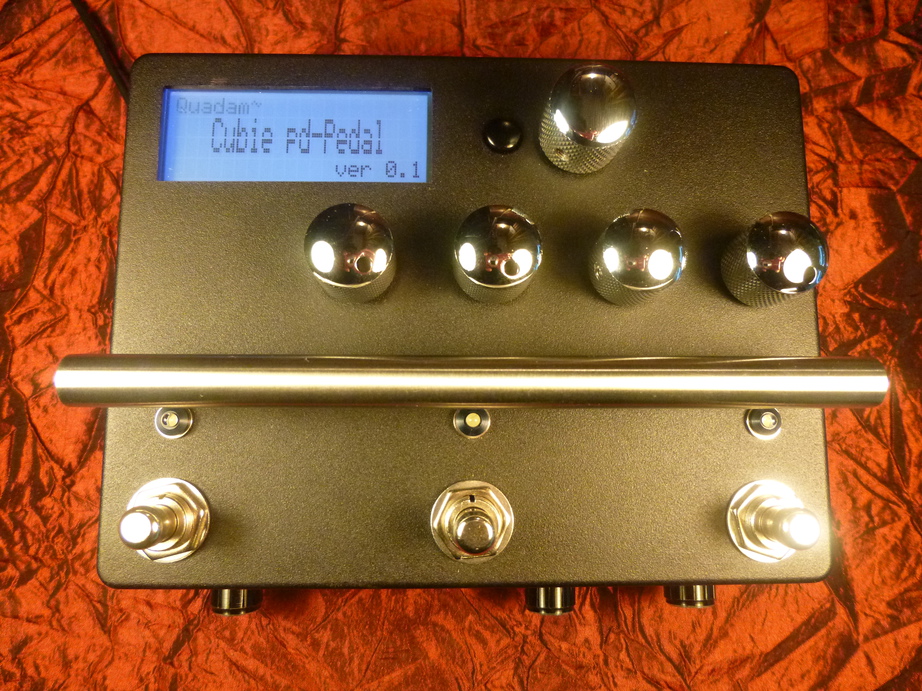
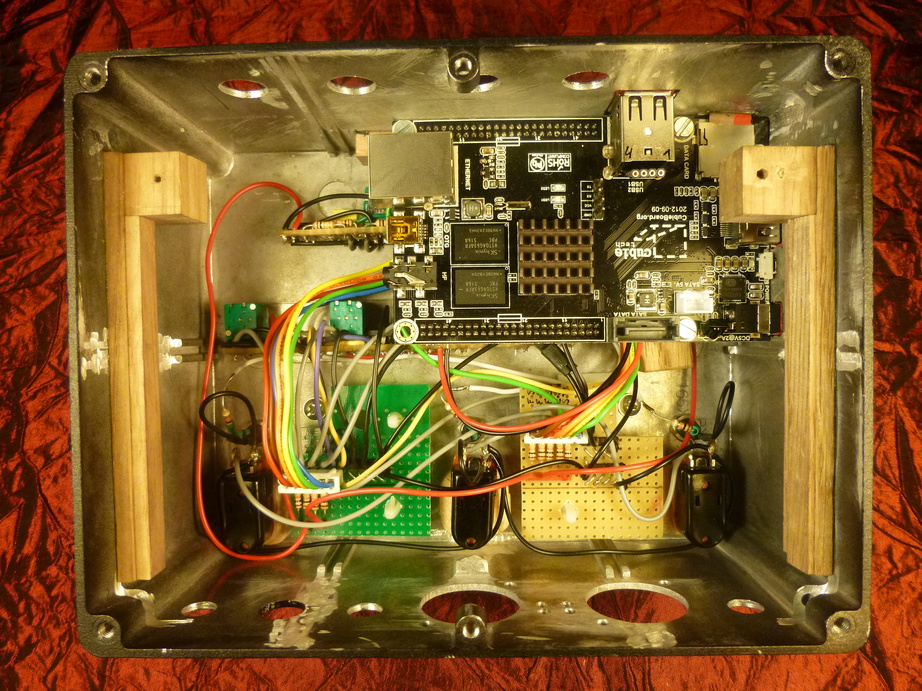
Here are two pics, one of the inside before the audio card is stacked and the other one showing it outside look.
Thanks,
Nau
 posted in I/O hardware diy
Artists using Pure Data
Thanks mod.
Electronic dance music is like a tribal dance, just that we have adapted the sounds to our time. If you are at the right club (or wherever) the right night, just be amazed and can not leave this electronic-world anymore.
Its base is almost as old as humans and simple, but for many electronic music is something cool and sophisticated.
Sorry for edit this, but I forget explain something about my previous words.
What I want to explain is that the least important is who is on stage, but the experience. Many times I see how people presumed to have gone to a club to see a very famous dj, but all they done all night was sit in front of dj, recording a video with their mobiles.
When I see that, I feel they have not understood anything.
Thanks for listening a long life to pure data!
 posted in technical issues
Electronic cajon
O.K. What I want to do is something like changing the equalizer, when I change the [osc~] argument I whant to change the sound of Cajon.
The problem is that when I make the argument higher I have a sound with out hitting the cajon because the amp makes noise.
Sorry, but I am new in PD and maybe I can not express myself properly.
Thanks
 posted in technical issues