
Electronic cajon
Hello everybody,
I want to make electronic variant of this musical instrument, so my idea is to change the sound of it by changing the distance of my hand or leg, coming closer and the opposite. I use distance sensor and arduino for this and piezo plate and amplifier to take a sound, and I make this patch. I add the frequency from [~osc] to the sound from amp.
The problem is that, there is a noise and when I change the [~osc] argument it makes a sound that I don't want.
First I tried with [~bp] filter but the result is unsatisfactory, after it I tried with [snapshot]. I tried to select the numbers higher than this noise and I add the frequency from [~osc] only to this parts of sound, but it not works fine. May be I miss something important, or I have to change the way of solving of this problem.
Please help.
 posted in technical issues
Workshop: Xth Sense - Biophysical generation and control of music
April 6, 7, 8 2011
11:00-19:00
Xth Sense – biophysical generation and control of music
@NK
Elsenstr. 52/
2.Hinterhaus Etage 2
12059 Berlin Neukölln
FULL PROGRAM: http://www.nkprojekt.de/xth-sense-%E2%80%93-biophysical-generation-and-control-of-music/
~ What
The workshop offers an hands-on experience and both theoretical and practical training in gestural control of music and bodily musical performance, deploying the brand-new biosensing technology Xth Sense.
Developed by the workshop teacher Marco Donnarumma within a research project at The University of Edinburgh, Xth Sense is a framework for the application of muscle sounds to the biophysical generation and control of music. It consists of a low cost, DIY biosensing wearable device and an Open Source based software for capture, analysis and audio processing of biological sounds of the body (Pure Data-based).
Muscle sounds are captured in real time and used both as sonic source material and control values for sound effects, enabling the performer to control music simply with his body and kinetic energy. Forget your mice, MIDI controllers, you will not even need to look at your laptop anymore.
The Xth Sense biosensor was designed to be easily implemented by anyone, no previous experience in
electronics is required.
The applications of the Xth Sense technology are manifold: from complex gestural control of samples and audio synthesis, through biophysical generation of music and sounds, to kinetic control of real time digital processing of traditional musical instruments, and more.
~ How
Firstly, participants will be introduced to the Xth Sense Technology by its author and led through the assembling of their own biosensing wearable hardware using the materials provided.
Next, they will become proficient with the Xth Sense software framework: all the features of the framework will be unleashed through practical exercises.
Theoretical background on the state of art of gestural control of music and new musical instruments will be developed by means of an audiovisual review and participatory critical analysis of relevant projects selected by the instructor.
Eventually, participants will combine hardware and software to implement a solo or group performance to be presented during the closing event. At the end of the workshop, participants will be free to keep the Xth Sense biosensors they built and the related software for their own use.
~ Perspective participants
The workshop is open to anyone passionate about sound and music. Musical background and education does not matter as long as you are ready to challenge your usual perspective on musical performance. Composers, producers, sound designers, musicians, field recordists are all welcome to join our team for an innovative and highly creative experience. No previous experience in electronics or programming is required, however participants should be familiar with digital music creation.
Participation is limited to 10 candidates.
Preregistration is required and can be done by sending an email to info@nkprojekt.de
Requirements and further info
Participants need to provide their own headphones, soundcards and laptops with Pd-extended already installed.
Musicians interested in augmenting their favourite musical instrument by means of body gestures are encouraged to bring their instrument along. More information about the Xth Sense and a video of a live performance can be viewed on-line at
http://res.marcodonnarumma.com/projects/xth-sense/
http://marcodonnarumma.com/works/music-for-flesh-ii/
http://marcodonnarumma.com/teaching/
Dates
6-7-8 April, 11.00-19.00 daily (6 hours sessions + 1 hour break)
Fee
EUR 90 including materials (EUR 15).
Contact
Marco Donnarumma
m[at]marcodonnarumma.com
http://marcodonnarumma.com
 posted in news
2nd Pd Scots Users MeetUp
Hi all,
Tomorrow 13th November we’ll be gathering for the 2nd Pure Data Scots User MeetUp.
The meeting kicks off at 3pm at the Electron Club, CCA, Glasgow.
Meeting is free, public and open to all practitioners, beginners, artists, programmers, musicians, passionates of digital arts and simply anybody who might be interested in spending few hours patching, talking, sharing ideas, making some noise, teach and learn.
We encourage you to actively take part in our newborn community and propose presentations or talks for next meetings.
If you want to keep up to date with our activities, please subscribe to the Pd Scots User list at:
http://lists.electronclub.org/cgi-bin/mailman/listinfo/pdusers
Hope to see you soon!
Thanks to the Electron Club and CCA Glasgow for hosting us:
http://www.electronclub.org/doku.php
http://www.cca-glasgow.com
posted in news
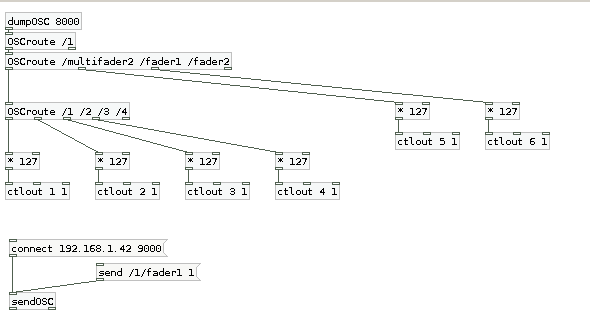
Send to TouchOSC using sendOSC
Hello!
I really googled and searched for days before posting (I even asked on gearslutz first hoping that someone else may have tried this before me, http://www.gearslutz.com/board/electronic-music-instruments-electronic-music-production/502944-touchosc-puredata.html), but alas, I failed to come up with a solution, which I suspect may be easy.
Sending data FROM TouchOSC is working fine, and I receive the Midi Messages in my Sequencer (Cubase 5) just fine, but I would like to figure out a way of sending midi FROM my Sequencer TO TouchOSC, but I can't get it to work.
I have attached a screenshot which displays where I am currently at, and I feel I must be really close. I would very much appreciate a nudge into the right direction.
Thanks a lot in advance!
 posted in technical issues
Pd/rjdj skillshare @ Eyebeam, NYC, Dec 5th
http://eyebeam.org/events/rjdj-skillshare
December 5, 2009
12:00 -- 1:30 PM : Introductory workshop on Pd with Hans-Christoph Steiner
2:00 -- 6:00 PM : SkillShare w/Steiner and members of RjDj programming team
Free, capacity for up to 30 participants
RSVP HERE: http://tinyurl.com/ykaq3l3
Hans-Christoph Steiner returns to Eyebeam with members of the RjDj programming team from Europe to help turn your iPhone or iPod-Touch into a programmable, generative, and interactive sound-processor! Create a variable echo, whose timing varies according to the phone's tilt-sensor or an audio synthesizer that responds to your gestures, accelerations and touches. Abuse the extensive sound capabilities of the Pure Data programming language to blend generative music, audio analysis, and synthy goodness. If you're familiar with the awesome RjDj, then you already know the possibilities of Pure Data on the iPhone or iPod Touch (2nd and 3rd generation Touch only).
Creating and uploading your own sound-processing and sound-generating patches can be as easy as copying a text file to your device! In this 4-hour hands-on SkillShare, interactive sound whiz and Pure Data developer Hans-Christoph Steiner and several of the original RjDj programers will lead you through all the steps necessary to turn your phone into a pocket synth.
How Eyebeam SkillShares work
Eyebeam's SkillShares are Peer-to-Peer working/learning sessions that provide an informal context to develop new skills alongside leading developers and artists. They are for all levels and start with an introduction and overview of the topic, after which participants with similar projects or skill levels break off into small groups to work on their project while getting feedback and additional instruction and ideas from their group. It's a great way to level-up your skills and meet like-minded people. This SkillShare is especially well-suited for electronic musicians and other people who have experience programming sound. Some knowledge of sound analysis and synthesis techniques will go a long way.
We'll also take a lunch break in the afternoon including a special informal meeting about how to jailbreak your iPhone!
Your Skill Level
All levels of skill are OK as long as you have done something with Pd or Max/MSP before. If you consider yourself a beginner It would help a lot to run through the Pd audio tutorials before attending.
NOTE: On the day of the SkillShare we will hold an introductory workshop from 12:00 until 1:30 PM, led by Steiner, for those who want to make sure they're up-to-speed before the actual SkillShare starts at 2:00. The introductory workshop is for people who have some done something in Pd or Max/MSP but are still relative beginners in the area of electronic sound programming.
What You Should Bring
You'll need to bring your iPhone or iPod Touch (2nd or 3rd generation Touch only), your own laptop, a headset with a built-in mic (especially if using an iPod Touch) and the data cable you use to connect your device to your laptop. Owing to a terrific hack, you won't even need an Apple Developer License for your device!
More Information
RjDj is an augmented reality app that uses the power of the new generation personal music players like iPhone and iPod Touch to create mind blowing hearing sensations. The RjDj app makes a number of downloadable scenes from different artists available as well as the opportunity to make your own and share them with other users. RjDj.me
Pd (aka Pure Data) is a real-time graphical programming environment for audio, video, and graphical processing. Pd is free software, and works on multiple platforms, and therefore is quite portable; versions exist for Win32, IRIX, GNU/Linux, BSD, and MacOS X running on anything from a PocketPC to an old Mac to a brand new PC. Recent developments include a system of abstractions for building performance environments, and a library of objects for physical modeling for sound synthesis.
kill your television
 posted in news
"electronic" Chopin with PureData?
I'd like to arrange an electronic version of Chopin's Berceuse <
>).I haven't acoustic knowledges, but I'm searching for advices, for tips on "from where I could begin?".
So, this is Berceuse's score: <http://www.allpianoscores.com/audio_scores.php?id=208>, <http://imslp.org/wiki/Berceuse,_Op.57_(Chopin,_Frederic)>, <http://www.kunstderfuge.com/chopin.htm>.
The theme is continously processed with different "automatic" variations: quadruplets in spirals, chromatic quadruplets, triplets in thirds, appoggiaturas in sixths, repeated thirds, etc. It's like a catalogue of the "auto-generative" abilities of Chopin's pianoforte and composition techniques.
Now come back to electronic...thinking about an electronic "upgrade" of Berceuse, my question will be "Which is, in your opinion, the autogenerative processes that match with quadruplets in spirals, chromatic quadruplets, triplets in thirds, appoggiaturas in sixths, repeated thirds, etc? (I don't mean "how can I obtain a repeated third with PD", I mean "which modern electronic effect could refer to the ancient repeated third in Chopin".) Let's take one by one...
So, guys, can you answer something like "bars 1-8 use this-process in PD", "bars 9-16 use that-process in PD"?
I'm not searching for filters or equalization for a live performance, I'm searching for generative process for audio (or MIDI, but I'd prefer audio).
 posted in technical issues
TENET TECHNETRONICS is distributing TT-Devkit8000 evaluation boards
TENET TECHNETRONICS is distributing TT-Devkit8000 evaluation boards which is equivalent to beagle
board . We also host a range of electronic boards - Micro Controller, VLSI and Embedded boards and
sensors. We host a wide range of electronic components to cater your needs. You name it we have it.
DevKit8000 Evaluation Board:
DevKit8000 Evaluation Board is a compact board using OMAP3530 microprocessor. It takes full features
of this processor and supports 128MByte DDR SDRAM and 128MByte NAND Flash as well as high-speed
USB2.0 OTG function. The board has exposed many other hardware interfaces including RS232 serial
port, LCD/TSP, DVI-D, S-Video, Ethernet, SD/MMC, keyboard, camera, SPI, I2C and JTAG. The board has
two methods to boot the system from either SD card or NAND flash. It is able to support WinCE and
Linux OS and provided with WinCE6.0 BSP and Linux2.6.28 BSP and also provides demo of Google
Android OS and Angstrom (GPE) for user experience.
TI OMAP3530 Processor based on 600MHz ARM Cortex-A8 core:
- Memory supporting 128MByte DDR SDRAM and 128MByte NAND Flash
- UART, USB OTG, Ethernet, Camera, Audio, SD/MMC, Keyboard, Jtag...
- Supports 24-bit TFT LCD/VGA, DVI-D and TV S-Video Output Display
- Supports Linux2.6 and WinCE 6.0
Features of DevKit8000 Evaluation Board :
-Processor: TI OMAP3530 microprocessor with 600MHz ARM Cortex-A8 RISC Core
-Power supply: +5V
-128MB DDR SDRAM, 166MHz
-128MB NAND Flash, 16bit
-Four buttons (Reset, Boot, User defined, On/Off)
Visit us at www.tenettech.com for more products
Contact us at info@tenettech.com for more info
Official Distributor for SPARKFUN ELECTRONICS EMARTEE and EMBEST.
 posted in news
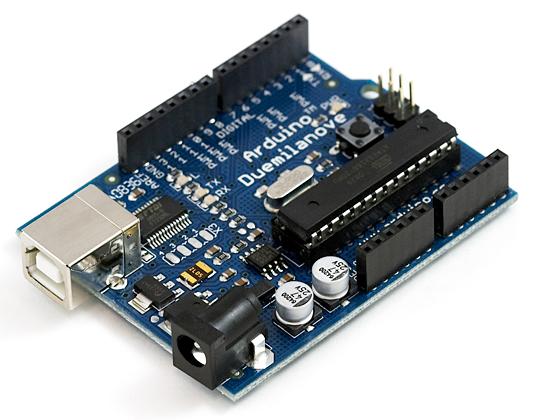
TENET TECHNETRONICS is now an official Distributor in INDIA for Arduin
TENET TECHNETRONICS is now an official Distributor in INDIA for Arduino Boards an open source Electronic Prototyping/Development Board, an easy way to procure boards in INDIA. These boards will help your electronic ideas to become a reality. We also host a range of electronic boards - Micro Controller, VLSI and Embedded boards. We host a wide range of electronic components to cater your needs.
Boards we currently distribute
Arduino Mega
Arduino USB/Arduino Duemilanove
Arduino Pro
Ethernet Shield for Ardunio
ARM 7 Development Boards
ARM 9 Development Boards
ARM with Touch Screen
PIC Development Boards
Peripherals
ARM Programmers/Debuggers
PIC Programmers
AVR Programmers
USB2UART(FTDI)
Touch Screens
LCDs
Sensors - Accelerometer, Proximity, Fingerprint etc.,
Communication - Bluetooth, GSM, GPS etc.,
Track Ball
Components
LEDs - RGB, Single Color
Breakout Boards
Controllers
iPOD Components
Cables and IC adapters
Visit us at www.tenettech.com for more products
Contact us at info@tenettech.com for more info
Official Distributor for SPARKFUN ELECTRONICS and EMARTEE
--
warm regards
Vasanth Kumar B
posted in technical issues
Java.lang.ArithmeticException: negative exponent
Hi everybody!
I'm facing a strange error when i try to generate Key-Pair to be used for encryption purposes.
Either in linux or in windows, it is working perfectly with SUN JDK.
But in RedHat GNUClASS+jamvm, it's wrong as follow.what should I to do ?
Thanks and waiting your replies!
-------------------------------------The error showing is:
genKeyPair failed: java.lang.ArithmeticException: negative exponent
java.lang.ArithmeticException: negative exponent
at java.math.BigInteger.pow(BigInteger.java:1001)
at gnu.java.security.key.dss.FIPS186.generateParameters(FIPS186.java:200)
at gnu.java.security.key.dss.DSSKeyPairGenerator.generate(DSSKeyPairGenerator.java:305)
at gnu.java.security.jce.sig.KeyPairGeneratorAdapter.generateKeyPair(KeyPairGeneratorAdapter.java:93)
at java.security.KeyPairGenerator.genKeyPair(KeyPairGenerator.java:289)
at cn.com.webinfo.security.RSA.generateKey(RSA.java:100)
at cn.com.webinfo.stest.MainRSA.main(MainRSA.java:23)
java.lang.NullPointerException
at cn.com.webinfo.security.RSA.generateKey(RSA.java:102)
at cn.com.webinfo.stest.MainRSA.main(MainRSA.java:23)
Generating private key is failure!
----------------------------------------my code:
MainRSA.java:23 RSA.generateKey("001","prikeyRSA.dat", "pubkeyRSA.dat");
public static boolean generateKey(String id, String priFileName, String pubFileName) {
try {
KeyPairGenerator keygen = KeyPairGenerator.getInstance("RSA");
SecureRandom secrand = new SecureRandom();
secrand.setSeed(id.getBytes());
keygen.initialize(1024, secrand);
RSA.java:100 KeyPair keys = keygen.genKeyPair();
RSA.java:102 PrivateKey prikey = keys.getPrivate();
PublicKey pubkey = keys.getPublic();
.........
 posted in technical issues
Java.lang.ArithmeticException Error
Hi !
I also have the same matter, It's good , either in linux or in windows, with SUN JDK.
But in RedHat GNUClASS+jamvm, it's wrong as follow.what should I to do ?
Thank you !
genKeyPair failed: java.lang.ArithmeticException: negative exponent
java.lang.ArithmeticException: negative exponent
at java.math.BigInteger.pow(BigInteger.java:1001)
at gnu.java.security.key.dss.FIPS186.generateParameters(FIPS186.java:200)
at gnu.java.security.key.dss.DSSKeyPairGenerator.generate(DSSKeyPairGenerator.java:305)
at gnu.java.security.jce.sig.KeyPairGeneratorAdapter.generateKeyPair(KeyPairGeneratorAdapter.java:93)
at java.security.KeyPairGenerator.genKeyPair(KeyPairGenerator.java:289)
at cn.com.webinfo.security.RSA.generateKey(RSA.java:100)
at cn.com.webinfo.stest.MainRSA.main(MainRSA.java:23)
java.lang.NullPointerException
at cn.com.webinfo.security.RSA.generateKey(RSA.java:102)
at cn.com.webinfo.stest.MainRSA.main(MainRSA.java:23)
Generating private key is failure!
MainRSA.java:23 RSA.generateKey("001","prikeyRSA.dat", "pubkeyRSA.dat");
public static boolean generateKey(String id, String priFileName, String pubFileName) {
try {
KeyPairGenerator keygen = KeyPairGenerator.getInstance("RSA");
SecureRandom secrand = new SecureRandom();
secrand.setSeed(id.getBytes());
keygen.initialize(1024, secrand);
RSA.java:100 KeyPair keys = keygen.genKeyPair();
RSA.java:102 PrivateKey prikey = keys.getPrivate();
PublicKey pubkey = keys.getPublic();
.........
posted in Off topic