@rewindForward said:
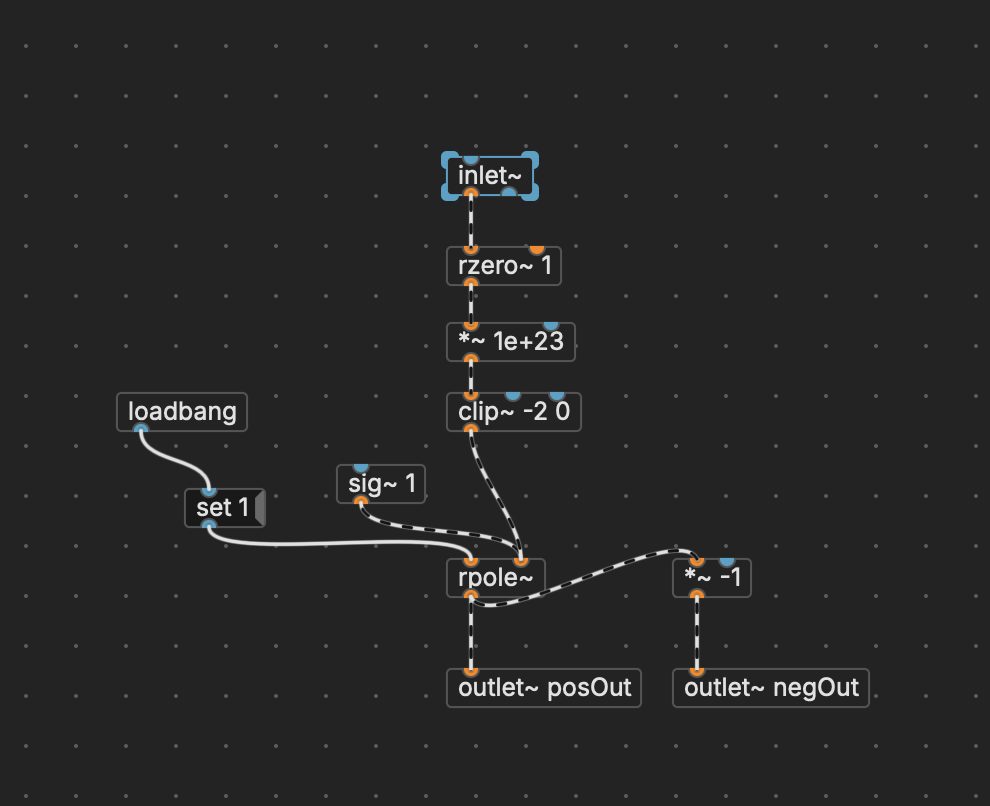
I'm not clear on what value "le+23" is meant to indicate.
Edit: crossed messages, didn't see the reply before sending mine...
It isn't le -- it's 1e.
Scientific notation is a way to write very large and very small numbers, with one digit to the left of the point, and then multiply by a power of 10. 123 in scientific notation would be 1.23x10^2; 123 million, 1.23x10^8. By convention, these are shortened to 1.23e+2 and 1.23e+8. 1.23e+2 is a bit silly, so a relatively small number like 123 is displayed without the exponent, but if you type 123000000 into an object box, Pd will show it as 1.23e+8.
1e+23 then is a 1 followed by 23 zeroes.
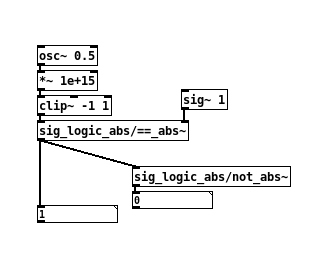
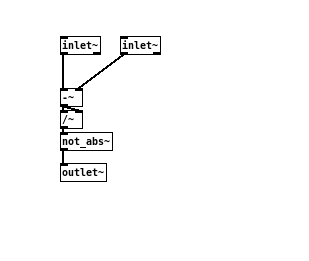
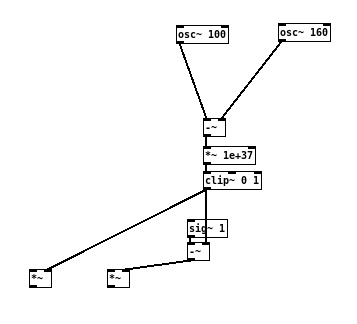
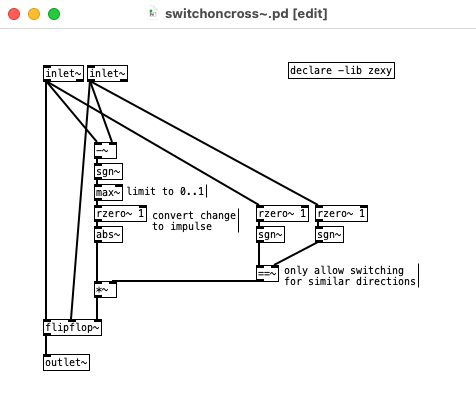
The vanilla way to do a comparator (as solipp and others pointed out) is to subtract the signals first. If a > b, then a - b > 0. To flatten "any number that's >0 (true) or <=0 (false)" into 1 or 0, you multiply by a very large number (such as 1 then 23 zeroes) and clip: [clip~ 0 1] gives you a binary result, or [clip~ -1 1] gives you +1 for a > b, -1 for a < b, or 0 for a == b. (There's a very narrow range of numbers where the multiplication result would be between -1 and +1, but it's extremely unlikely to hit. So we just ignore it.)
hjh