
-
rewindForward
posted in technical issues • read more@solipp said:
looks like you found a solution(?) I'm wondering if you even need to generate/process a stream of audio rate triggers to achieve your goals. I know supercollider uses audio rate triggers, but in pd it is a bit tricky to work with this concept.
That's a good question, and the one I guess I'm asking by trying this out. I blocked out the general idea in Supercollider to figure out how to approach it, and I'm trying to port those ideas to PD/Plugdata so that I can compile it for hardware. I've always wanted to go deeper with PD, so this seemed like a great opportunity to learn.
@solipp said:
mh i don't know. It depends on what you do with [max~], which is not clear to me.
The goal with the signal crossing -> trigger -> toggle -> wave switching portion is to switch waveforms when there's a signal crossing, and both signals are either of the rise or fall of their waveform. Compared to min max, it produces a signal with much less of a "buzz", and I like what it does for combining sine waves.
Thanks for your help.
-
posted in technical issues • read more
@ddw_music
Thanks for the deeper explanation of the level crossing.Also fun to see you over in this forum. I always associate you with Supercollider.
-
posted in technical issues • read more
@lacuna said:
I'm not clear on what value "le+23" is meant to indicate.
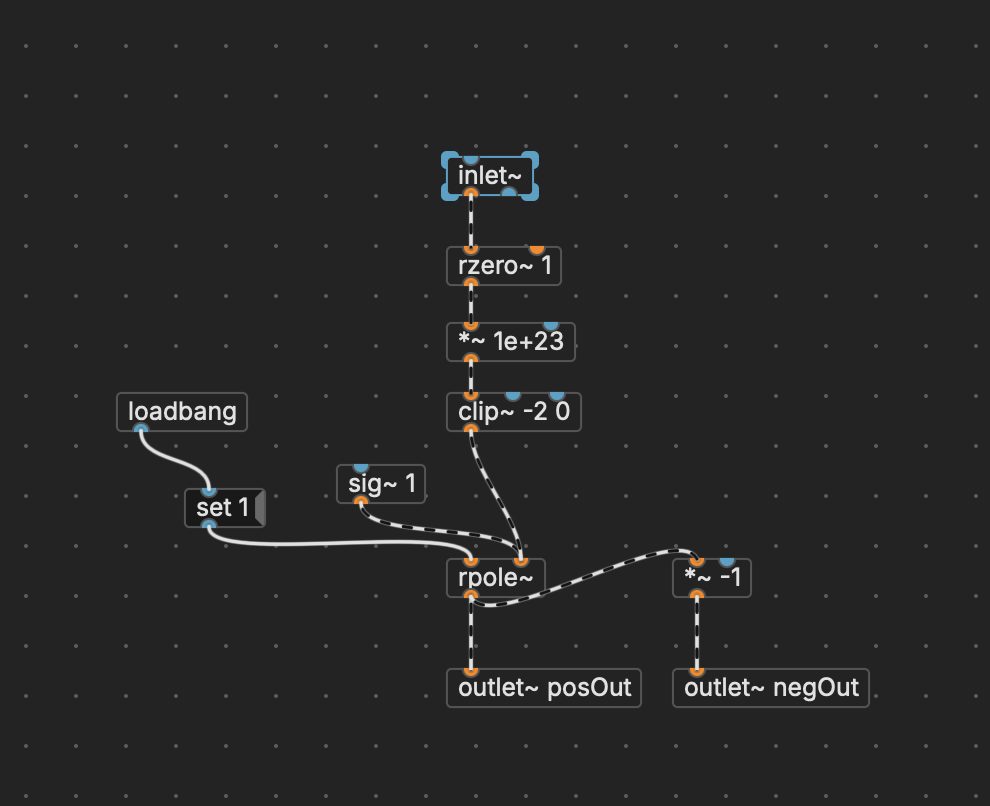
1e+23 is just a very big number (+ - 1e+32 is Pd's 32-bit single precision space). By multiplying the output of [rzero~ 1] to extremes, then clipping with [clip~ -2 0], turns it into a boolean, either -2 or 0.
This is the answer - I was quickly copying these examples off of the forums, and I kept typing "1e+23" as "le+23", so of course it didn't work! Thanks for the push.
Thanks for the help. It's worth nothing that @solipp posted a really nice way of finding signal crossings.
This works, for reference:
-
posted in technical issues • read more
@solipp I really like that solution for finding crossings between signals. Very elegant and precise, thanks. I do think it's very similar to what [max~ ] is doing, unless I'm misunderstanding?
For my purposes, I'll need a stream of triggers to gate a trigger (vs gate) stream that I'm going to gate with another process so that trigger signals only pass when the other process opens to gate the level crossing triggers. The problem is, then I need a flipflop/toggle...
-
posted in technical issues • read more
@lacuna I'm looking to do what [min~ ] [max~ ] do, but with matching slope directions, so there's less of a buzz to the resulting waveform. I'd also like to be able to set it up so that it ignores every other toggle so there's more of a low-end to the waveform. I'd have to get the flipflop/toggling to work first, of course, before I get a toggle to toggle another toggle . It's something I've done a bunch with modular synths using comparators and switches, but I'm trying to work this out in PD.
Either way, I need more than min max provide.
-
posted in technical issues • read more
@jameslo
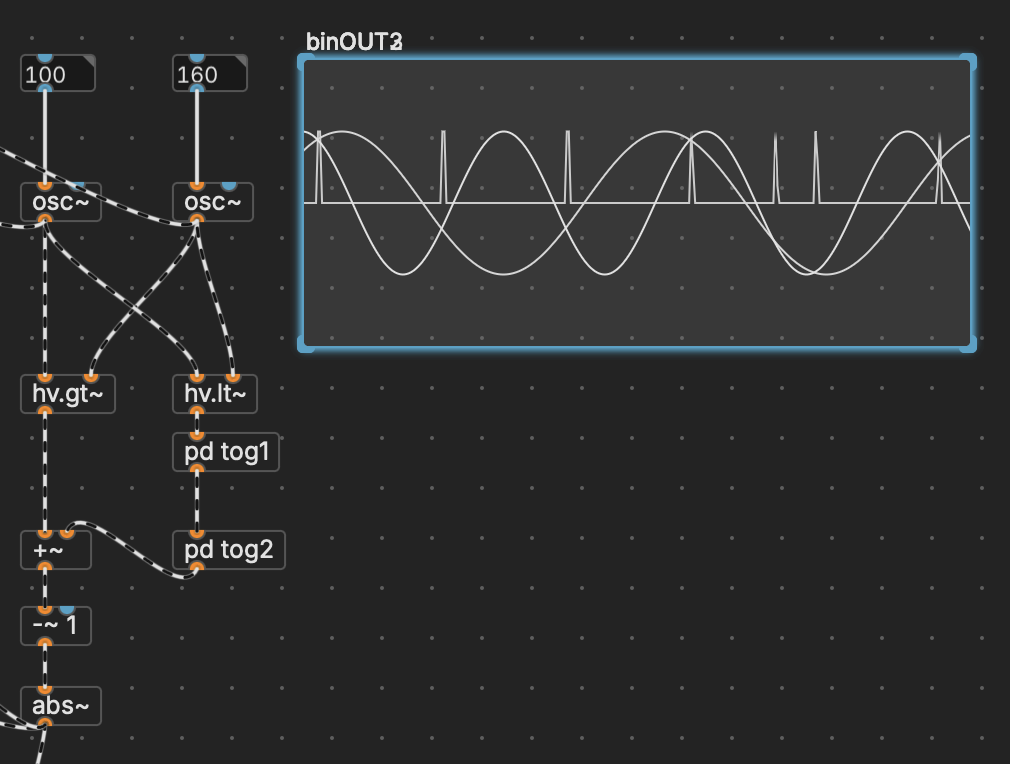
the patch that's generating the triggers is below. This is just a test patch, but I'm trying to extract level crossings between 2 signals, generate a trigger from each crossing, and use that to switch signals. What's behind [pd tog1] [pd tog2] is just a really short delay line. The result is very much like a min/max combination, but I'm going to use this with other aspects that min/max doesn't accommodate. I'm using the heavy greater than and less than audio rate objects [hv.gt~ ] [hv.lt~ ].I'm essentially trying to find something like the ToggleFF ugen in Supercollider.
-
posted in technical issues • read more
@whale-av Thanks. I'm actually struggling to figure out the how to use an audio rate trigger to drive the toggle to between the waveforms. I want to use every ~1ms trigger to either toggle from one waveform to the other.
It would be so much easier I could just use [expr~ }
-
posted in technical issues • read more
@lacuna I tried those, but each has something that doesn't function. In the second example, nothing passed beyond [*~ le+23]. I'm not clear on what value "le+23" is meant to indicate.
In the first example, I assuming tabreceive~ and tabsend~ are depreciated?
-
posted in technical issues • read more
I'm trying to come up with an audio rate flipflop that doesn't use the [expr~ ] object. I'm using Plugdata in compile mode, so expr~ isn't available. I've done lots of searching, here and elsewhere, I haven't been able to find anything that I can implement.
Any ideas? What I'm hoping to do is use a brief ~1ms trigger signal to switch between two signals, so I need each trigger to change the state of a toggle/flipflop to drive the signal switching. I can't make the trigger longer, because it's coming from a signal cross detection.