
ELSE 1.0-0 RC13 with Live Electronics Tutorial Released
Ok, the cat is out of the bag --> https://github.com/porres/pd-else/releases/tag/1.0-rc13 I'm officialy announcing the update and uploaded binaries to deken for mac (intel/arm), Win and Linux. It all looks ok but tell me if you see something funny please. There's also a raspberry pi binary but not working 100%yet and we'll still look into that. Hopefully someone could help me/us with it. I might make another upload just for the pi later on if/when we figure it out. Find release notes and changelog below.
RELEASE NOTES:
Please support me on Patreon https://www.patreon.com/porres I'll now try to add special content for subscribers. You can follow me on instagram as well if you like... I'm always posting Pd development stuff over there https://www.instagram.com/alexandre.torres.porres/
It's been a little bit over 7 months since the last update and I almost broke the record for taking too long to release an update (which had happened in my previous update). So yeah, there's just too much to talk about! I guess the delays in releasing updates is because it's been a little tricky and hard to sync the release cycles of ELSE with PlugData, which includes ELSE in its download.
Plugdata 0.9.2 should come out soon with ELSE RC13 and it's supposedly the last update before 1.0.0, so I've heard. And the plans was to get to that still in 2025! This means ELSE could be at its last "Release Candidate" phase as I'm aiming to sync the final release with PlugData. Until then, I'll still make breaking changes and I can't wait until I can't do that anymore as I really feel bad. On the other hand, it's kind of inevitable when I'm always adding new stuff and redesigning and reconfiguring objects to include more functionalities. And I always got a lot of new stuff! So I'm thinking that I will eventually try some mechanism like Pd's compatibility flag or something. I'll try to come up with something like that in the next update.
This update has 22 new objects for a total of 573 and 26 new examples in my tutorial for a total of 554 examples. Let's dive into the highlights (see full changelog below after the release notes).
-
Multichannel Support: Last release had 92 MC aware objects, now it's 139! Over a 50% increase that include old and new objects (all the new ones have been coming with MC support). Virtually all oscillators and envelope generators now have MC support, plus some other random ones. Let me highlight the new [lace~]/[delace~] objects that are 'MC' tools that perform interleave/deinterleave in Multichannel connections. My bare minimum number of objects "to start with" would be at least a bit over half the number of signal objects. That was my target for 1.0! ELSE right now has 319 signal objects, so that'd be at least 160. I will definitely pass this milestone in the next update. I guess a good number of MC objects would be around 75% of the signal objects. I will aim for that as soon as I can. Some objects simply can't be MC at all, so 100% will never be the case, but maybe an ideal 90% eventually? We'll see... I am just proud and happy that ELSE is taking such a big jump on MC awareness in less than a couple years.
-
Envelope generators ([adsr~]/[asr~]/[envgen~]/[function~]) now have more curve options. For [adsr~]/[asr~] the default is now a new log curve that you can set the curve parameter (and was 'stolen' from SuperCollider). A new [smooth~] family of objects perform the same kind of curved smoothening for alternating inputs - [envgen~] and [function~] also have that but also '1-pole' filtering, 'sine' and 'hann' curves. You can now trigger [adsr~] and [asr~] with impulses.
-
The [play.file~] object now supports even more file formats besides MP3 and stuff. Hey, you can even stream the supported formats from weblinks! The [sfload] object (which loads files into arrays) also gained support for more formats and can download from weblinks as well! It also has a new threaded mode, so loading big files won't choke Pd. It now also outputs the file information, which is a way to tell you when loading finished in threaded mode. The [sample~], [player~], [gran.player~] and [pvoc.player~] objects are now also based on [sfload], so they support all these file formats!!! Now [sample~] and [tabplayer~] are integrated in a way that [tabplayer~] is always aware of the sample rate of the file loaded in [sample~] (so it reads in the "correct speed"). A new [sfinfo] object is able to extract looping regions and instrument metadata information from AIFF files (which is something I wanted for ages) - it should do more stuff in the future.
-
[knob] has become the ultimate featured bloated creep GUI I always feared and avoided. MAX is envy! but I'm happy with this structure and I want to replicate in other GUIs in the future (yeah, I got plans to offer alternatives to all iemguis). I wanna highlight a new 'param' symbol I added that allows you to remotely set a particular method in an object, so you don't to connect to a "method $1" message and you can even do this wirelessly with a send symbol. [knob] now also acts like a number box, where you can type in the value, which may also be displayed in different ways or the value can be sent elsewhere via another send symbol so you can temper with it using [makefilename] or [else/format]. I've been using this for the MERDA modules and it's really cool.
-
We finally have a [popmenu] GUI object! This was in my to do list forever and was crucial to improve the MERDA modules to set waveforms, instruments and whatnot.
-
Let's about MERDA, the "Modular Euroracks Dancing Along" subset of abstractions in ELSE. It was first released in the last update and it's been driving lots of the development in ELSE as you can see. I now added a MIDI Learn feature for all knobs that feels great and quite handy! There are many fixes and improvements in general and some new modules. I wanna highlight the new [sfont.m~] module, which loads "sound font" banks and you can just click on a [popmenu] to choose the instrument you want. The default bank has numerous (hundreds) options and also comes with PlugData. The sequencer module [seq8.m~] was rather worthless but it's now a whole new cool thingie. It allows you to set pitches with symbols and even has quarter tone resolution. I added a right outlet to send impulses to trigger envelopes and stuff (there's still more stuff of course, see full changelog below).
-
There are newly designed/renamed/recreated [resonbank~]/[resonbank2~] objects that are well suited for Modal Synthesis.
-
What actually drives my development is my Live Electronics tutorial, which got a fair upgrade with a new chapter on Modal Synthesis amongst other things, such as new subtractive synthesis examples and a revision of envelope generators with examples on AHDSR and DAHDSR - by the way, there are new gaterelease~/gatedelay~ objects for handling envelopes (and other processes).
-
I have to thank some people. Tim added 'zoom' to the [pic] object, as well as an image offset. Tim also implemented a new and better technique for bandlimited oscillators. Ben Wesh gave me a new [scope3d~] GUI object, pretty cool, that plots an oscilloscope in 3 dimensions, which is coded in LUA - and ELSE has been carrying a modified version of [pdlua] because it now depends on it for a couple of GUIs. Tim and Ben made many improvements to [pdlua] (as well as Albert Graef, of course).
-
For more new objects, let me also tell you about the simple and cool [float2imp~], that is based on [vline~] and can convert floats to impulses with sample accuracy (don't know why I didn't think of that earlier). A new [tanh~] object has Multichannel support. A bit earlier I made an update to Cyclone that actually "borrows" and includes this one from ELSE instead of its original one (which does not have Multichannel support). PlugData users will load the one from ELSE. This is another tiny step that sort of integrates ELSE and Cyclone, specially for PlugData users.
happy patching.
CHANGELOG:
LIBRARY:
Breaking changes:
- [adsr~]/[asr~]: now a gate off before reaching the sustain point does not start the release right away (this allows you to trigger it with impulses). There's a new mode just for immediate release. There's a new exponential setting for curve factors, the old 'log' mode is renamed to 'lag' as it's the same as used in the [lag~] object. For [adsr~], a bang now is not "retrigger", but an impulse at control rate, there's a new 'retrigger' message for control rate retriggering (and now it only retriggers if the gate is on). For [asr~] a bang now also works like an impulse.
- [sample~]: no more 'load' message, args to 'open' message changed, size is now only in 'ms'.
- [format]: outputs are now always symbols, before you could get float outputs. Also, we just have a simplified symbol output, no more lists or anythings. Hopefully I'll be able to get the 'list' output back, but it involved some bugs that I couldn't fix so I just removed it. You cannot use bangs and lists in secondary inlets no more (this is cylone/max crappy paradigm we don't want here). Bang method was actually removed as well.
- [pack2]: no more support for anythings, also no more support for lists in secondary inlets and output has a list selector (I wanna make this more Pd like and not a silly clone from MAX's [pak], cause fuck MAX).
- [merge]/[unmerge]/[group]: no more '-trim' flag (again, respecting pd's usual list paradigm), in [merge] now there's no more 'hot' argument and a bang now represents an empty list and inlets initialized with empty lists
- [mono]: 1st argument is now 'glide' in ms.
- [sfont~] now uses 'mma' for bank selection (this alters how CC messages set the bank number).
- [player~]/[play.file~]: 'open' message does not play files right away anymore.
- [tabplayer~]/[player~]: play message without args now play at the default settings (whole file at regular speed).
- [envgen~]: removed the 'maxsustain' parameter, use the new [gaterelease~] or [gaterelease] objects instead. Removed the rightmost inlet just to set envelopes, now a list input only sets the envelope and doesn't trigger it. The 'set' message is then removed.
- [envgen~]/[function~]: simplified and got rid of '-exp' flag and message, also deleted 'expl' and 'expi' messages. A new 'curve' and cimpler message sets exponential factors for all or individual segments, and includes more curve formats.
- [knob]: 'esc' key now deactivates the object. The 'ticks' message is renamed to 'steps' and there is a new 'ticks' message that toggles showing ticks on and off. The 'start' message has been renamed to 'arcstart'. The 'outline' message has been renamed to 'square' for better clarity. Design changed a bit to make it like it is in PlugData (they won), so we now fill the whole background color when in 'square mode' and the knob circle has an 85% proportion in this case inside the full 100% square size (so it grows bigger when not in 'square' mode). Now, by default, the GUI is in a new 'loadbang' mode (I don't think this will influence old patches). I'm afraid some old patches might behave really weird since I added a lot of new stuff. I changed the 'load' message behaviour to not update the object (this can arguably be considered a bug fix).
- [wavetable~], [bl.wavetable~] and [wt2d~]: 'set' message now sets frequencies because of the MC support in [wt~] and [wt2d~], while there's a new 'table' method to set the table name.
- [gbman~]/[cusp~] list method is now for MC, old list method is now renamed back to an old 'coeffs' method.
- [f2s~]/[float2sig~] default value is now 10 ms.
- [op] now behaves like [*~] where the smaller list wraps til reaching the size of the longer one.
- [list.seq] does not loop anymore by default.
- [impseq~] list input removed, use the new [float2imp~] object to convert floats to impulses.
- [resonant~] now has 'q' as the default.
- [resonant2~] has been removed.
- [decay2~] has also been removed ([asr~] much better).
- [vcf2~] has been renamed to [resonator2~].
- [resonbank~]/[resonbank2~] have basically been deleted and replaced by new objects with the same name... [resonator~] is based on a new [resonator~] object which is similar to [resonant~] and [resonbank2~] is now based on [resonator2~] (old [vcf2~] instead of [resonant2~] that got deleted). These are well suited objects for Modal Synthesis.
- [oscbank~] now uses a 'partial' list and not a frequency list. The freq input now defaults to '1' and this makes [oscbank2~] completely obsolete.
- [oscbank2~] has been deleted since it became completely obsolete.
- [sfload] load message changed the behaviour a bit.
Enhancements/fixes/other changes:
- [adsr~]: We have now a new mode for immediate release (see breaking changes above, I'm not repeating it). Fixed ADSR signal inputs (it was simply not really working, specially for linear). Fixed status output for MC signals. There's a new curve parameter that allows you to set the curvature.
- [asr~] I actually just made the new [adsr~] code into a new [asr~] code as a simplified version (as it was before)... so it's got the same impromevents/fixes.
- [play.file~]: added support for more file formats and even weblinks for online streaming!
- [sfload]: added an outlet to output information, added threaded mode, added support for more file formats and even weblinks for downloading.
- [sample~], [player~], [gran.player~] and [pvoc.player~] are now also based on [sfload], so they support more file formats!
- [sample~]: improved extension management with [file splitext].
- [sample~] and [tabplayer~] now are automatically integrated in a way that [tabplayer~] is always aware of the sample rate of the file loaded in [sample~], so it automatically adjusts the reading speed if it is different than the one Pd is running with.
- [numbox~]'s number display is not preceded by "~" anymore (that was just kinda stupid to have).
- [format]: fixed issues where empty symbols and symbols with escaped spaces didn't work. Added support '%a' and '%A' type. Added support for an escaped 'space' flag. Improved and added support for length modifiers. Improved syntax check which prevents a crash. Improved documentation.
- [knob]: added new 'param', 'var', 'savestate', 'read only', 'loadbang', "active", "reset" and 'ticks' methods. Added the possibility to type in number values and also modes on how to display these number values, plus new send symbols for 'activity', 'typing', 'tab' and 'enter'. New design more like plugdata. Changed some shortcuts to make it simpler. If you have the yet unreleased Pd 0.56-0 you can also use 'double clicking' in the same way that works in PlugData. Properties were also significantly improved (I'm finally starting to learn how to deal with this tcl/tk thingie). Yup, a lot of shit here...
- [autofade2~]/[autofade2.mc~]: fixed immediate jump up for 0 ramp up.
- [synth~]: fixed polyphony bug.
- [metronome~]: fixed bug with 'set' message.
- [midi2note]: fixed range (octaves 0-8).
- [pulsecount~]: fixed reset count to not output immediately, added bang to reset counter at control rate
- [click]: fixed regression bug where it stopped working.
- [else]: new 'dir' method to output ELSE's binary directory in a new rightmost outlet. The print information also includes the directory.
- [pic]: added zoom capability finally (thanks to tim schoen) and added offset message (also thanks to tim).
- [store]: added 'sort' functionality.
- [scales]: fixed octave number argument. Added functionality to allow octave number as part of the note symbol.
- [mono]: added 'glide' parameter, as in [mono~].
- [pluck~]: fixed list input.
- [rescale]/[rescale~]: added a "reverse log" mode.
- [limit]: added a new second ignore mode.
- [graph~]: added an external source input for plotting the graph and a 'clear' message.
- [canvas.setname]: added a new argument for "abstraction mode" and methods to set name, depth (and mode).
- [midi.learn]: added a new argument for "abstraction mode", fixed 'dirty' message sent to parent.
- [brickwall~]: fixed initialization.
- [list.seq]: added a loop mode and a 2nd outlet to send a bang when the sequence is done.
- [delete]: fixed index for positive numbers.
- [dust~]: added 'list', 'set' and '-mc' flag for managing the already existing Multichannel capabilities.
- Thanks to Tim we have many fixes and a whole new technique for band limited oscillators. Now [bl.saw~], [bl.saw2~], [bl.vsaw~], [bl.square~], [bl.tri~], [bl.imp~] and [bl.imp2~] have been redesigned to implement elliptic blep, which should provide better anti-aliasing.
- [parabolic~] now uses and internal wavetable for more efficiency.
- [resonant~]: added 'bw' resonance mode.
- [lowpass~]/[highpass~]: added 't60' resonance mode.
- [quantizer~]/[quantizer]: added a new mode, which combines floor (for negative) and ceil (for positive) values.
- [crusher~]: now uses the new [quantizer~] mode from above (arguably a breaking change).
- [envgen~]: fixed a bug (actually a misconception) where ramps started one sample earlier. Fixed 0-length lines. Added a possibility to set time in samples instead of ms. Maximum number of lines is now 1024. Added loop mode. Added many curve options (sin/hann/log curve/lag).
- [function~]: Added many curve options (sin/hann/log curve/lag).
- [The out~] family of abstractions now use [bitnormal~] so you won't blow your speakers beyond repair in edge cases.
- [trig.delay~]/[trig.delay2~]: fixed bug where impulse values different than '1' didn't work.
- Added MC support to: [trig.delay~], [trig.delay2~], [gatehold~], [vca.m~], [gain2~], [decay~], [asr~], [envgen~], [function~], [bl.osc~], [bl.saw~], [bl.saw2~], [bl.vsaw~], [bl.square~], [bl.tri~], [bl.imp~], [bl.imp2~], [imp2~], [tri~], [saw~], [saw2~], [vsaw~], [square~], [pulse~], [parabolic~], [gaussian~], [wavetable~], [wt2d~], [randpulse~], [randpulse2~], [stepnoise~], [rampnoise~] [pink~], [gbamn~], [cusp~], [gray~] and [white~].
- Also added MIDI input and soft sync to [imp2~], [tri~], [saw~], [saw2~], [vsaw~], [square~], [pulse~], [gaussian~] and [parabolic~].
- [wavetable~] and [wt2d~] gained args to set xfading.
- Updated pdlua to 0.12.23.
- M.E.R.D.A: Added MIDI-LEARN for all modules (this is only for the knobs). Replaced some number boxes that were attached to knobs by an internal number display mechanism (new feature from knob). Improved interface of [gendyn.m~]. Preset/symbol name fixes to [flanger.m~]. Now we have automatic MIDI mode detection for [plaits.m~] and [pluck.m~] when no signals are connected (still trying to get plaits right, huh? Yup! And bow MIDI input with monophony and trigger mode has been fixed in [plaits.m~]). Added MC support to [vca.m~]. Increased range of [drive.m~] down to 0.1. Changed some objects to include the new [popmenu] GUI. [vco.m~] now uses the new MC functionalities of oscillators and doesn't need to load abstractions into [clone], I hope it makes this more efficient and clean. The [seq8.m~] module was worthless and got a decent upgrade, it's practically a new module. Added new modules (see below). Note that MERDA is still at alpha development phase, much experimental. Expect changes as it evolves.
- 22 new objects: [float2imp~], [lace], [delace], [lace~], [delace~], [gatehold], [gatedelay],[gatedelay~], [gaterelease~], [gaterelease], [popmenu], [scope3d~], [tanh~], [resonator~], [sfinfo], [smooth], [smooth2], [smooth~], [smooth2~], [dbgain~], [level~] plus [crusher.m~], [sfont.m~] and [level.m~] MERDA Modules.
Objects count: total of 573 (319 signal objects [139 of which are MC aware] and 254 control objects)!
- 323 coded objects (210 signal objects / 113 control objects)
- 227 abstractions objects (87 signal objects / 140 control objects)
- 23 MERDA modular abstractions (22 audio / 1 control)
TUTORIAL:
- New examples and revisions to add the new objects, features and breaking changes in ELSE.
- Added the MERDA modules into the examples for reference.
- Revised section on envelopes.
- New subtractive synthesis examples.
- New chapter on Modal Synthesis.
- Total number of examples is now 554! (26 new ones)
 posted in news
ELSE 1.0-0 RC12 with Live Electronics Tutorial Released
Hi, it's been a while, here we go:
RELEASE NOTES:
Hi, it's been almost 8 months without an update and I never took this long!!! So there's a lot of new stuff to cover, because it's not like I've been just sleeping around 
The reason for the delay is that I'm trying to pair up with the release cycles of PlugData and we're having trouble syncing up. PlugData 0.9.0 came out recently after a delay of 6 months and we couldn't really sync and pair up then... we had no luck in syncing for a new update now, so now I'm just releasing it up cause enough is enough, and hopefully in the next plugdata release we can sync and offer the same version.
As usual, the development pace is always quite busy and I'm just arbitrarily wrapping things up in the middle of adding more and more things that will just have to wait.
First, I had promised support for double precision. I made changes so we can build for it, but it's not really working yet when I uploaded to deken and tested it. So, next time?
And now for the biggest announcement: - I'm finally and officially releasing a new pack as a submodule, which is a set of abstractions inspired by EuroRack Modules, so I'm thinking of VCV like things but into the Pd paradigm. Some similar stuff has been made for Pd over the years, most notably and famously "Automatonism", but I'm really proud of what I'm offering. I'm not trying to pretend Pd is a modular rack and I'm taking advantage of being in Pd. I'm naming this submodule "Modular EuroRacks Dancing Along" (💩 M.E.R.D.A 💩) and I've been working on it for a year and a half now (amongst many other things I do). PlugData has been offering this for a while now, by the way. Not really fully in sync though.
MERDA modules are polyphonic, thanks to multichannel connections introduced in Pd 0.54! There are 20 modules so far and some are quite high level. I'm offering a PLAITS module based on the Mutable Instruments version. I have a 6-Op Phase Modulation module. A "Gendyn" module which is pretty cool. I'm also including an "extra" module that is not really quite a modular thing at all but fits well called "brane", which was a vanilla patch I first wrote like 15 years ago and is a cool granular live sampler and harmonizer. You'll also find the basics, like oscillators, filters, ADSR envelope and stuff I'm still working on. Lastly, a cool thing is that it has a nice presets system that still needs more work but is doing the job so far.
There are ideas and plans to add hundreds more MERDA modules, let's see when and if I can. People can collaborate and help me and create modules that follow the template by the way
Thanks to Tim Schoen, [play.file~] is now a compiled object instead of an abstraction and it supports MP3, FLAC, WAV, AIF, AAC, OGG & OPUS audio file extensions. A new [sfload] object can import these files into arrays (but still needs lots of more work). There are many other player objects in ELSE that can load and play samples but these don't yet support these new formats (hang in there for the next version update).
Tim also worked on new [pdlink] and [pdlink~] objects, which send control and signal data to/from Pd instances, versions and even forks of Pure Data (it's like [send]/[receive] and [send~]/[receive~], all you need is a symbol, no complicated network or OSC configuration!). And yes, it works via UDP between different computers on the same network. And hell yeah, [pdlink~] has multichannel connections support! By the way, you can also communicate to a [pd~] subprocess. This will be part of ELSE and PlugData of course, and will allow easy communication between PlugData and Pd-Vanilla for instance.
The great pd-lib-build system has been replaced for a 'cmake' build process called 'pd.build' by Pierre Guillot. This was supposed to simplify things. Also, the [sfont~] object was a nightmare to build and with several dependencies that was simply hell to manage, now we have a new and much simpler system and NO DEPENDENCIES AT ALL!!! Some very rare file formats with obscure and seldom sound file extensions may not work though... (and I don't care, most and the 'sane' ones will work). The object now also dumps all preset information with a new message and backwards compatibility broke a bit 
I'm now back to offering a modified version of [pdlua] as part of ELSE, which has recently seen major upgrades by Tim to support graphics and signals! This is currently needed in ELSE to provide a new version of [circle] that needed to be rewritten in lua so it'd look the same in PlugData. Ideally I'd hope I could only offer compiled GUI objects, but... things are not ideal 
The lua loader works by just loading the ELSE library, no need for anything "else". I'm not providing the actual [pdlua] and [pdluax] objects as they are not necessary, and this is basically the only modification. Since PlugData provides support for externals in lua, if you load ELSE you can make use of stuff made for PlugData with lua without the need to install [pdlua] in Pd-Vanilla.
For next, we're working on a [lua] object that will allow inline scripting and will also work for audio signals (again, wait for the next version)! Also for the next version, I'm saving Ben Wesch's nice 3d oscilloscope made in lua (it'll be called [scope3d~]). There's a lot going on with the lua development, which is very exciting.
As for more actual new objects I'm including, we have [vcf2~] and [damp.osc~]. The first is a complex one pole resonant filter that provides a damping oscillation for a ringing time you can set, the next is an oscillator based on it. There's also the new [velvet~] object, a cool and multichannel velvet noise generator that you can also adjust to morph into white noise.
I wasn't able to add multichannel capabilities to many existing objects in ELSE in this one, just a couple of them ([cosine~] and [pimp~]). Total number of objects that are multichannel aware now are: 92! This is almost a third of the number of audio objects in ELSE. I think that a bit over half might be a reasonably desired target. More multichannel support for existing objects to come in the next releases.
Total number of objects in the ELSE library is now 551!
As for the Live Electronics tutorial, as usual, there are new examples for new objects, and I made a good revision of the advanced filter section, where I added many examples to better explain how [slop~] works, with equivalent [fexpr~] implementations.
Total number of examples in the Live Electronics Tutorial is now 528!
There are more details of course, and breaking changes as usual, but these are the highlights! For a full changelog, check https://github.com/porres/pd-else/releases/tag/v.1.0-rc12 (or below at this post).
As mentioned, unfortunately, ELSE RC12 is not yet fully merged, paired up and 100% synced in PlugData. PlugData is now at version 0.9.1, reaching the 1.0 version soon. Since ELSE is currently so tightly synced to the development of PlugData, the idea is to finally offer a final 1.0 version of ELSE when PlugData 1.0 is out. Hence, it's getting closer than ever Hopefully we will have a 100% synced ELSE/PlugData release when 0.9.2 is out (with a RC 13 maybe?).
Please support me on Patreon https://www.patreon.com/porres
You can follow me on instagram as well if you like... I'm always posting Pd development stuff over there https://www.instagram.com/alexandre.torres.porres/
cheers
ps. Binaries for mac/linux/windows are available via deken. I needed help for raspberry pi
CHANGELOG:
LIBRARY:
Breaking changes:
- [oscope~] renamed to [scope~]
- [plaits~] changed inlet order of modulation inputs and some method/flags name. If a MIDI pitch of 0 or less input is given, it becomes a '0hz'.
- [gbman~] changed signal output range, it is now filtered to remove DC and rescaled to a sane -1 to 1 audio range.
- [dust~] and [dust2~] go now up to the sample rate and become white noise (removed restriction that forced actual impulses, that is, no conscutive non zero values)
- [cmul~] object removed (this was only used in the old conv~ abstraction to try and reduce a bit the terrible CPU load)
- [findfile] object removed (use vanilla's [file which] now that it has been updated in Pd 0.55-0)
- [voices] swapped retrig modes 0 and 1, 'voices' renamed to 'n', now it always changes voice number by default as in [poly] (this was already happening unintentionally as a bug when one voice was already taken). The 'split' mode was removed (just use [route], will you?)
- [voices~] was also affected by changes in [voices] of course, such as 'voices' message being renamed to 'n'.
- [sr~]/[nyquist] changed output loading time to 'init' bang
- [sample~] object was significantly redesigned and lots of stuff changed, new messages and flags, added support for 64-bit audio files (Pd 0.55 in double precision and ELSE compiled for 64 bits is required for this). Info outlet now also outputs values for lenght in ms and bit depth.
- [sfont~] uses now a simpler build system and this might not load very very rare and unusual sound formats.
Enhancements/fixes/other changes:
- builds for double precision is now supposedly supported, by the way, the build system was changed from pd-lib-builder to pd.build by Pierre Guillot.
- [play.file~] is now a compiled object instead of an abstraction thanks to Tim Schoen, and it supports MP3, FLAC, WAV, AIF, AAC, OGG & OPUS file extensions.
- Support for double precision compilation was improved and should be working for all objects (not yet providing binaries and fully tested yet by the way).
- The ELSE binary now loads a modified version of [pdlua], but no [pdlua] and [pdluax] objects are provided.
- added signal to 2nd inlet of [rm~].
- fixed 'glide' message for [mono~].
- fixed [voices] consistency check bug in rightmost outlet and other minor bugs, added flags for 'n', 'steal' and offset.
- [gain~] and [gain2~] changed learn/forget shortcut
- [knob] fixed sending messages to 'empty' when it shouldn't, ignore nan/inf, prevent a tcl/tk error if lower and upper values are the same; added "learn/forget" messages and shortcut for a midi learn mechanism.
- [mpe.in] now outputs port number and you can select which port to listen to.
- Other MIDI in objects now deal with port number encoded to channel as native Pd objects. Objects affected are [midi.learn], [midi.in], [note.in], [ctl.in], [bend.in], [pgm.in], [touch.in] and [ptouch.in].
- [pi]/[e] now takes a value name argument.
- [sr~]/[nyquist~] take clicks now and a value name argument.
- fixed phase modulation issues with [impulse~] and [pimp~].
- [cosine~] fixed sync input.
- added multichannel features to [cosine~] and [pimp~].
- [plaits~] added a new 'transp' message and a functionality to allow MIDI input to supersede signal connections (needed for the 'merda' version [see below]), fixed MIDI velocity.
- [pluck~] added a new functionality to allow MIDI input to supersede signal connections (needed for the 'merda' version [see below]).
- 26 new objects, [velvet~], [vcf2~], [damp.osc~], [sfload], [pdlink] and [pdlink~], plus abstractions from a newly included submodule called "Modular Euro Racks Dancing Along" (M.E.R.D.A)! Warning, this is all just very very experimental still, the object are: [adsr.m~], [brane.m~], [chorus.m~], [delay.m~], [drive.m~], [flanger.m~], [gendyn.m~], [lfo.m~], [phaser.m~], [plaits.m~], [plate.rev.m~], [pluck.m~], [pm6.m~], [presets.m], [rm.m~], [seq8.m~], [sig.m~], [vca.m~], [vcf.m~] and [vco.m~] (6 of these are multichannel aware).
Objects count: total of 551 (307 signal objects [92 of which are MC aware] and 244 control objects)!
- 311 coded objects (203 signal objects / 108 control objects
- 240 abstractions (104 signal objects / 136 control objects)
TUTORIAL:
- New examples and revisions to add the new objects, features and breaking changes in ELSE.
- Added a couple of examples for network communication via FUDI and [pdlink]/[pdlink~]
- Section 36-Filters(Advanced) revised, added more examples and details on how [slop~] works.
- Total number of examples is now 528!
posted in news
Downsample experiment
@lacuna said:
Indeed, stairs require lowered anti-aliasing filtering at the output.
There used to be CD players boasting of "8x (or 16x) oversampling" DACs.
They would do exactly what you're seeing here: 1. Zero-order hold the 44.1 kHz samples up to 352.8 kHz or 705.6 kHz. 2. Then, the final filter could be a gentle rolloff at a much lower order, rather than a very tight, high-order 20k - 22.5k filter.
But does always any DAC need filtering, even for sines below Nyquist??
If there's a zero-order hold, then yes, you do need to filter away the sharp corners. The added samples extend the frequency range above the original Nyquist -- but the zero-order hold does not accurately reflect the original signal. The sharp corners introduce high frequency energy that couldn't possibly exist at the original sample rate. It is necessary to remove those.
Reconstructing the signal from the samples could be done in a way other than upsampling and filtering. Sinc interpolation convolves the samples against a band limited impulse (band limited impulse = (sin x) / x except y = 1 when x = 0), and this can reconstruct the original signal at any time resolution, without filtering. But it's expensive, compared to upsample-and-filter.
hjh
 posted in technical issues
How to construct a background noise filter in PD?
@s.elliot.perez This was an attempt from a few years ago....... not mine..... background noise filter.zip
It might have some useful pointers.
1 will not work.
2 will work, especially if the room has frequencies that resonate, but will not filter all noise, which changes all the time. It will be an automatic equaliser in effect.
The patches posted above take that idea, and elaborate.
Sabine "feedback killers" also used automatic notch filters.
You could try cancellation by phase inversion, bypassed as a threshold is met so as to pass "non background" noise, but it will be no more effective than a noise gate.... and will introduce nasty artefacts.
Noise cancelling headphones work by phase inversion, but the program material is known and so can bypass the function. With live microphones that is not an option.
David.
 posted in technical issues
Coarse-grained noise?
@jameslo Oh, [expr~] obviously can't handle this kind of pow notation ... So what I suggested (pretty arbitrarily, to be honest) was just a skinny Gaussian curve. Try exp(-1000*$v1*$v1) instead.
The intuition behind my choice was quite simple: First off, I thought it might be useful to reduce the density of the echoes of the input sample. In fact, convolution does produce "echoes" at every sample, although most of them won't be heard as echoes but as filtering effects. Furthermore, the exponential function has the useful property to be bounded between 0 and 1 for negative input values, and it seemed to be a natural choice, since it corresponds to our perception of amplitude.
Trying to generalize on how to use a transfer/shaping function in this specific case: The input (noise) is equally distributed, so the distribution of the output will be exactly the same as the distribution of the shaping function itself. If I correctly understand the concept of white noise, any shaping function will also produce white noise as its output. The "color" of noise is only affected, if the operation introduces some kind of correlation between successive samples. That's what all digital filters do, of course. So now you may ask: Then why does waveshaping in its conventional use affect the timbre of a sound? Well, usually successive samples of an input signal aren't uncorrelated, right? A transfer/shaping function then will have some impact on the existing autocorrelation of the sound. So the case of applying such a function to white noise is really quite specific.
BTW: Thinking about distributions of sample values also helps to understand the RMS amplitude of differently distributed white noise signals: Equally distributed noise has the same power as triangle and sawtooth waves, whereas binary noise has the greatest possible power, equal to square waves etc.
Hopefully, this does help in some way ... Apart from that, I would recommend to implement the transfer function as a lookup table and draw different curves. I think, this might be the best way to get an intuition of how a waveshaping transfer function works.
Edit: Drawing the histogram instead of the transfer function may be even more intuitive, especially if you already know how to use [array random]. So here's basically an audio rate version of that ... array_random~.pd
 posted in technical issues
Coarse-grained noise?
@whale-av Judging from your reply I think I could have asked my question more clearly. I'm simply applying a impulse-response (IR) reverb to a piano chord, and IR reverbs use convolution under the hood. In this case though I'm using an artificial impulse response, stereo white noise, which is like simulating a 100% reverberant space that has a 30s hang time during which the reverb does not decay. In such a strange space, if you could go in and pop a balloon, it would give you 30s of white noise back.
Changing the noise color is not what I need. Darker noise just creates darker reverb, one with less high frequency energy. I need a different kind of white noise if such a thing exists. Something bumpy, coarse-grained.
The volume variation I'm referring to is analogous to watching a real-time analyzer (RTA) while playing noise through a sound system. Each of the frequency band strengths bounce around a bit--that's the variation. I'm wondering if I make noise that would cause an RTA to bounce around like crazy whether that noise, when used as an IR, would cause my piano chord (or whatever) to sound even more tremolo-ish.
I did a little FFT analysis on [noise~] and found that while the phase angle of each term appears randomly and equally distributed, the modulus has a bell-curve distribution that favors smaller moduli. Ah ha! Evidence that certain frequencies are popping out from moment to moment. I tried using [array random] to synthesize similar distributions of moduli together with completely randomized phases but the result was disappointing. The noise sounds like a low fidelity mp3 and when used as an IR it increases the tremolo effect only slightly, if at all. Next, I tried resynthesizing [noise~] by subtracting an amount from each modulus, multiplying it back up to match the former peak, and then [clip~ 0 1e+09]. The result sounds like nasty digital noise but as an IR is just as smooth as [noise~] itself. I did both experiments using [block~ 1024 2 1] and a plain cosine window (like what you might use in a granular synth) hoping to lengthen each frequency peak. <--probable BS alert.
Returning to time domain, I then tried filtering noise through something like a 64 band 1/5 oct graphic EQ with rapidly changing random band cut amounts up to 12dB. When used as an IR, the result gives a strong but unnatural effect.
So far the best noise I've generated (for use as an IR) is to take some real-world steady-ish sound, like a bubbling cauldron, and to "whiten" it by using the technique in I05.compressor. The result sounds awful but that surprisingly doesn't mean it's not useful as an IR. I've got a lot more investigation to do, but if anyone is curious about the view from down here in the weeds I'd be happy to post snapshots, patches and sound files.
 posted in technical issues
Higher order filter in PD extended
@manuels The moog is nothing special here just a standard cascaded filter. What do you think about this?
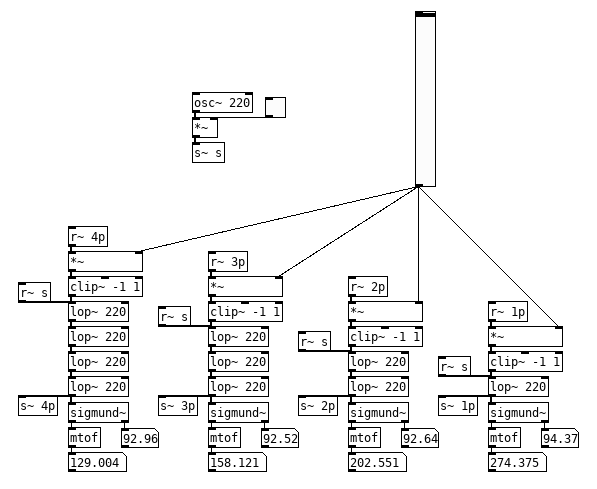
Which also should solve @elwinbran's issue and I had completely spaced out until you got my neglected filter theory working again, higher order VCFs generally put the feedback around only part of the filter and even a few lower VCFs did this. As you steepen the filter you change the frequency which has the proper cumulative phase alignment.
Edit: Out of curiosity I pulled out the Blofeld to see how they deal with this in hardware, the displayed filter cutoff is actually the frequency which the filter oscillates at and not the usual cutoff point. I wanted to also test this on the Micron which has an 8pole filter but it has some quirks regarding getting its filters to self oscillate and I don't seem to quite recall what they are at this moment or it might just be that not all of its filters can self oscillate, scrolling through my patches it seems I never use oscillating filters on that synth.
Another Edit: The Blofeld could actually be using a 2-pole resonance loop on the 4-pole filter, I tested by seeing if the frequency was the same between the two which I now realize is flawed. How the sound changed makes me suspect this is not the case and I was correct, I will do a more proper test later and maybe figure out the Micron, this got me curious.
 posted in technical issues
Higher order filter in PD extended
@kyro By non-linear I was referring to things like [pow~] getting stuck in the feedback loop, not a correct terminology but one I fall back on with synths because it was a common term in the synth diy community 20 years ago to refer to anything that is not the normal distortion/filtering type stuff in a filters feedback loop.
@manuels The magic of the moog (as in minimoog) is primarily in the output amp which affects the entire filter and is why the ARP version sounds so different, they 'fixed' it and lost the characteristic flavor of the mini's filter. The output amp on the mini's filter does not have anywhere high enough of an impedance to deal with the ladder which drags down frequency response and distorts things, feedback loop comes off output amp so nothing in the filter is untouched by the output amps flaws and it is more the heart of the filter than the ladder. Later Moog ladders are closer to the ARP version, output amp has a high enough impedance and we loose most of the mini's character but we get a decent response in the upper registers in trade.
Most of the classic VCFs are just cascaded 6db filters with a feedback loop for resonance and is my standard, the various 'proper' filters created in the digital world are lacking in many ways to my ears. The cascaded nature of many circuits in the analog world is part of what the digital world is missing, in a 4 pole filter that means we at least have input amp, 4 filter stages, output stage and feedback each giving their own distrotion and frequency characteristic. The filter stages we try and balance and get them to cancel out any quirks to work together but they still have an individual character and input, output and feedback have a very strong character which gives us a rather dynamic result when everything is combined.
And since analog feedback is basically delayless (which in digital land is of course impossibe)
Check my thread on feedback which actually came about because of trying to get a decent filter executed in pd, getting closer.
posted in technical issues
Odd behavior after saving cloned abstract
@Pathagas said:
I'm not sure what you mean about data rate triggered envelopes. And how would I use a filter for the sinusoid? I've heard someone say that before, but I wasn't sure what it meant.
Every filter can be described or understood in terms of its impulse response -- put a single sample impulse into it (the most neutral possible signal), and the result is 100% because of the filter's coloration.
The impulse response of a bandpass filter is a decaying sinewave -- the same as mechanical resonance. (I saw a video somewhere describing the movement of a weight on a spring using the classical physics formulas, and then reducing those down to a two-pole filter formula -- demonstrating that bandpass is literally a physical model of resonance.)
The catch is that the beginning of the impulse response is an instantaneous jump, producing a click.
I learned a neat trick from SuperCollider. It has a UGen called Formlet, which takes an input signal, frequency, and attack and decay times as input. It's implemented by subtracting two bandpass filters: in SC code, Ringz.ar(input, freq, decay) - Ringz.ar(input, freq, attack). These are constant skirt gain filters, meaning that energy at the center frequency is amplified, and the stopbands stay at the same volume -- meaning that, once subtracted, they cancel out, giving you 1/ a smoother sound and 2/ a natural envelope.
At some point, I found in Pd's ELSE library what appears to be an exact duplicate of Ringz: [resonant~]. It's easy to implement Formlet with it:
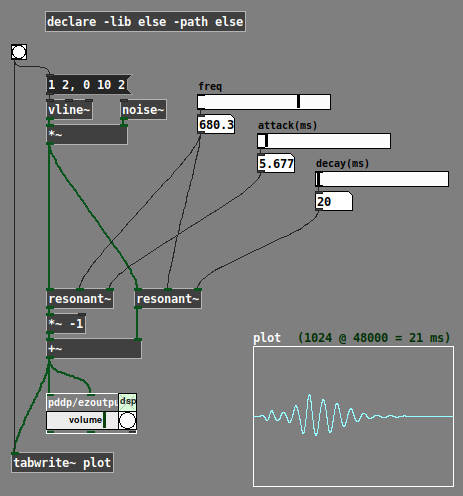
(Here, I'm using a standard exciter for modal synthesis -- a short burst of noise. Pink noise might sound better than white.)
ELSE is one of those external libraries I wish I'd known about at the beginning... a proper complement of standard DSP.
hjh
posted in technical issues
20 mode pole mixing and morphing filter. Updated
Hmm wouldn't be far from this Oid to make a Oberheim 12db Filter?
https://www.kvraudio.com/forum/viewtopic.php?p=8194407
"I'm implementing a VA LadderFilter following Will Pirkle's synth book. A cascade of four VA one-pole filters is used to achieve the filter. However, there's a twist. From what is called Oberheim Variations, more filter responses (LP, BP, HP, each 2-pole or 4-pole) are achieved.
It is done by taking the outputs of each cascaded stage separately as well as the input and mixing them together following a set of coefficients A through E. So the equation goes like:
output = A * (input + feedback) + B * LPF1 + C * LPF2 + D * LPF3 + E * LPF4
I have the coefficients for the above mentioned filter types, but I recon there is more to be discovered.
The book references a research paper by Välimäki and Huovilainen, where these coefficients are taken from. However, the paper doesn't explain how the coefficients came to be.
A further reference points towards a service manual for the Oberheim Xpander. There's several relevant information on pages 26 and 27, but I don't see the connection between the provided information and the coefficients I already have.
So I was wondering if anybody could point me in the right direction, how to obtain the rest of the coefficients. I am particularly after the 3- and 1-pole versions, notch-filters and allpass-variants."
So the only missing piece in the puzzle are the A-E coeficients.
From the KVR Thread:
5.5 of VAFilterDesign (rev 2.1.2) contains an explanation of the principles.
https://archive.org/details/the-art-of-va-filter-design-rev.-2.1.2
Here is also a c++ example of an Oberheim Filter:
https://github.com/ddiakopoulos/MoogLadders/blob/master/src/OberheimVariationModel.h
My math is not so good to understand this
 posted in abstract~