
How to loop/reset an audio file to the beginning
@KMETE Requoting myself: "To crossfade properly, it needs to subtract 100 ms from the file's total duration."
Let's say you have 10 seconds of audio.
You want to loop it, with a 100 ms crossfade.
If you just use "all" then it will do this:
- Start at 0 and play to 10 sec.
- Loop back to 0.
- At this point, for a cross fade, the step 2 audio fades in, and the step 1 audio fades out. But step 1 has already run out of audio.
So at that point, you don't get a cross fade. You get an immediate jump to silence (maybe with a click), and then a fade in.
It "seems to work" in that there is no error, nothing crashes, no major audio glitches. But it isn't crossfade looping.
The solution here changes it to:
- Start at 0 and play to 9.9 sec.
- Loop back to 0.
- At this point, the step 2 audio fades in, and the step 1 audio fades out over the range 9.9 - 10 sec = clean crossfade.
But if you're happy without a proper crossfade, then by all means, do what you feel is best.
At this point, with apologies, I need to withdraw from the thread. I've already spent much more time on it than I expected, and the follow-up questions are becoming a bit like... not the best use of time. Like, I'm getting ready to shoot a YouTube tutorial on Pd external sync, and instead of working on those materials, I was explaining crossfading here. I think I need to strike a better balance.
hjh
 posted in technical issues
Audiolab is now available on deken!
@solipp I was wondering if fft-split~ could be used as an upsampled anti-aliasing filter but I'm not getting the results I expected. Things seem to change radically depending on the oversampling factor. What am I misunderstanding?
fft-split~ as antialias filter.pd 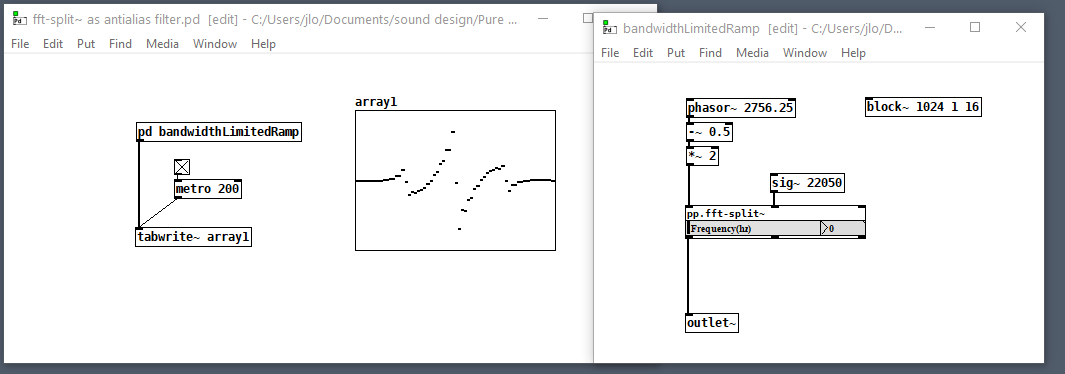
EDIT: NEVERMIND
It appears that Pd doesn't perform the 4X overlapped FFT windowing as expected if the FFT's block size is smaller than 4X the block size of the enclosing patch. When I change fft-split~'s block size to 4096, things are fine. But let me know if I've given the wrong reason.
 posted in news
Having lots of switches into Pd
@alexandros
This code sort of works with wip_multiple_PWM.pd
// merging works but pwm leds are choppy.

// number of elements in arrays need to
// match for() cycles in void setup and void loop
int pinsIn[2] = {2, 4};
int pinsAnalog[8] = {0, 1, 2, 3, 4, 5, 6, 7};

int pin = 0;
int val = 0;
int pinsOut[2] = {7, 12};

//TMP setup pwm:

// variables to hold pin numbers
int pwmLED1 = 3;
int pwmLED2 = 5;
int pwmLED3 = 6;
int pwmLED4 = 9;
int pwmLED5 = 10;
int pwmLED6 = 11;

// variables to hold pin states
int pwmLEDvalue1;
int pwmLEDvalue2;
int pwmLEDvalue3;
int pwmLEDvalue4;
int pwmLEDvalue5;
int pwmLEDvalue6;

//should this be omitted and use the a
// variable to hold and assemble incoming data
int temporary;

//END TMP pwm setup

void setup()
{
  //set up a total of pins for digital input (has to match number of elements in array)
  for(int i = 0; i < 2; i++)
  pinMode(pinsIn[i], INPUT);

  for (int i = 0; i < 2; i++) {
    pinMode(pinsOut[i], OUTPUT);
    digitalWrite(pinsOut[i], LOW);
  }

//DEFAULT works with thermistors,
//INTERNAL with transitor thermostats

  analogReference(DEFAULT);

  pinMode(A0, INPUT_PULLUP);
  pinMode(A1, INPUT_PULLUP);
  pinMode(A2, INPUT_PULLUP);
  pinMode(A3, INPUT_PULLUP);
  pinMode(A4, INPUT_PULLUP);
  pinMode(A5, INPUT_PULLUP);
  pinMode(A6, INPUT);
  pinMode(A7, INPUT);

//TMP test pwm setup:

  pinMode(pwmLED1, OUTPUT);
  pinMode(pwmLED2, OUTPUT);
  pinMode(pwmLED3, OUTPUT);
  pinMode(pwmLED4, OUTPUT);
  pinMode(pwmLED5, OUTPUT);
  pinMode(pwmLED6, OUTPUT);

  Serial.begin(115200); // perhaps use a faster baud rate
}

void loop()
{
  Serial.print("knobs"); // use "knobs" as a keyword so you can receive
  // the knob values as a list with a [r knobs] in Pd
  for(int i = 0; i < 8; i++){
    unsigned int knob = analogRead (pinsAnalog[i]);
    Serial.print(" "); // first print a white space to separate the "knob" keyword from the values
    // and the values from each other
    Serial.print(knob); // then  print the actual knob value
  }
  Serial.println(); // finally print a newline character to denote end of data for keyword "knobs"

  // the same technique applies to the switches too
  // receive the switch values as a list with [r switches]
  Serial.print("switches");
  for(int i = 0; i < 2; i++) {
    int switchVal = digitalRead(pinsIn[i]);
    Serial.print(" ");
    Serial.print(switchVal);
  }
  Serial.println();

  //handle digital outputs
  if (Serial.available()) {
    static int temp;
    byte in = Serial.read();
    if (isDigit(in)) {
      temp = temp * 10 + in - '0';
    }
    else if (in == 'p') {
      pin = temp;
      temp = 0;
    }
    else if (in == 'v')  {
      val = temp;
      temp = 0;
      digitalWrite(pinsOut[pin], val);
    }
}

//TMP merge test PWMs:
while(Serial.available()){
     byte inByte = Serial.read();
     if((inByte >= '0') && (inByte <= '9'))
       temporary = 10 * temporary + inByte - '0';
     else{
       if(inByte == 'p'){
         pwmLEDvalue1 = temporary;
         temporary = 0;
       }
       else if(inByte == 'q'){
         pwmLEDvalue2 = temporary;
         temporary = 0;
       }
       else if(inByte == 'r'){
         pwmLEDvalue3 = temporary;
         temporary = 0;
       }
       else if(inByte == 's'){
         pwmLEDvalue4 = temporary;
         temporary = 0;
       }
       else if(inByte == 't'){
         pwmLEDvalue5 = temporary;
         temporary = 0;
       }
       else if(inByte == 'u'){
         pwmLEDvalue6 = temporary;
         temporary = 0;
       }
     }
     analogWrite(pwmLED1, pwmLEDvalue1);
     analogWrite(pwmLED2, pwmLEDvalue2);
     analogWrite(pwmLED3, pwmLEDvalue3);
     analogWrite(pwmLED4, pwmLEDvalue4);
     analogWrite(pwmLED5, pwmLEDvalue5);
     analogWrite(pwmLED6, pwmLEDvalue6);
     //digitalWrite(dspLED, dspLEDstate);
   }
}
This is the code without PWM control. It works fine.
//number of elements in arrays need to match for() cycles in void setup
int pinsIn[4] = {6, 7, 8, 9};
int pinsAnalog[8] = {0, 1, 2, 3, 4, 5, 6, 7};

int pin = 0;
int val = 0;
int pinsOut[4] = {2, 3, 4, 5};

void setup()
{
  //set up a total of pins for digital input (has to match number of elements in array)
  for(int i = 0; i < 4; i++)
  pinMode(pinsIn[i], INPUT);

  for (int i = 0; i < 4; i++) {
    pinMode(pinsOut[i], OUTPUT);
    digitalWrite(pinsOut[i], LOW);
  }
//DEFAULT works with thermistors,
//INTERNAL with transitor thermostats
// ELLER var det tvartom???
  analogReference(DEFAULT);

  pinMode(A0, INPUT_PULLUP);
  pinMode(A1, INPUT_PULLUP);
  pinMode(A2, INPUT_PULLUP);
  pinMode(A3, INPUT_PULLUP);
  pinMode(A4, INPUT_PULLUP);
  pinMode(A5, INPUT_PULLUP);
  pinMode(A6, INPUT);
  pinMode(A7, INPUT);

  Serial.begin(115200); // perhaps use a faster baud rate
}

void loop()
{
  Serial.print("knobs"); // use "knobs" as a keyword so you can receive
  // the knob values as a list with a [r knobs] in Pd
  for(int i = 0; i < 8; i++){
    unsigned int knob = analogRead (pinsAnalog[i]);
    Serial.print(" "); // first print a white space to separate the "knob" keyword from the values
    // and the values from each other
    Serial.print(knob); // then  print the actual knob value
  }
  Serial.println(); // finally print a newline character to denote end of data for keyword "knobs"

  // the same technique applies to the switches too
  // receive the switch values as a list with [r switches]
  Serial.print("switches");
  for(int i = 0; i < 4; i++) {
    int switchVal = digitalRead(pinsIn[i]);
    Serial.print(" ");
    Serial.print(switchVal);
  }
  Serial.println();

  //handle digital outputs
  if (Serial.available()) {
    static int temp;
    byte in = Serial.read();
    if (isDigit(in)) {
      temp = temp * 10 + in - '0';
    }
    else if (in == 'p') {
      pin = temp;
      temp = 0;
    }
    else if (in == 'v')  {
      val = temp;
      temp = 0;
      digitalWrite(pinsOut[pin], val);
    }
}
}
and here is the code from tutorial5 from Arduino for Pd'ers. It goes with arduinoforpdrs_tut5.pd
// variables to hold pin numbers
int pwmLED = 9;
int dspLED = 2;
// variables to hold pin states
int pwmLEDvalue;
int dspLEDstate;
//variable to hold and assemble incoming data
int temporary;

void setup()
{
  pinMode(pwmLED, OUTPUT);
  pinMode(dspLED, OUTPUT);
  Serial.begin(9600);
}

void loop()
{
  while(Serial.available()){
    byte inByte = Serial.read();
    if((inByte >= '0') && (inByte <= '9'))
    temporary = 10 * temporary + inByte - '0';
    else{
      if(inByte == 'p'){
        pwmLEDvalue = temporary;
        temporary = 0;
      }
      else if(inByte == 'd'){
        dspLEDstate = temporary;
        temporary = 0;
      }
    }
    analogWrite(pwmLED, pwmLEDvalue);
    digitalWrite(dspLED, dspLEDstate);
  }
}
I am aiming at using same type of array handling as for the digital outs.
Thanks a lot
 posted in I/O hardware diy
Ofelia - using addons, GL_TEXTURE_3D and binding openGL functions
i think i learned how to integrate addons (not everything is working yet...).
this is what i added to ofxOfeliaPdBindings.h to integrate ofxVolumetrics:
class pdTexture3d
{
public:
    pdTexture3d(){};

    void allocate(int w, int h, int d, int internalGlDataType)
    {
        texture3d.allocate(w, h, d, internalGlDataType);
    }

    void loadData(unsigned char * data, int w, int h, int d, int xOffset, int yOffset, int zOffset, int glFormat)
    {
        texture3d.loadData(data, w, h, d, xOffset, yOffset, zOffset, glFormat);
    }

    void loadData(float* data, int w, int h, int d, int xOffset, int yOffset, int zOffset, int glFormat)
    {
        texture3d.loadData(data, w, h, d, xOffset, yOffset, zOffset, glFormat);
    }

    void loadData(unsigned short* data, int w, int h, int d, int xOffset, int yOffset, int zOffset, int glFormat)
    {
        texture3d.loadData(data, w, h, d, xOffset, yOffset, zOffset, glFormat);
    }

    void loadData(ofPixels & pix, int d, int xOffset, int yOffset, int zOffset)
    {
        texture3d.loadData(pix, d, xOffset, yOffset, zOffset);
    }

    void loadData(ofShortPixels & pix, int d, int xOffset, int yOffset, int zOffset)
    {
        texture3d.loadData(pix, d, xOffset, yOffset, zOffset);
    }

    void loadData(ofFloatPixels & pix, int d, int xOffset, int yOffset, int zOffset)
    {
        texture3d.loadData(pix, d, xOffset, yOffset, zOffset);
    }

    void bind()
    {
        texture3d.bind();
    }

    void unbind()
    {
        texture3d.unbind();
    }

    void clear()
    {
        texture3d.clear();
    }

    ofxTextureData3d getTextureData()
    {
        return texture3d.getTextureData();
    }

private:
    ofxTexture3d texture3d;
};


class pdVolumetrics
{
public:
    pdVolumetrics(){};

    void setup(int w, int h, int d, ofVec3f voxelSize, bool usePowerOfTwoTexSize=false)
    {
        volumetrics.setup(w, h, d, voxelSize, usePowerOfTwoTexSize);
    }

    void destroy()
    {
        volumetrics.destroy();
    }

    void updateVolumeData(unsigned char * data, int w, int h, int d, int xOffset, int yOffset, int zOffset)
    {
        volumetrics.updateVolumeData(data, w, h, d, xOffset, yOffset, zOffset);
    }

    void drawVolume(float x, float y, float z, float size, int zTexOffset)
    {
        volumetrics.drawVolume(x, y, z, size, zTexOffset);
    }

    void drawVolume(float x, float y, float z, float w, float h, float d, int zTexOffset)
    {
        volumetrics.drawVolume(x, y, z, w, h, d, zTexOffset);
    }

    bool isInitialized()
    {
        return volumetrics.isInitialized();
    }

    int getVolumeWidth()
    {
        return volumetrics.getVolumeWidth();
    }

    int getVolumeHeight()
    {
        return volumetrics.getVolumeHeight();
    }

    int getVolumeDepth()
    {
        return volumetrics.getVolumeDepth();
    }

    ofFbo & getFboReference()
    {
        return volumetrics.getFboReference();
    }

    int getRenderWidth()
    {
        return volumetrics.getRenderWidth();
    }

    int getRenderHeight()
    {
        return volumetrics.getRenderHeight();
    }

    float getXyQuality()
    {
        return volumetrics.getXyQuality();
    }

    float getZQuality()
    {
        return volumetrics.getZQuality();
    }

    float getThreshold()
    {
        return volumetrics.getThreshold();
    }

    float getDensity()
    {
        return volumetrics.getDensity();
    }

    void setXyQuality(float q)
    {
        volumetrics.setXyQuality(q);
    }

    void setZQuality(float q)
    {
        volumetrics.setZQuality(q);
    }

    void setThreshold(float t)
    {
        volumetrics.setThreshold(t);
    }

    void setDensity(float d)
    {
        volumetrics.setDensity(d);
    }

    void setRenderSettings(float xyQuality, float zQuality, float dens, float thresh)
    {
        volumetrics.setRenderSettings(xyQuality, zQuality, dens, thresh);
    }

    void setVolumeTextureFilterMode(GLint filterMode)
    {
        volumetrics.setVolumeTextureFilterMode(filterMode);
    }

private:
    ofxVolumetrics volumetrics;
};


class pdImageSequencePlayer
{
public:
    pdImageSequencePlayer(){};

    void init(std::string prefix, int digits, std::string extension, int start)
    {
        imageSequencePlayer.init(prefix, digits, extension, start);
    }

    int getWidth()
    {
        return imageSequencePlayer.getWidth();
    }

    int getHeight()
    {
        return imageSequencePlayer.getHeight();
    }

    ofPixels_<unsigned char> getPixels()
    {
        return imageSequencePlayer.getPixels();
    }

    int getSequenceLength()
    {
        return imageSequencePlayer.getSequenceLength();
    }

    bool loadNextFrame()
    {
        return imageSequencePlayer.loadNextFrame();
    }

    bool loadPreviousFrame()
    {
        return imageSequencePlayer.loadPreviousFrame();
    }

    bool loadFrame(int n)
    {
        return imageSequencePlayer.loadFrame(n);
    }

    int getCurrentFrameNumber()
    {
        return imageSequencePlayer.getCurrentFrameNumber();
    }

    void setCurrentFrameNumber(int i)
    {
        imageSequencePlayer.setCurrentFrameNumber(i);
    }

    bool isInitialized()
    {
        return imageSequencePlayer.isInitialized();
    }

private:
    ofxImageSequencePlayer imageSequencePlayer;
};
 posted in pixel#
CPU usage of idle patches, tabread4~?
@zigmhount said:
Good advice on the discontinuities. I was kind of hoping that [phasor~] would handle this better than restarting [line~] from 1 to 0, but I suppose that it also just jump from 1 to 0?
Yep. Regardless of whether you're using [line~] or [phasor~] to drive [tabread4~], discontinuities can happen anytime you abruptly jump from one spot to another. This isn't unique to Pd, if you perform edits to a waveform in any DAW without crossfades at the edit points, you will get clicks/pops (unless you get lucky & happen to edit at a zero crossing). So, if the first & last values stored in your array (loop) are not the same & the loop restarts (either beginning a new 0->1 ramp with [line~] or letting [phasor~] wrap around), you'll get a pop unless you use windowing.
In your example, you record the ramp up and ramp down into the array itself, right? Is that not audible when looping the same array over and over? Thanks to this ramp in the array, I guess that [tabread4~] may not click even if started without a volume ramp in, would it?
Yes indeed, that example essentially records the fade in/out into the array, so you wouldn't hear clicks when the loop wraps even without using a window with [tabread4~]. However, note that this is only one of the causes I mentioned... if you're eventually planning to add any playback controls with abrupt changes (such as pause/stop, start from the middle, rewind, jump to a new position, etc), you'll need a fade out before the change and a fade in after the change. FYI, my personal use for recording the fade into the array itself is because I sometimes use a phase vocoder for time stretching of my loops, which seems to misbehave if I have extreme values at the start/end of the array.
And, yes, the windowing can be audible, but it really depends on the nature of the audio that you're recording into the array. I randomly chose a 10ms fade in/out for the example above, but that could be any duration you like (you might want it to be adjustable if you're looping many different types of sounds, to experiment with shorter/longer fade times). There are also ways of shaping the curve of the fades if you really want to minimize their chances of being audible. But even if the fades are obvious, I think you'll still find them to be a million times less strident than a loud speaker pop. 


 posted in technical issues
RMS vs FFT complex magnitudes
I'm up to the beginning of Katja V's Fourier Transform section and I've already found a few answers to my questions. I also managed to get the sum of FFT term amplitudes to match the RMS value for arbitrary input. Here's the patch:
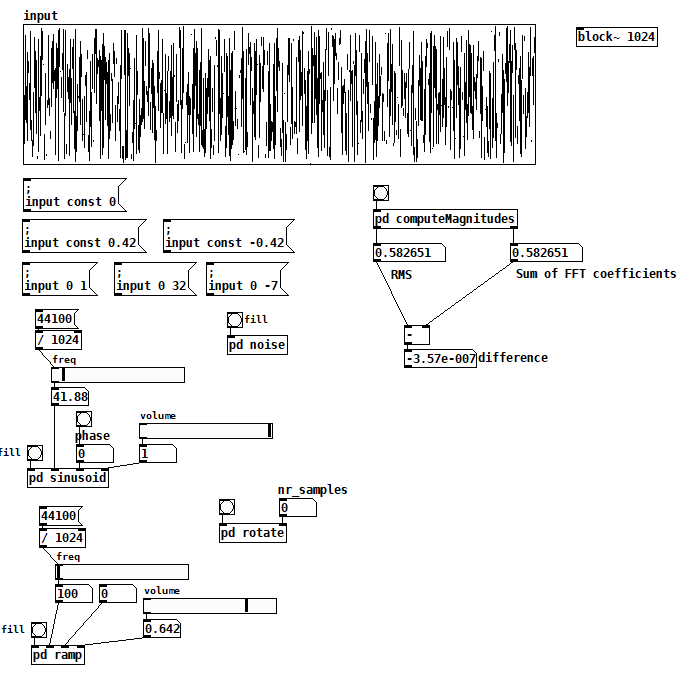 Inside [pd computerMagnitudes]: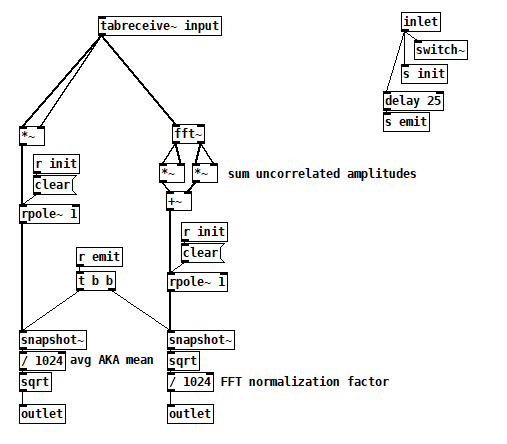
compareTimeFreqAmpl2.pd
All the things on the left are just tools to fill the input table, but you can also just draw. Once you have your signal, bang computeMagnitudes to measure its amplitude both ways.
I made a couple of simplifications that not only got the test working but also gave me more confidence that I was comparing apples to apples:
- I'm computing RMS and the FFT from a single static 1024 vector, so I'm now comparing two views of the exact same signal and there's no need for averaging.
- I learned from Katja that if you perform a complex FFT on a real signal, you don't have to worry about which terms to double because the FFT gives you those terms's double in the upper half of the output explicitly. The real FFT skips the upper half for efficiency because it's related to the lower half.
- I also learned that even the cosine and sine components of each harmonic are uncorrelated signals, so I now sum their magnitudes individually across all harmonics. There's no need to compute the magnitude of each FFT term first.
So I think the issue I was having with noise was just an artifact of a badly programmed test, probably having to do with the way I was averaging term magnitudes, but I don't really know.
7/18/2020 update: I've found info in Katja's blog that suggests that this patch is wrong (or maybe even not possible). Exhibit A:
 IMHO, this contradicts what she spent so much effort establishing on the prior two pages (http://www.katjaas.nl/sinusoids2/sinusoids2.html
http://www.katjaas.nl/correlation/correlation.html), that the cos and sine components of all FFT terms are orthogonal. If they're orthogonal, how could they cancel each other out?
She raises a another point on the FFT output page that really makes me wonder why my patch seems to work:
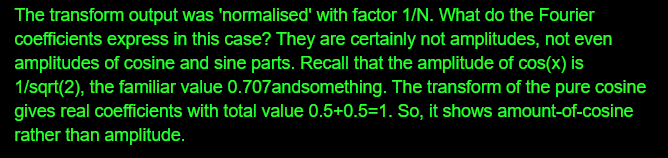 In this case I agree--Fourier coefficents are really the peak amplitudes of the cos and sine components--but my confusion over this is what made me program the patch the way that I did. So why is it working?
posted in technical issues
How to do Voice Activity Detection (VAD) Algorithms?
Hello!
I’ve been working on a sound installation that records your voice on a public space and then plays it back on a FM radio transmitter.
Since then, I’ve been searching for different voice activity detection (VAD) algorithms for Pure Data and found very little.
So far, my best lead is this article: https://medium.com/linagoralabs/voice-activity-detection-for-voice-user-interface-2d4bb5600ee3
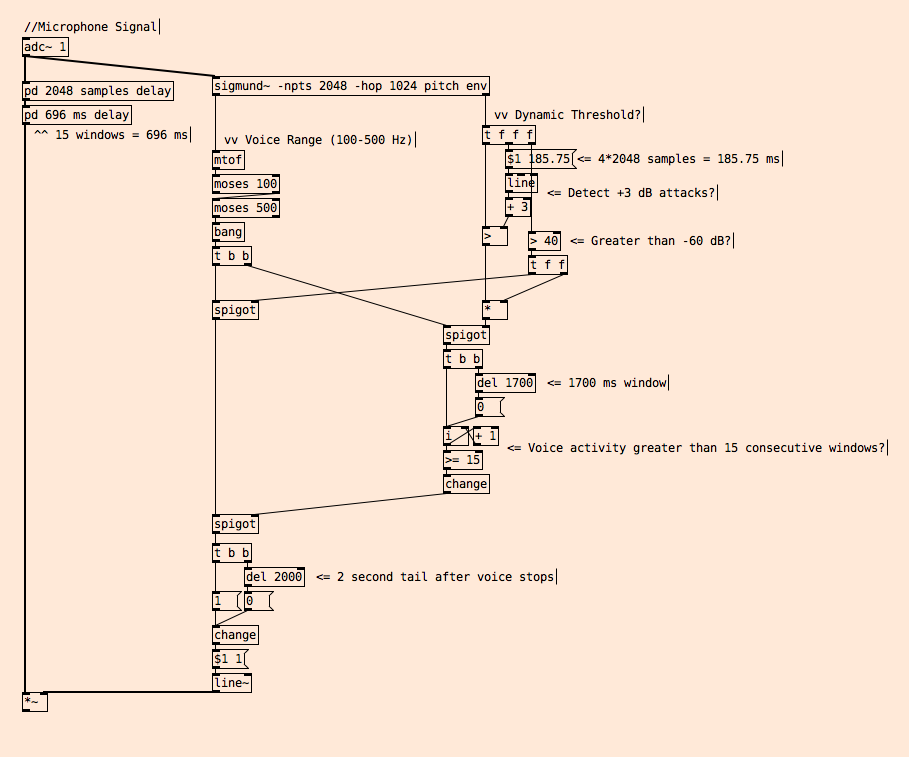
So I thought I’d share my simple algorithm for VAD in public spaces and ask:
How would you approach detecting voice activity in real-time in a public space with a lot of noises and non-voice signals?
Here's my patch: VAD.pd
 posted in technical issues
sending / receiving variables with emscripten ofelia?
i managed to send and receive values (numbers) with EM_ASM between java script and c++
here is an example: http://emasm.handmadeproductions.de/
EMASM.zip
but it works only with regular open frameworks programs yet, not with ofelia...
#include "ofApp.h"
#include "emscripten.h"


//--------------------------------------------------------------
void ofApp::setup(){

}

//--------------------------------------------------------------
void ofApp::update(){

}

//--------------------------------------------------------------
void ofApp::draw(){

    EM_ASM_({
    console.log('I send: ' + $0);
    document.getElementById("display_time").textContent = Number($0).toFixed(2);
    }, ofGetElapsedTimef());

    int size = EM_ASM_INT({
    console.log('I received size: ' + document.getElementById("slider_size").value);
    return document.getElementById("slider_size").value;
    });

    int blue = EM_ASM_INT({
    console.log('I received blue: ' + document.getElementById("slider_blue").value);
    return document.getElementById("slider_blue").value;
    });

    int t = ofGetElapsedTimef();
    ofSetColor(t % 255, t % 255, blue);

    ofRectangle rect;
    rect.x = 10;
    rect.y = 10;
    rect.width = size * 1.344827586;
    rect.height = size;

    ofDrawRectangle(rect);

}

//--------------------------------------------------------------
void ofApp::keyPressed(int key){

}

//--------------------------------------------------------------
void ofApp::keyReleased(int key){

}

//--------------------------------------------------------------
void ofApp::mouseMoved(int x, int y ){

}

//--------------------------------------------------------------
void ofApp::mouseDragged(int x, int y, int button){

}

//--------------------------------------------------------------
void ofApp::mousePressed(int x, int y, int button){

}

//--------------------------------------------------------------
void ofApp::mouseReleased(int x, int y, int button){

}

//--------------------------------------------------------------
void ofApp::mouseEntered(int x, int y){

}

//--------------------------------------------------------------
void ofApp::mouseExited(int x, int y){

}

//--------------------------------------------------------------
void ofApp::windowResized(int w, int h){

}

//--------------------------------------------------------------
void ofApp::gotMessage(ofMessage msg){

}

//--------------------------------------------------------------
void ofApp::dragEvent(ofDragInfo dragInfo){

}
@Cuinjune i wonder if it is possible to access ofelia variables from ofApp.cpp,
or if it could be possible to use EM_ASM in an future update inside an ofelia script?
Or is it possible to already use EM_ASM inside an ofelia script and I just need to know how to use it with Lua?
posted in libpd / webpd
PD's scheduler, timing, control-rate, audio-rate, block-size, (sub)sample accuracy,
@EEight said:
@lacuna said:
I just see this flag on linux:
-nosleep -- spin, don't sleep (may lower latency on multi-CPUs)
Oh yes and there are startup flags for loading a different scheduler (I corrected this in my first post now)
https://puredata.info/docs/faq/commandline
  -rt or -realtime -- use real-time priority
  -nrt             -- don't use real-time priority
  -sleep           -- sleep when idle, don't spin (true by default)
  -nosleep         -- spin, don't sleep (may lower latency on multi-CPUs)
  -schedlib <file> -- plug in external scheduler
  -extraflags <s>  -- string argument to send schedlib
  -batch           -- run off-line as a batch process
  -nobatch         -- run interactively (true by default)
Not sure, would be interested to know too.
@EEight output of full text search of sleep with grep in pd's source folder -nri flags set:
https://pastebin.com/3mBw6Mnj
/pd-0.50-2.src.tar.gz.extracted/pd-0.50-2/src/u_pdsend.c:86: sleep (nretry < 5 ? 1 : 5);
/pd-0.50-2.src.tar.gz.extracted/pd-0.50-2/src/s_stuff.h:65:extern int sys_sleepgrain;
/pd-0.50-2.src.tar.gz.extracted/pd-0.50-2/src/s_stuff.h:163:EXTERN void sys_microsleep(int microsec);
/pd-0.50-2.src.tar.gz.extracted/pd-0.50-2/src/s_stuff.h:369:EXTERN int* get_sys_sleepgrain(void);
/pd-0.50-2.src.tar.gz.extracted/pd-0.50-2/src/s_main.c:58:int sys_nosleep = 0; /* skip all "sleep" calls and spin instead */
/pd-0.50-2.src.tar.gz.extracted/pd-0.50-2/src/s_main.c:115:int* get_sys_sleepgrain() { return &sys_sleepgrain; }
/pd-0.50-2.src.tar.gz.extracted/pd-0.50-2/src/s_main.c:424:"-sleepgrain <n> -- specify number of milliseconds to sleep when idle\n",
/pd-0.50-2.src.tar.gz.extracted/pd-0.50-2/src/s_main.c:520:"-sleep -- sleep when idle, don't spin (true by default)\n",
/pd-0.50-2.src.tar.gz.extracted/pd-0.50-2/src/s_main.c:521:"-nosleep -- spin, don't sleep (may lower latency on multi-CPUs)\n",
/pd-0.50-2.src.tar.gz.extracted/pd-0.50-2/src/s_main.c:732: else if (!strcmp(*argv, "-sleepgrain"))
/pd-0.50-2.src.tar.gz.extracted/pd-0.50-2/src/s_main.c:737: sys_sleepgrain = 1000 * atof(argv[1]);
/pd-0.50-2.src.tar.gz.extracted/pd-0.50-2/src/s_main.c:1242: else if (!strcmp(*argv, "-sleep"))
/pd-0.50-2.src.tar.gz.extracted/pd-0.50-2/src/s_main.c:1244: sys_nosleep = 0;
/pd-0.50-2.src.tar.gz.extracted/pd-0.50-2/src/s_main.c:1247: else if (!strcmp(*argv, "-nosleep"))
/pd-0.50-2.src.tar.gz.extracted/pd-0.50-2/src/s_main.c:1249: sys_nosleep = 1;
/pd-0.50-2.src.tar.gz.extracted/pd-0.50-2/src/s_inter.c:202:extern int sys_nosleep;
/pd-0.50-2.src.tar.gz.extracted/pd-0.50-2/src/s_inter.c:204:/* sleep (but cancel the sleeping if pollem is set and any file descriptors are
/pd-0.50-2.src.tar.gz.extracted/pd-0.50-2/src/s_inter.c:207:sleep. */
/pd-0.50-2.src.tar.gz.extracted/pd-0.50-2/src/s_inter.c:208:static int sys_domicrosleep(int microsec, int pollem)
/pd-0.50-2.src.tar.gz.extracted/pd-0.50-2/src/s_inter.c:226: perror("microsleep select");
/pd-0.50-2.src.tar.gz.extracted/pd-0.50-2/src/s_inter.c:242: Sleep(microsec/1000);
/pd-0.50-2.src.tar.gz.extracted/pd-0.50-2/src/s_inter.c:244: usleep(microsec);
/pd-0.50-2.src.tar.gz.extracted/pd-0.50-2/src/s_inter.c:251: /* sleep (but if any incoming or to-gui sending to do, do that instead.)
/pd-0.50-2.src.tar.gz.extracted/pd-0.50-2/src/s_inter.c:253:void sys_microsleep(int microsec)
/pd-0.50-2.src.tar.gz.extracted/pd-0.50-2/src/s_inter.c:256: sys_domicrosleep(microsec, 1);
/pd-0.50-2.src.tar.gz.extracted/pd-0.50-2/src/s_inter.c:909: int didsomething = sys_domicrosleep(0, 1);
/pd-0.50-2.src.tar.gz.extracted/pd-0.50-2/src/s_audio_pa.c:16: correct thread synchronization (by defining THREADSIGNAL) or just sleeping
/pd-0.50-2.src.tar.gz.extracted/pd-0.50-2/src/s_audio_pa.c:21: switch to usleep in s_inter.c
/pd-0.50-2.src.tar.gz.extracted/pd-0.50-2/src/s_audio_pa.c:91:#include <windows.h> /* for Sleep() */
/pd-0.50-2.src.tar.gz.extracted/pd-0.50-2/src/s_audio_pa.c:549: sys_microsleep(sys_sleepgrain);
/pd-0.50-2.src.tar.gz.extracted/pd-0.50-2/src/s_audio_pa.c:550: if (!pa_stream) /* sys_microsleep() may have closed device */
/pd-0.50-2.src.tar.gz.extracted/pd-0.50-2/src/s_audio_pa.c:591: sys_microsleep(sys_sleepgrain);
/pd-0.50-2.src.tar.gz.extracted/pd-0.50-2/src/s_audio_pa.c:592: if (!pa_stream) /* sys_microsleep() may have closed device */
/pd-0.50-2.src.tar.gz.extracted/pd-0.50-2/src/s_audio_oss.c:672: sys_microsleep(2000);
/pd-0.50-2.src.tar.gz.extracted/pd-0.50-2/src/s_audio_alsamm.c:105:/* if more than this sleep detected, should be more than periodsize/samplerate ??? */
/pd-0.50-2.src.tar.gz.extracted/pd-0.50-2/src/s_audio_alsamm.c:106:static double sleep_time;
/pd-0.50-2.src.tar.gz.extracted/pd-0.50-2/src/s_audio_alsamm.c:340: sleep_time = (float) alsamm_period_size/ (float) alsamm_sr;
/pd-0.50-2.src.tar.gz.extracted/pd-0.50-2/src/s_audio_alsamm.c:798: sleep(1); /* wait until the suspend flag is released */
/pd-0.50-2.src.tar.gz.extracted/pd-0.50-2/src/s_audio_alsamm.c:1336: if ((timenow = sys_getrealtime()) > (timelast + sleep_time))
/pd-0.50-2.src.tar.gz.extracted/pd-0.50-2/src/s_audio_alsamm.c:1342: timenow,timelast,sleep_time,(timelast + sleep_time));
/pd-0.50-2.src.tar.gz.extracted/pd-0.50-2/src/s_audio_alsa.c:691: sys_microsleep(5000);
/pd-0.50-2.src.tar.gz.extracted/pd-0.50-2/src/m_sched.c:23:int sys_usecsincelastsleep(void);
/pd-0.50-2.src.tar.gz.extracted/pd-0.50-2/src/m_sched.c:24:int sys_sleepgrain;
/pd-0.50-2.src.tar.gz.extracted/pd-0.50-2/src/m_sched.c:442:will now sleep. */
/pd-0.50-2.src.tar.gz.extracted/pd-0.50-2/src/m_sched.c:454: if (sys_sleepgrain < 100)
/pd-0.50-2.src.tar.gz.extracted/pd-0.50-2/src/m_sched.c:455: sys_sleepgrain = sys_schedadvance/4;
/pd-0.50-2.src.tar.gz.extracted/pd-0.50-2/src/m_sched.c:456: if (sys_sleepgrain < 100)
/pd-0.50-2.src.tar.gz.extracted/pd-0.50-2/src/m_sched.c:457: sys_sleepgrain = 100;
/pd-0.50-2.src.tar.gz.extracted/pd-0.50-2/src/m_sched.c:458: else if (sys_sleepgrain > 5000)
/pd-0.50-2.src.tar.gz.extracted/pd-0.50-2/src/m_sched.c:459: sys_sleepgrain = 5000;
/pd-0.50-2.src.tar.gz.extracted/pd-0.50-2/src/m_sched.c:477: the machine sleeps. */
/pd-0.50-2.src.tar.gz.extracted/pd-0.50-2/src/m_sched.c:539: /* if even that had nothing to do, sleep. */
/pd-0.50-2.src.tar.gz.extracted/pd-0.50-2/src/m_sched.c:541: sys_microsleep(sys_sleepgrain);
/pd-0.50-2.src.tar.gz.extracted/pd-0.50-2/src/m_sched.c:574: Sleep(1000);
/pd-0.50-2.src.tar.gz.extracted/pd-0.50-2/src/m_sched.c:576: sleep(1);
/pd-0.50-2.src.tar.gz.extracted/pd-0.50-2/portmidi/portmidi/porttime/ptwinmm.c:67:PMEXPORT void Pt_Sleep(int32_t duration)
/pd-0.50-2.src.tar.gz.extracted/pd-0.50-2/portmidi/portmidi/porttime/ptwinmm.c:69: Sleep(duration);
/pd-0.50-2.src.tar.gz.extracted/pd-0.50-2/portmidi/portmidi/porttime/ptmacosx_mach.c:128:void Pt_Sleep(int32_t duration)
/pd-0.50-2.src.tar.gz.extracted/pd-0.50-2/portmidi/portmidi/porttime/ptmacosx_mach.c:130: usleep(duration * 1000);
/pd-0.50-2.src.tar.gz.extracted/pd-0.50-2/portmidi/portmidi/porttime/ptmacosx_cf.c:137:void Pt_Sleep(int32_t duration)
/pd-0.50-2.src.tar.gz.extracted/pd-0.50-2/portmidi/portmidi/porttime/ptmacosx_cf.c:139: usleep(duration * 1000);
/pd-0.50-2.src.tar.gz.extracted/pd-0.50-2/portmidi/portmidi/porttime/ptlinux.c:14:of sleeping when realtime threads request a sleep of <=2ms (as a way
/pd-0.50-2.src.tar.gz.extracted/pd-0.50-2/portmidi/portmidi/porttime/ptlinux.c:132:void Pt_Sleep(int32_t duration)
/pd-0.50-2.src.tar.gz.extracted/pd-0.50-2/portmidi/portmidi/porttime/ptlinux.c:134: usleep(duration * 1000);
/pd-0.50-2.src.tar.gz.extracted/pd-0.50-2/portmidi/portmidi/porttime/porttime.h:82: Pt_Sleep() pauses, allowing other threads to run.
/pd-0.50-2.src.tar.gz.extracted/pd-0.50-2/portmidi/portmidi/porttime/porttime.h:88:PMEXPORT void Pt_Sleep(int32_t duration);
/pd-0.50-2.src.tar.gz.extracted/pd-0.50-2/portmidi/portmidi/pm_mac/pmmacosxcm.c:492: usleep((useconds_t)
/pd-0.50-2.src.tar.gz.extracted/pd-0.50-2/portmidi/patches/mac_limit_rate_override.patch:52: usleep((useconds_t)
/pd-0.50-2.src.tar.gz.extracted/pd-0.50-2/portaudio/portaudio/src/os/win/pa_win_util.c:102:void Pa_Sleep( long msec )
/pd-0.50-2.src.tar.gz.extracted/pd-0.50-2/portaudio/portaudio/src/os/win/pa_win_util.c:104: Sleep( msec );
/pd-0.50-2.src.tar.gz.extracted/pd-0.50-2/portaudio/portaudio/src/os/unix/pa_unix_util.c:108:void Pa_Sleep( long msec )
/pd-0.50-2.src.tar.gz.extracted/pd-0.50-2/portaudio/portaudio/src/os/unix/pa_unix_util.c:110:#ifdef HAVE_NANOSLEEP
/pd-0.50-2.src.tar.gz.extracted/pd-0.50-2/portaudio/portaudio/src/os/unix/pa_unix_util.c:116: nanosleep(&req, &rem);
/pd-0.50-2.src.tar.gz.extracted/pd-0.50-2/portaudio/portaudio/src/os/unix/pa_unix_util.c:117: /* XXX: Try sleeping the remaining time (contained in rem) if interrupted by a signal? */
/pd-0.50-2.src.tar.gz.extracted/pd-0.50-2/portaudio/portaudio/src/os/unix/pa_unix_util.c:120: { /* to usleep must be < 1000000. */
/pd-0.50-2.src.tar.gz.extracted/pd-0.50-2/portaudio/portaudio/src/os/unix/pa_unix_util.c:121: usleep( 999000 );
/pd-0.50-2.src.tar.gz.extracted/pd-0.50-2/portaudio/portaudio/src/os/unix/pa_unix_util.c:124: usleep( msec * 1000 );
/pd-0.50-2.src.tar.gz.extracted/pd-0.50-2/portaudio/portaudio/src/os/unix/pa_unix_util.c:599: /* Test before and after in case whatever underlying sleep call isn't interrupted by pthread_cancel */
/pd-0.50-2.src.tar.gz.extracted/pd-0.50-2/portaudio/portaudio/src/os/unix/pa_unix_util.c:601: Pa_Sleep( intervalMsec );
/pd-0.50-2.src.tar.gz.extracted/pd-0.50-2/portaudio/portaudio/src/os/unix/pa_unix_util.c:644: PA_DEBUG(( "%s: Watchdog sleeping for %lu msecs before unthrottling\n", __FUNCTION__, th->throttledSleepTime ));
/pd-0.50-2.src.tar.gz.extracted/pd-0.50-2/portaudio/portaudio/src/os/unix/pa_unix_util.c:645: Pa_Sleep( th->throttledSleepTime );
/pd-0.50-2.src.tar.gz.extracted/pd-0.50-2/portaudio/portaudio/src/os/unix/pa_unix_util.c:704: Pa_Sleep( intervalMsec );
/pd-0.50-2.src.tar.gz.extracted/pd-0.50-2/portaudio/portaudio/src/hostapi/wmme/pa_win_wmme.c:2185: unsigned long throttledSleepMsecs;
/pd-0.50-2.src.tar.gz.extracted/pd-0.50-2/portaudio/portaudio/src/hostapi/wmme/pa_win_wmme.c:2565: /* time to sleep when throttling due to >100% cpu usage.
/pd-0.50-2.src.tar.gz.extracted/pd-0.50-2/portaudio/portaudio/src/hostapi/wmme/pa_win_wmme.c:2567: stream->throttledSleepMsecs =
/pd-0.50-2.src.tar.gz.extracted/pd-0.50-2/portaudio/portaudio/src/hostapi/wmme/pa_win_wmme.c:3194: /* sleep to give other processes a go */
/pd-0.50-2.src.tar.gz.extracted/pd-0.50-2/portaudio/portaudio/src/hostapi/wmme/pa_win_wmme.c:3195: Sleep( stream->throttledSleepMsecs );
/pd-0.50-2.src.tar.gz.extracted/pd-0.50-2/portaudio/portaudio/src/hostapi/coreaudio/pa_mac_core_utilities.c:395: /* No match yet, so let's sleep and try again. */
/pd-0.50-2.src.tar.gz.extracted/pd-0.50-2/portaudio/portaudio/src/hostapi/coreaudio/pa_mac_core_utilities.c:396: Pa_Sleep( 100 );
/pd-0.50-2.src.tar.gz.extracted/pd-0.50-2/portaudio/portaudio/src/hostapi/coreaudio/pa_mac_core_blocking.h:69:#define PA_MAC_BLIO_BUSY_WAIT_SLEEP_INTERVAL (5)
/pd-0.50-2.src.tar.gz.extracted/pd-0.50-2/portaudio/portaudio/src/hostapi/coreaudio/pa_mac_core_blocking.c:454: Pa_Sleep( PA_MAC_BLIO_BUSY_WAIT_SLEEP_INTERVAL );
/pd-0.50-2.src.tar.gz.extracted/pd-0.50-2/portaudio/portaudio/src/hostapi/coreaudio/pa_mac_core_blocking.c:535: Pa_Sleep( PA_MAC_BLIO_BUSY_WAIT_SLEEP_INTERVAL );
/pd-0.50-2.src.tar.gz.extracted/pd-0.50-2/portaudio/portaudio/src/hostapi/coreaudio/pa_mac_core_blocking.c:607: Pa_Sleep( msecPerBuffer );
/pd-0.50-2.src.tar.gz.extracted/pd-0.50-2/portaudio/portaudio/src/hostapi/coreaudio/pa_mac_core.c:2722: Pa_Sleep( 100 );
/pd-0.50-2.src.tar.gz.extracted/pd-0.50-2/portaudio/portaudio/src/hostapi/asio/pa_asio.cpp:3401: Sleep(1);
/pd-0.50-2.src.tar.gz.extracted/pd-0.50-2/portaudio/portaudio/src/hostapi/alsa/pa_linux_alsa.c:1129: Pa_Sleep( 10 );
/pd-0.50-2.src.tar.gz.extracted/pd-0.50-2/portaudio/portaudio/src/hostapi/alsa/pa_linux_alsa.c:2759: /* self->threading.throttledSleepTime = (unsigned long) (minFramesPerHostBuffer / sampleRate / 4 * 1000); */
/pd-0.50-2.src.tar.gz.extracted/pd-0.50-2/portaudio/portaudio/src/hostapi/alsa/pa_linux_alsa.c:3831: Pa_Sleep( 1 ); /* avoid hot loop */
/pd-0.50-2.src.tar.gz.extracted/pd-0.50-2/portaudio/portaudio/src/hostapi/alsa/pa_linux_alsa.c:3849: if( timeouts > 1 ) /* sometimes device times out, but normally once, so we do not sleep any time */
/pd-0.50-2.src.tar.gz.extracted/pd-0.50-2/portaudio/portaudio/src/hostapi/alsa/pa_linux_alsa.c:3851: Pa_Sleep( 1 ); /* avoid hot loop */
/pd-0.50-2.src.tar.gz.extracted/pd-0.50-2/portaudio/portaudio/src/common/pa_util.h:152:/* void Pa_Sleep( long msec ); must also be implemented in per-platform .c file */
/pd-0.50-2.src.tar.gz.extracted/pd-0.50-2/portaudio/portaudio/include/portaudio.h:1211:/** Put the caller to sleep for at least 'msec' milliseconds. This function is
/pd-0.50-2.src.tar.gz.extracted/pd-0.50-2/portaudio/portaudio/include/portaudio.h:1215: The function may sleep longer than requested so don't rely on this for accurate
/pd-0.50-2.src.tar.gz.extracted/pd-0.50-2/portaudio/portaudio/include/portaudio.h:1218:void Pa_Sleep( long msec );
/pd-0.50-2.src.tar.gz.extracted/pd-0.50-2/portaudio/portaudio/include/pa_win_wmme.h:64: to THREAD_PRIORITY_NORMAL and sleeps the thread if the CPU load exceeds 100%
/pd-0.50-2.src.tar.gz.extracted/pd-0.50-2/portaudio/portaudio/include/pa_linux_alsa.h:91:/** Set the maximum number of times to retry opening busy device (sleeping for a
/pd-0.50-2.src.tar.gz.extracted/pd-0.50-2/doc/1.manual/x5.htm:599:<P> In linux, a "-nosleep" flag causes Pd to poll instead of sleeping as it
/pd-0.50-2.src.tar.gz.extracted/pd-0.50-2/doc/1.manual/x5.htm:798:<P> Fixed a thread-safety problem in sys_microsleep().
/pd-0.50-2.src.tar.gz.extracted/pd-0.50-2/doc/1.manual/x5.htm:1224:the controlling parameter for MIDI jitter is "-sleepgrain", which specifies
/pd-0.50-2.src.tar.gz.extracted/pd-0.50-2/doc/1.manual/x5.htm:1225:the interval of time Pd sleeps when it believes it's idle.
/pd-0.50-2.src.tar.gz.extracted/pd-0.50-2/doc/1.manual/x5.htm:1373:<P> -sleepgrain: if you aren't using audio I/O, this can reduce time jitter in
/pd-0.50-2.src.tar.gz.extracted/pd-0.50-2/doc/1.manual/x3.htm:488:scheduling; "-sleepgrain 1" sets the sleep grain to 1 (see under MIDI below),
/pd-0.50-2.src.tar.gz.extracted/pd-0.50-2/doc/1.manual/x3.htm:489:and typing "-rt -sleepgrain 1" does both.
/pd-0.50-2.src.tar.gz.extracted/pd-0.50-2/doc/1.manual/x3.htm:527:-sleepgrain <n> -- specify number of milliseconds to sleep when idle
/pd-0.50-2.src.tar.gz.extracted/pd-0.50-2/doc/1.manual/x3.htm:573:-nosleep -- never relinquish CPU (only for multiprocessors!)
/pd-0.50-2.src.tar.gz.extracted/pd-0.50-2/doc/1.manual/x3.htm:610:<H4> MIDI and sleepgrain</H4>
/pd-0.50-2.src.tar.gz.extracted/pd-0.50-2/doc/1.manual/x3.htm:619:<P> The "sleepgrain" controls how long (in milliseconds) Pd sleeps between
good night sweet dreams
 posted in technical issues
Audiolab is now available on deken!
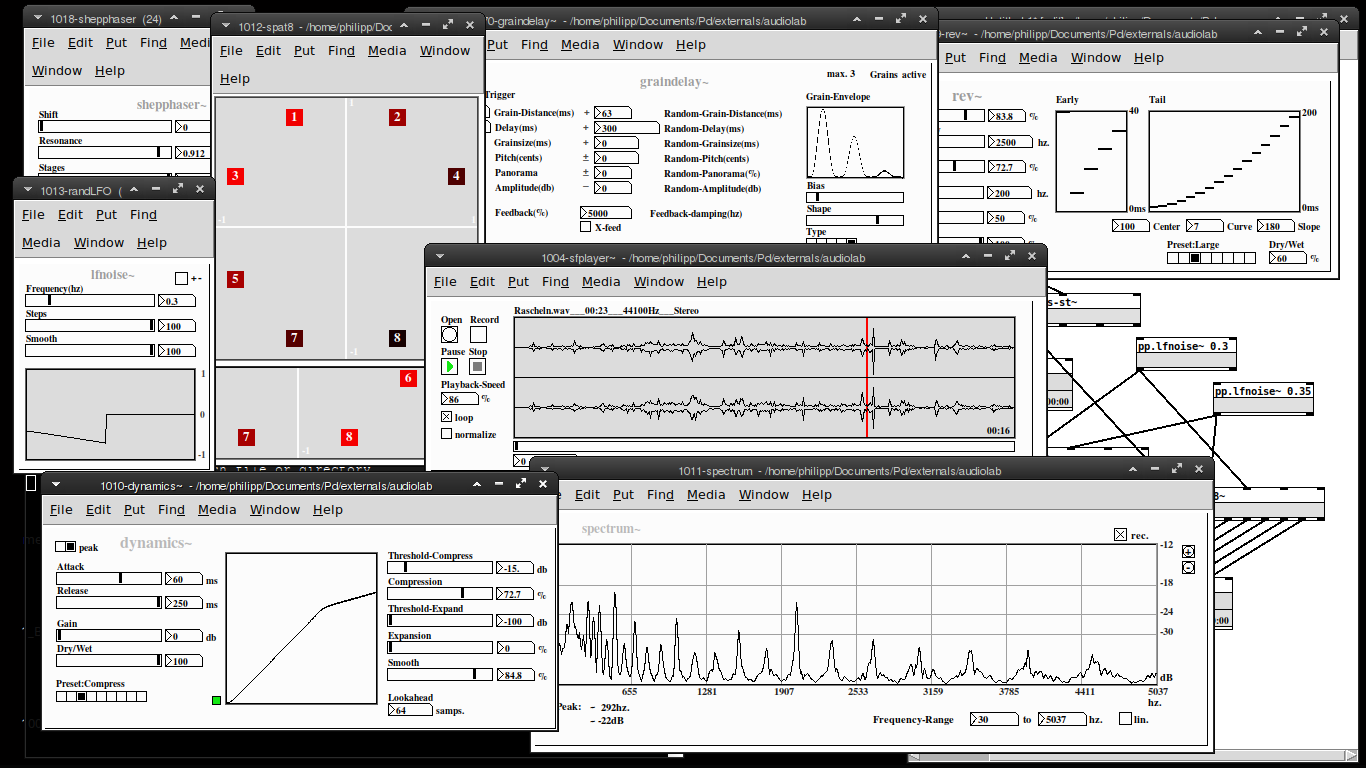
my "audiolab" abstraction library is now available on deken. You'll need Pd-0.50 or later to run this.
Please report any bugs on github: https://github.com/solipd/AudioLab
here is a picture to draw you in (:
Edit:
list of objects:
Soundfle processing
pp.sfplayer~ ... variable-speed soundfile player
pp.grainer~ ... granular sampler
pp.fft-stretch~ ... pvoc time stretching & pitch shifting
Spatialization
pp.pan~ ... constant power stereo panning
pp.midside~ ... mid-side panning
pp. spat8~ ... 8-channel distance based amplitude panning
pp.doppler~ ... doppler effect, damping & amplitude modulation
pp.dopplerxy~ ... xy doppler effect
Effects
pp.freqshift~ ... ssb frequency shifter
pp.pitchshift~ ... pitch shifter
pp.eqfilter~ ... eq-filter (lowpass, highpass, resonant, bandpass, notch, peaking, lowshelf, highshelf or allpass)
pp.vcfilter~ ... signal controlled filter (lowpass, highpass, resonant)
pp.clop~ ... experimental comb-lop-filter
pp.ladder~ ... moogish filter
pp.dynamics~ ... compressor / expander
pp.env~ ... simple envelope follower
pp.graindelay~ ... granular delay
pp.rev~ ... fdn-reverberator based on rev3~
pp.twisted-delays~ ... multipurpose twisted delay-thing
pp.shepphaser~ ... shepard tone-like phaser effect
pp.echo~ ... "analog" delay
Spectral processing
pp.fft-block~ ... audio block delay
pp.fft-split~ ... spectral splitter
pp.fft-gate~ ... spectral gate
pp.fft-pitchshift~ ... pvoc based pitchshifter
pp.fft-timbre~ ... spectral bin-reordering
pp.fft-partconv~ ... partitioned low latency convolution
pp.fft-freeze~ ... spectral freezer
Misc.
pp.in~ .... mic. input
pp.out~ ... stereo output & soundfile recorder
pp.out-8~ ... 8 channel output & soundfile recorder
pp.sdel~ ... samplewise delay
pp.lfnoise~ ... low frequency noise generator
pp.spectrum~ ... spectrum analyser
pp.xycurve
 posted in news