
Ofelia - videoPlayer and GLSL Effects
i think it is possible after trying a bit.
what seems important:
-use photo JPG (or something similar) as the codec for the video. a good program for converting is http://www.squared5.com/
-use setPosition and not setFrame for scrubbing or playing reverse through the video (it is much faster)
-playing with setPosition is without sound
-for playing with setPosition the video needs to be paused
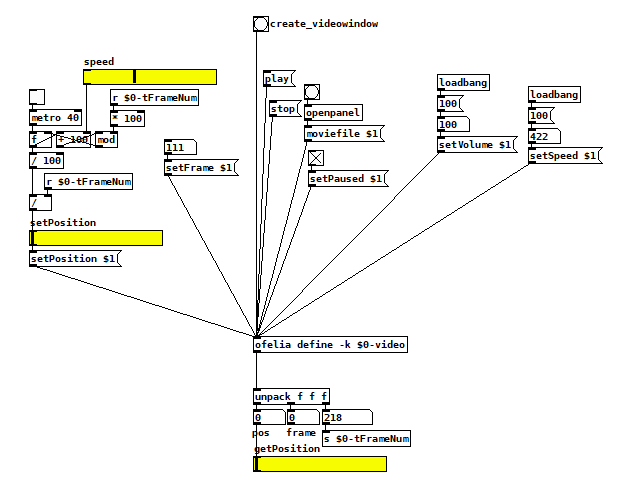
it is adapted from the video example and can be optimized a lot to work like the [pixfilm] object...
video4.pd
if type(window) ~= "userdata" then;
window = ofWindow();
end;
;
local canvas = pdCanvas(this);
local clock = pdClock(this, "setup");
local videoPlayer = ofVideoPlayer();
;
function ofelia.bang();
ofWindow.addListener("setup", this);
ofWindow.addListener("update", this);
ofWindow.addListener("draw", this);
ofWindow.addListener("exit", this);
window:setPosition(50, 100);
window:setSize(800 + 40, 600 + 40);
if type(window) ~= "userdata" then;
window = ofWindow();
end;
;
window:create();
if ofWindow.exists then;
clock:delay(0);
end;
end;
;
function ofelia.free();
window:destroy();
ofWindow.removeListener("setup", this);
ofWindow.removeListener("update", this);
ofWindow.removeListener("draw", this);
ofWindow.removeListener("exit", this);
end;
;
function ofelia.setup();
ofSetWindowTitle("Video Player");
ofBackground(0, 0, 0, 255);
end;
;
function ofelia.moviefile(path);
videoPlayer:load(path);
videoPlayer:setLoopState(OF_LOOP_NORMAL);
videoPlayer:setPaused(true);
end;
;
function ofelia.setSpeed(f);
videoPlayer:setSpeed(f / 100);
end;
;
function ofelia.play();
videoPlayer:play();
end;
;
function ofelia.stop();
videoPlayer:setFrame(0);
videoPlayer:setPaused(true);
end;
;
function ofelia.setPaused(f);
if f == 1 then pause = true;
else pause = false;
end;
videoPlayer:setPaused(pause);
end;
;
function ofelia.setFrame(f);
videoPlayer:setFrame(f);
end;
;
function ofelia.setPosition(f);
videoPlayer:setPosition(f);
end;
;
function ofelia.setVolume(f);
videoPlayer:setVolume(f / 100);
end;
;
function ofelia.update();
videoPlayer:update();
end;
;
function ofelia.draw();
ofSetHexColor(0xFFFFFF);
videoPlayer:draw(20, 20, 800, 600);
local outputList = {};
outputList[1] = videoPlayer:getPosition();
outputList[2] = videoPlayer:getCurrentFrame();
outputList[3] = videoPlayer:getTotalNumFrames();
return outputList;
end;
;
function ofelia.exit();
videoPlayer:close();
end;
 posted in technical issues
new vanilla list sort
@ingox If you are looking for source code for any old extended externals they are all in https://sourceforge.net/projects/pure-data/files/pd-extended/0.43.4/Pd-extended_0.43.4-source.tar.bz2/download
Worth grabbing a copy while it remains available.
All the "makefile"s are included.
Useful for compiling externals for 64-bit (when they work).
I have seen the sort message almost hidden in a subpatch in 12-tut.pd in a tutorial on scalars here...... https://puredata.info/community/projects/convention04/lectures/tk-barknecht/tut.tgz
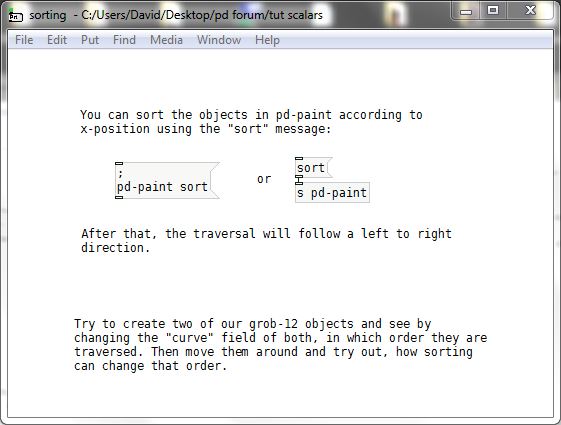
and it is mentioned (again... sort of.... with no explanation of the message call) as a function in Chapter 2.9.1 here...... http://puredata.info/docs/manuals/pd/x2.htm
and so it is also in Pd's \doc\1.manual\x2.htm
Zexy sort below. But it looks like the canvas sort is in g.graph.c.
There is an "if scalar sort" statement in there.
However g.graph.c has been disappeared from 0.49...... so......?
David.
.... sort.c.... (zexy)
In/*
* sort : sort a list of floats
*
* (c) 1999-2011 IOhannes m zmölnig, forum::für::umläute, institute of electronic music and acoustics (iem)
*
* This program is free software; you can redistribute it and/or
* modify it under the terms of the GNU General Public License
* as published by the Free Software Foundation; either version 2
* of the License, or (at your option) any later version.
*
* This program is distributed in the hope that it will be useful,
* but WITHOUT ANY WARRANTY; without even the implied warranty of
* MERCHANTABILITY or FITNESS FOR A PARTICULAR PURPOSE. See the
* GNU General Public License for more details.
*
* You should have received a copy of the GNU General Public License along
* with this program. If not, see <http://www.gnu.org/licenses/>.
*/
#include "zexy.h"
/* ------------------------- sort ------------------------------- */
/*
SHELL SORT: simple and easy
*/
static t_class *sort_class;
typedef struct _sort
{
t_object x_obj;
int bufsize;
t_float *buffer;
t_int *indices;
int ascending;
t_outlet*indexOut, *sortedOut;
} t_sort;
static void sort_dir(t_sort *x, t_float f)
{
x->ascending = (f < 0.f)?0:1;
}
static void sort_buffer(t_sort *x, int argc, t_atom *argv)
{
int n = argc;
t_float *buf;
t_atom *atombuf = argv;
if (argc != x->bufsize) {
if (x->buffer) freebytes(x->buffer, x->bufsize * sizeof(t_float));
if (x->indices)freebytes(x->indices, x->bufsize * sizeof(t_int));
x->bufsize = argc;
x->buffer = getbytes(x->bufsize * sizeof(t_float));
x->indices = getbytes(x->bufsize * sizeof(t_int));
}
buf = x->buffer;
while (n--){
*buf++ = atom_getfloat(atombuf++);
x->indices[n] = n;
}
}
static void sort_list(t_sort *x, t_symbol *s, int argc, t_atom *argv)
{
int step = argc, n;
t_atom *atombuf = (t_atom *)getbytes(sizeof(t_atom) * argc);
t_float *buf;
t_int *idx;
int i, loops = 1;
sort_buffer(x, argc, argv);
buf = x->buffer;
idx = x->indices;
while (step > 1) {
step = (step % 2)?(step+1)/2:step/2;
i = loops;
loops += 2;
while(i--) { /* there might be some optimization in here */
for (n=0; n<(argc-step); n++) {
if (buf[n] > buf[n+step]) {
t_int i_tmp = idx[n];
t_float f_tmp = buf[n];
buf[n] = buf[n+step];
buf[n+step] = f_tmp;
idx[n] = idx[n+step];
idx[n+step] = i_tmp;
}
}
}
}
if (x->ascending)
for (n = 0; n < argc; n++) SETFLOAT(&atombuf[n], idx[n]);
else
for (n = 0, i=argc-1; n < argc; n++, i--) SETFLOAT(&atombuf[n], idx[i]);
outlet_list(x->indexOut , gensym("list"), n, atombuf);
if (x->ascending)
for (n = 0; n < argc; n++) SETFLOAT(&atombuf[n], buf[n]);
else
for (n = 0, i=argc-1; n < argc; n++, i--) SETFLOAT(&atombuf[n], buf[i]);
outlet_list(x->sortedOut, gensym("list"), n, atombuf);
freebytes(atombuf, argc*sizeof(t_atom));
}
static void *sort_new(t_floatarg f)
{
t_sort *x = (t_sort *)pd_new(sort_class);
x->ascending = (f < 0.f)?0:1;
x->sortedOut=outlet_new(&x->x_obj, gensym("list"));
x->indexOut=outlet_new(&x->x_obj, gensym("list"));
x->bufsize = 0;
x->buffer = NULL;
inlet_new(&x->x_obj, &x->x_obj.ob_pd, gensym("float"), gensym("direction"));
return (x);
}
static void sort_help(t_sort*x)
{
post("\n%c sort\t\t:: sort a list of numbers", HEARTSYMBOL);
}
void sort_setup(void)
{
sort_class = class_new(gensym("sort"), (t_newmethod)sort_new,
0, sizeof(t_sort), 0, A_DEFFLOAT, 0);
class_addlist (sort_class, sort_list);
class_addmethod (sort_class, (t_method)sort_dir, gensym("direction"), A_DEFFLOAT, 0);
class_addmethod(sort_class, (t_method)sort_help, gensym("help"), A_NULL);
zexy_register("sort");
}
` posted in abstract~
[small job offer] porting max external to pd
Edit 1: Took a shot porting it in this little textarea. Probably doesn't compile yet...
Edit 2: Ok, this should compile now. I haven't actually tried to instantiate it yet, though. It's possible I set it up with the wrong number of xlets.
Edit 3: Seems to instantiate ok. It appears it doesn't take signal input so the CLASS_MAINSIGNALIN macro is neccessary. Just comment that part out to make it a control signal.
Note-- in my port it's called [vb_fourses~] for the reason noted below.
I have no idea if the algorithm behaves correctly, but it does output sound.
Btw-- AFAICT you should be able to compile this external for the 64-bit version of Purr Data and it should work properly. It doesn't require a special 64-bit codepath in Pd so I commented that part out.
Btw 2-- there should probably be a "best practices" rule that states you can only name your class something that is a legal C function name. Because this class doesn't follow that practice I made a mistake in the port. Further, the user will make a mistake because I had to change the class name. If I had instead made the setup function a different name than the creator I would create an additional problem that would force users to declare the lib before using it. Bad all around, and not worth whatever benefit there is to naming a class "foo.bar" instead of "foo_bar"
/*
#include "ext.h"
#include "ext_obex.h"
#include "z_dsp.h"
#include "ext_common.h"
*/

#include "m_pd.h"
#include "math.h"

/*
    a chaotic oscillator network
    based on descriptions of the 'fourses system' by ciat-lonbarde
    www.ciat-lonbarde.net

    07.april 2013, volker b?hm
*/

#define NUMFOURSES 4

static void *myObj_class;

typedef struct {
    // this is a horse... basically a ramp generator
    double      val;
    double      inc;
    double      dec;
    double      adder;
    double      incy, incym1;       // used for smoothing
    double      decy, decym1;       // used for smoothing
} t_horse;

typedef struct {
    t_object    x_obj;
    double      r_sr;
    t_horse     fourses[NUMFOURSES+2];  // four horses make a fourse...
    double      smoother;
    t_sample x_f;
} t_myObj;


// absolute limits
static void myObj_hilim(t_myObj *x, t_floatarg input);
static void myObj_lolim(t_myObj *x, t_floatarg input);

// up and down freqs for all oscillators
static void myObj_upfreq(t_myObj *x, t_floatarg freq1, t_floatarg freq2, t_floatarg freq3, t_floatarg freq4);
static void myObj_downfreq(t_myObj *x, t_floatarg freq1, t_floatarg freq2, t_floatarg freq3, t_floatarg freq4);

static void myObj_smooth(t_myObj *x, t_floatarg input);
static void myObj_info(t_myObj *x);

// DSP methods
static void myObj_dsp(t_myObj *x, t_signal **sp);
static t_int *myObj_perform(t_int *w);
//void myObj_dsp64(t_myObj *x, t_object *dsp64, short *count, double samplerate,
//               long maxvectorsize, long flags);
//void myObj_perform64(t_myObj *x, t_object *dsp64, double **ins, long numins,
//                     double **outs, long numouts, long sampleframes, long flags, void *userparam);
//

static void *myObj_new( t_symbol *s, int argc, t_atom *argv);
//void myObj_assist(t_myObj *x, void *b, long m, long a, char *s);


void vb_fourses_tilde_setup(void) {
    t_class *c;
    myObj_class = class_new(gensym("vb_fourses~"), (t_newmethod)myObj_new, 0, sizeof(t_myObj),
                  0, A_GIMME, NULL);
    c = myObj_class;
    class_addmethod(c, (t_method)myObj_dsp, gensym("dsp"), A_CANT, 0);
//  class_addmethod(c, (t_method)myObj_dsp64, gensym("dsp64"), A_CANT, 0);
    class_addmethod(c, (t_method)myObj_smooth, gensym("smooth"), A_FLOAT, 0);
    class_addmethod(c, (t_method)myObj_hilim, gensym("hilim"), A_FLOAT, 0);
    class_addmethod(c, (t_method)myObj_lolim, gensym("lolim"), A_FLOAT, 0);
    class_addmethod(c, (t_method)myObj_upfreq, gensym("upfreq"), A_FLOAT, A_FLOAT, A_FLOAT, A_FLOAT, 0);
    class_addmethod(c, (t_method)myObj_downfreq, gensym("downfreq"), A_FLOAT, A_FLOAT, A_FLOAT, A_FLOAT, 0);

    class_addmethod(c, (t_method)myObj_info, gensym("info"), 0);
    //class_addmethod(c, (t_method)myObj_assist, "assist", A_CANT,0);
    CLASS_MAINSIGNALIN(myObj_class, t_myObj, x_f);
//  class_dspinit(c);
//  class_register(CLASS_BOX, c);

    post("vb_fourses~ by volker b?hm\n");

//  return 0;
}


static void myObj_smooth(t_myObj *x, t_floatarg input) {
//  input = CLAMP(input, 0., 1.);
   if (input < 0.) input = 0;
     if (input > 1.) input = 1;
    x->smoother = 0.01 - pow(input,0.2)*0.01;
}

static void myObj_hilim(t_myObj *x, t_floatarg input) {
    x->fourses[0].val = input;      // store global high limit in fourses[0]
}
static void myObj_lolim(t_myObj *x, t_floatarg input) {
    x->fourses[5].val = input;      // store global low limit in fourses[5]
}

static void myObj_upfreq(t_myObj *x, t_floatarg freq1, t_floatarg freq2, t_floatarg freq3, t_floatarg freq4) {
    x->fourses[1].inc = fabs(freq1)*4*x->r_sr;
    x->fourses[2].inc = fabs(freq2)*4*x->r_sr;
    x->fourses[3].inc = fabs(freq3)*4*x->r_sr;
    x->fourses[4].inc = fabs(freq4)*4*x->r_sr;
}

static void myObj_downfreq(t_myObj *x, t_floatarg freq1, t_floatarg freq2, t_floatarg freq3, t_floatarg freq4) {
    x->fourses[1].dec = fabs(freq1)*-4*x->r_sr;
    x->fourses[2].dec = fabs(freq2)*-4*x->r_sr;
    x->fourses[3].dec = fabs(freq3)*-4*x->r_sr;
    x->fourses[4].dec = fabs(freq4)*-4*x->r_sr;
}


//#pragma mark 64bit dsp-loop ------------------

//void myObj_dsp64(t_myObj *x, t_object *dsp64, short *count, double samplerate,
//               long maxvectorsize, long flags) {
//  object_method(dsp64, gensym("dsp_add64"), x, myObj_perform64, 0, NULL);
//
//  if(samplerate<=0) x->r_sr = 1.0/44100.0;
//  else x->r_sr = 1.0/samplerate;
//
//
//}

//static void myObj_perform64(t_myObj *x, t_object *dsp64, double **ins, long numins,
//                     double **outs, long numouts, long sampleframes, long flags, void *userparam){
//
//  t_double **output = outs;
//  int vs = sampleframes;
//  t_horse *fourses = x->fourses;
//  double val, c, hilim, lolim;
//  int i, n;
//
//  if (x->x_obj.z_disabled)
//      return;
//
//  c = x->smoother;
//  hilim = fourses[0].val;
//  lolim = fourses[5].val;
//
//  for(i=0; i<vs; i++)
//   {
//      for(n=1; n<=NUMFOURSES; n++) {
//          // smoother
//          fourses[n].incy = fourses[n].inc*c + fourses[n].incym1*(1-c);
//          fourses[n].incym1 = fourses[n].incy;
//
//          fourses[n].decy = fourses[n].dec*c + fourses[n].decym1*(1-c);
//          fourses[n].decym1 = fourses[n].decy;
//
//          val = fourses[n].val;
//          val += fourses[n].adder;
//
//          if(val <= fourses[n+1].val || val <= lolim ) {
//              fourses[n].adder = fourses[n].incy;
//          }
//          else if( val >= fourses[n-1].val || val >= hilim ) {
//              fourses[n].adder = fourses[n].decy;
//          }
//
//          output[n-1][i] = val;
//
//          fourses[n].val = val;
//      }
//   }
//
//  return;
//
//}

//#pragma mark 32bit dsp-loop ------------------

static void myObj_dsp(t_myObj *x, t_signal **sp)
{
    dsp_add(myObj_perform, 6, x, sp[0]->s_vec, sp[1]->s_vec, sp[2]->s_vec, sp[3]->s_vec, sp[0]->s_n);

    if(sp[0]->s_sr<=0)
        x->r_sr = 1.0/44100.0;
    else x->r_sr = 1.0/sp[0]->s_sr;
}


static t_int *myObj_perform(t_int *w)
{
    t_myObj *x = (t_myObj*)(w[1]);
    t_float *out1 = (float *)(w[2]);
    t_float *out2 = (float *)(w[3]);
    t_float *out3 = (float *)(w[4]);
    t_float *out4 = (float *)(w[5]);
    int vs = (int)(w[6]);

// Hm... not sure about this member. I don't think we can disable individual
// objects in Pd...
//    if (x->x_obj.z_disabled)
//        goto out;

    t_horse *fourses = x->fourses;
    double val, c, hilim, lolim;
    int i, n;

    c = x->smoother;
    hilim = fourses[0].val;
    lolim = fourses[5].val;

    for(i=0; i<vs; i++)
     {
        for(n=1; n<=NUMFOURSES; n++) {
            // smoother
            fourses[n].incy = fourses[n].inc*c + fourses[n].incym1*(1-c);
            fourses[n].incym1 = fourses[n].incy;

            fourses[n].decy = fourses[n].dec*c + fourses[n].decym1*(1-c);
            fourses[n].decym1 = fourses[n].decy;

            val = fourses[n].val;
            val += fourses[n].adder;

            if(val <= fourses[n+1].val || val <= lolim ) {
                fourses[n].adder = fourses[n].incy;
            }
            else if( val >= fourses[n-1].val || val >= hilim ) {
                fourses[n].adder = fourses[n].decy;
            }

            fourses[n].val = val;
        }

        out1[i] = fourses[1].val;
        out2[i] = fourses[2].val;
        out3[i] = fourses[3].val;
        out4[i] = fourses[4].val;

     }
//out:
    return w+7;
}

static void myObj_info(t_myObj *x) {
    int i;
    // only fourses 1 to 4 are used
    post("----- fourses.info -------");
    for(i=1; i<=NUMFOURSES; i++) {
        post("fourses[%ld].val = %f", i, x->fourses[i].val);
        post("fourses[%ld].inc = %f", i, x->fourses[i].inc);
        post("fourses[%ld].dec = %f", i, x->fourses[i].dec);
        post("fourses[%ld].adder = %f", i, x->fourses[i].adder);
    }
    post("------ end -------");
}

void *myObj_new(t_symbol *s, int argc, t_atom *argv)
{
    t_myObj *x = (t_myObj *)pd_new(myObj_class);
//  dsp_setup((t_pxobject*)x, 0);
    outlet_new((t_object *)x, &s_signal);
    outlet_new((t_object *)x, &s_signal);
    outlet_new((t_object *)x, &s_signal);
    outlet_new((t_object *)x, &s_signal);

    x->r_sr = 1.0/sys_getsr();
    if(sys_getsr() <= 0)
        x->r_sr = 1.0/44100.f;

    int i;
    for(i=1; i<=NUMFOURSES; i++) {
        x->fourses[i].val = 0.;
        x->fourses[i].inc = 0.01;
        x->fourses[i].dec = -0.01;
        x->fourses[i].adder = x->fourses[i].inc;

    }
    x->fourses[0].val = 1.; // dummy 'horse' only used as high limit for fourses[1]
    x->fourses[5].val = -1.;    // dummy 'horse' only used as low limit for fourses[4]

    x->smoother = 0.01;

    return x;
}


//void myObj_assist(t_myObj *x, void *b, long m, long a, char *s) {
//  if (m==1) {
//      switch(a) {
//          case 0: sprintf (s,"message inlet"); break;
//      }
//  }
//  else {
//      switch(a) {
//          case 0: sprintf (s,"(signal) signal out osc1"); break;
//          case 1: sprintf(s, "(signal) signal out osc2"); break;
//          case 2: sprintf(s, "(signal) signal out osc3"); break;
//          case 3: sprintf(s, "(signal) signal out osc4"); break;
//      }
//
//  }
//}
 posted in technical issues
ofelia lua table and a few questions
second try. i commented out the lines where i am not sure if they are a methods (i am quite new to programming except for pure data and a little bit of python). there are only "public:" methods in the list.
class Canvas
  // Canvas(t_symbol *s)
  // Canvas(t_symbol *s, t_floatarg f)
  t_symbol *realizeDollar(t_symbol *s)
  t_symbol *getName()
  int getIndex()
  void getArgs(int *argcp, t_atom **argvp, t_canvas **canvasp)
  void setArgs(int argc, t_atom *argv)
  void getPosition(int **posp)
  void setPosition(int xpos, int ypos)
  t_symbol *getDir()
  void remove()

class Send
  // Send(t_symbol *s)
  void sendBang()sendFloat(t_floatarg f)
  void sendSymbol(t_symbol *s)
  void sendPointer(t_gpointer *p)
  void sendList(int argc, t_atom *argv)
  void sendAnything(int argc, t_atom *argv)

class Inlet
  // Inlet(t_symbol *s)
  void setFloatInlet(t_floatarg f)
  void setFloatInlets(int n, t_floatarg *f)
  void setSignalInlet(t_floatarg f)

class Outlet
  // Outlet(t_symbol *s)
  void outletBang(int index)
  void outletFloat(int index, t_floatarg f)
  void outletSymbol(int index, t_symbol *s)
  void outletPointer(int index, t_gpointer *p)
  void outletList(int index, int argc, t_atom *argv)
  void outletAnything(int index, int argc, t_atom *argv)

class Value
  // Value(t_symbol *s)
  virtual ~Value()
  t_float get()
  void set(t_floatarg f)

class Array
  // Array(t_symbol *s)
  bool exists(t_garray **a)
  float getAt(int n)
  float getAt(int n)
  void getTable(t_word **vecp, int *sizep)
  void setTable(int n, t_floatarg *f)
  int getSize()
  void setSize(long n)

class Clock
  // Clock(t_symbol *s)
  // Clock(t_symbol *s, t_symbol *s2)
  virtual ~Clock()
  void delay(double delayTime)
  void unset()

class Sys
  double getRealTime()
  void lock()
  void unlock()
  int tryLock()
  void gui(t_symbol *s)

class Signal
  int getBlockSize()
  t_float getSampleRate()
  int getInChannels()
  int getOutChannels()
  bool getDspState()

class PD
  int getMaxString()
  int getFloatSize()
  t_float getMinFloat()
  t_float getMaxFloat()
  bool isBadFloat(t_floatarg f)
  bool isBigOrSmall(t_floatarg f)
  tuple<int, int, int> getVersion()
  // int maxString;
  // int floatSize;
  // t_float minFloat;
  // t_float maxFloat;
  // tuple<int, int, int> version;

class Log
  void post(const char *s)
  void post(const char *s, int level)
  void startPost(const char *s)
  void postString(const char *s)
  void postFloat(t_floatarg f)
  void postAtom(int argc, t_atom *argv)
  void endPost()
  void error(const char *s)
ofelia lua table and a few questions
@cuinjune i took a look into ofeliaBindings.h and i tried to make a list of the classes and methods that call internal pd methods.
i am not sure if it is correct / complete but at least it is an orientation for me.
class Canvas
int getIndex()
void getArgs(int *argcp, t_atom **argvp, t_canvas **canvasp)
void setArgs(int argc, t_atom *argv)
void getPosition(int **posp)
void setPosition(int xpos, int ypos)
void remove()

class Send
void sendBang()sendFloat(t_floatarg f)
void sendSymbol(t_symbol *s)
void sendPointer(t_gpointer *p)
void sendList(int argc, t_atom *argv)
void sendAnything(int argc, t_atom *argv)

class Inlet
void setFloatInlet(t_floatarg f)
void setFloatInlets(int n, t_floatarg *f)
void setSignalInlet(t_floatarg f)

class Outlet
void outletBang(int index)
void outletFloat(int index, t_floatarg f)
void outletSymbol(int index, t_symbol *s)
void outletPointer(int index, t_gpointer *p)
void outletList(int index, int argc, t_atom *argv)
void outletAnything(int index, int argc, t_atom *argv)

class Value
void set(t_floatarg f)

class Array
float getAt(int n)
float getAt(int n)
void getTable(t_word **vecp, int *sizep)
void setTable(int n, t_floatarg *f)
int getSize()
void setSize(long n)

class Clock
void delay(double delayTime)
void unset()

class Sys
double getRealTime()
void lock()
void unlock()
int tryLock()
void gui(t_symbol *s)

class PD
int getMaxString()
int getFloatSize()
t_float getMinFloat()
t_float getMaxFloat()
bool isBadFloat(t_floatarg f)
bool isBigOrSmall(t_floatarg f)
tuple<int, int, int> getVersion()
TimbreID On Raspberry Pi
Compiling only TimbreId against pd (not compiling pd source).
To load timbreIDLib, list the path to the timbreIDLib library file in Pd's startup dialog (e.g., /home/yourname/pd_libs/timbreID/timbreIDLib).

timbreID version 0.7 requires the FFTW library, available at http://www.fftw.org.

FFTW is included pre-compiled with timbreID's Windows binary package available through deken. It's fine to simply leave libfftw3f-3.dll in the timbreID directory for use as a shared library. For Linux and Macintosh, FFTW is statically linked with the timbreIDLib library file, so there is no need for compiling or obtaining FFTW.

If you are compliling FFTW yourself, it must be compiled in single precision. To do so in Linux, configure FFTW like this:

./configure CFLAGS="-fPIC" --enable-float

and like this on a Macintosh:

./configure CFLAGS="-arch i386 -arch x86_64" --enable-float

Then run:

make
sudo make install

The FFTW library for Windows is available precompiled at:

http://www.fftw.org/install/windows.html

You will need the 32-bit version, and the single precision version specifically. The provided zip file contains several compiled versions of FFTW, but only libfftw3f-3.dll is required for timbreID version 0.7.

On Linux and Macintosh, the FFTW library files should be installed to /usr/local/lib by default. Once FFTW is properly built and installed, you can make timbreID using the included Makefile by running:

make

You must specify the location of your Pure Data source code directory in the Makefile beforehand. Compilation from source on Windows can be done with the same Makefile if you use MinGW: http://www.mingw.org

On Linux and Macintosh, timbreIDLib will statically link the FFTW library. On Windows, you will either have to set up an environment variable to point to the location of libfftw3f-3.dll, or simply put libfftw3f-3.dll directly in the timbreID directory.
Cheers~
 posted in technical issues
Matrices and reallocating memory
I tried to find all my errors, corrected them and now it seemes to work.
(The method init_array is still missing a check if allocations failed.)
Do I really have to free the colums before reallocating the rows? Isn't it the other way around?
#include "m_pd.h"

#include <stdlib.h>
#include <stdio.h>
#include <math.h>

static t_class *average_tilde_class;

typedef struct _average_tilde {
    t_object    x_obj;
    t_int       len_avg;
    t_int       block_size;

    t_int       pos;
    t_sample    **sampel_arr;
    t_sample    *avg;

    t_inlet*    x_in;
    t_outlet*   x_out;

} t_average_tilde;

void average_tilde_free (t_average_tilde *x)
{
    // Deallocate rows
    for (int i = 0; i < x->len_avg; ++i)
        free(x->sampel_arr[i]);
    // Deallocate columns
    free(x->sampel_arr);
    // Deallocate avg
    free(x->avg);
}

t_int *average_tilde_perform(t_int *w)
{
    t_average_tilde *x = (t_average_tilde *)(w[1]);
    t_sample        *in = (t_sample *)(w[2]);
    t_sample        *out = (t_sample *)(w[3]);
    //int               block = (int)(w[4]);

    t_sample val;

    for (int n = 0; n < x->block_size; n++) {

        x->avg[n] -= x->sampel_arr[x->pos][n];
        val = in[n] / x->block_size;
        x->avg[n] += val;
        x->sampel_arr[x->pos][n] = val;

        *out++ = x->avg[n];
    }

    x->pos++;
    if (x->pos == x->len_avg) x->pos = 0;

    return (w + 5);
}

void resize_avg_array(t_average_tilde *x, int len_avg_new)
{
    int i,j;
    int success = 1;

    t_sample **temp = NULL;
    t_sample *temp2 = NULL;

    do {
        success = 1;

        // Allocate the columns
        temp = realloc(temp, len_avg_new * sizeof(t_sample*));

        if (temp == NULL) {
            len_avg_new--;
            free(temp);
            success = 0;
        }
        else {
            // The new column's pointer must be initialised to NULL
            for (i = 0; i < len_avg_new; i++)
                temp[i] = NULL;

            // Allocate the rows
            for (i = 0; i < len_avg_new; i++) {
                temp[i] = realloc(temp[i], x->block_size * sizeof(t_sample));

                if (temp[i] == NULL) {
                    len_avg_new--;
                    success = 0;
                    break;
                }
                else {
                    // Initialize the element(s)
                    for (j = 0; j < x->block_size; j++)
                        temp[i][j] = 0.0;
                }
            }

            if (success == 1) {

                // Initialize avg-array
                temp2 = realloc(temp2, x->block_size * sizeof(t_sample));

                if (temp2 == NULL) {
                    len_avg_new--;
                    success = 0;
                    free(temp2);
                }
                else {
                    // Initialize the element(s)
                    for (i = 0; i < x->block_size; i++)
                        temp2[i] = 0.0;
                }

                if (success == 1) {

                    // Deallocate rows
                    for (i = 0; i < x->len_avg; ++i)
                        free(x->sampel_arr[i]);
                    // Deallocate columns
                    free(x->sampel_arr);

                    // Copy temps to arrays
                    x->len_avg = len_avg_new;
                    x->sampel_arr = temp;
                    free(x->avg);
                    x->avg = temp2;
                    x->pos = 0;
                }
            }
        }
    } while (success = 0 && len_avg_new > 0);

    if (success = 0) {
        post("length of avg-vector stayed at %i samples", x->len_avg);
    }
}

void average_tilde_dsp(t_average_tilde *x, t_signal **sp)
{
    x->block_size = sp[0]->s_n;

    float arr_size = sizeof(x->sampel_arr) / sizeof(x->sampel_arr[0][0]);

    if (x->block_size * x->len_avg != arr_size)
        resize_avg_array(x, 10);

    dsp_add(average_tilde_perform, 4,
        x,
        sp[0]->s_vec,
        sp[1]->s_vec,
        sp[0]->s_n);
}

void set_len_avg(t_average_tilde *x, t_floatarg f)
{
    if ((int)f > 0)
        resize_avg_array(x, f);
}

void init_array(t_average_tilde *x)
{
    int i = 0, j = 0;

    // Allocate the columns
    x->sampel_arr = (t_sample**)calloc(x->len_avg, sizeof(t_sample*));

    // Allocate the rows
    for (i = 0; i < x->len_avg; i++)
        x->sampel_arr[i] = (t_sample*)calloc(x->block_size, sizeof(t_sample));

    // Initialize the element(s)
    for (i = 0; i < x->len_avg; i++)
        for (j = 0; j < x->block_size; j++)
            x->sampel_arr[i][j] = 0.0;

    // Initialize avg-array
    x->avg = realloc(x->avg, x->block_size * sizeof(t_sample));
    for (j = 0; j < x->block_size; j++)
        x->avg[j] = 0.0;
}

void *average_tilde_new(t_floatarg f)
{
    t_average_tilde *x = (t_average_tilde *)pd_new(average_tilde_class);

    // initialize values with defaults
    x->len_avg = ((int)f > 0) ? (int)f : 10;
    x->block_size = 64;
    x->pos = 0;
    init_array(x);

    x->x_out = outlet_new(&x->x_obj, &s_signal);

    return (void *)x;
}


void init_average(void) {
    average_tilde_class = class_new(gensym("r_avg~"),
        (t_newmethod)average_tilde_new,
        (t_method)average_tilde_free,
        sizeof(t_average_tilde),
        CLASS_DEFAULT,
        A_DEFFLOAT, 0);

    class_addmethod(average_tilde_class,
        (t_method)average_tilde_dsp, gensym("dsp"), 0);
    CLASS_MAINSIGNALIN(average_tilde_class, t_average_tilde, len_avg);
    class_addfloat(average_tilde_class, set_len_avg);
}

void helloworld_setup(void) {
    init_average();
}
EDIT: Corrected some logical errors in the code.
The variable success has to be set to 1 in each do while loop
The arrays x->sampel_arr and x->avg have to be freed inside the do while loop
 posted in extra~
Matrices and reallocating memory
EDIT:
The original thread title was: Interrupt/disable perform method while reallocating memory
I changed it, as it was based on searching for a solution caused by faulty code.
After discarding my code the topic of the thread got a new direction.
Hi,
I try to write an external, which calculates the averages of samples at their positions over time.
For example:
With average time = 3:
3 signals given over 3 blocks: [1, 3, 5 ...], [2, 4, 6...],[1, 3, 5...] should result in [1.33, 3,33, 5,33, ...]
The example code below works, as long as I don't try to resize the average time to a lower value while dsp is running.
On changing the average time while dsp is on, my code reallocates memory for the average vector. The result is an exception in the perform method in line 53 x->avg[n] -= x->sampel_arr[x->pos][n];
The commented lines using x->busy were an attempt to use a switch. But the code of the switch is never used, so it doesn't work.
Does anybody have an idea how to bypass the perform method while memory is reallocated?
#include "m_pd.h"
#include <string.h>
#include <stdlib.h>


static t_class *average_tilde_class;

typedef struct _average_tilde {
    t_object    x_obj;
    t_int       len_delay;
    t_int       block_size;

    t_int       pos;
    t_sample    **sampel_arr;
    t_float     *avg;
    t_int       busy;

    t_inlet*    x_in;
    t_outlet*   x_out;

} t_average_tilde;

void average_tilde_free(t_average_tilde *x)
{
    // Deallocate rows
    for (int i = 0; i < x->len_delay; ++i)
        free(x->sampel_arr[i]);
    // Deallocate columns
    free(x->sampel_arr);
    // Deallocate avg
    free(x->avg);
}

t_int *average_tilde_perform(t_int *w)
{
    t_average_tilde *x = (t_average_tilde *)(w[1]);
    t_sample        *in = (t_sample *)(w[2]);
    t_sample        *out = (t_sample *)(w[3]);
    int             block = (int)(w[4]);

    /*if (x->busy == 1) {
        while (block--) {
            *out++ = *in++;
        }
        return (w + 5);
    };*/


    float val;

    for (int n = 0; n < x->block_size; n++) {

        x->avg[n] -= x->sampel_arr[x->pos][n];
        val = in[n] / x->block_size;
        x->avg[n] += val;
        x->sampel_arr[x->pos][n] = val;

        *out++ = x->avg[n];
    }

    x->pos++;
    if (x->pos == x->len_delay) x->pos = 0;

    return (w + 5);
}

void resize_avg_array(t_average_tilde *x)
{
    int i,j;

    /*post("resize");
    x->busy = 1;*/

    // Allocate the columns
    x->sampel_arr = (int**)realloc(x->sampel_arr, x->len_delay * sizeof(int*));

    /*if (x->sampel_arr == NULL)
        post("error");*/

    // The new column's pointer must be initialised to NULL
    for (i = 0; i < x->len_delay; i++)
        x->sampel_arr[i] = NULL;

    // Allocate the rows
    for (i = 0; i < x->len_delay; i++) {
        x->sampel_arr[i] = (float*)realloc(x->sampel_arr[i], x->block_size * sizeof(float));
        /*if (x->sampel_arr == NULL)
            post("error");*/
    }


    // Initialize the element(s)
    for (i = 0; i < x->len_delay; i++)
        for (j = 0; j < x->block_size; j++)
            x->sampel_arr[i][j] = 0.0;

    // Allocate avg-array
    x->avg = realloc(x->avg, x->block_size * sizeof(float));

    /*if (x->avg == NULL)
        post("error");*/

    // Initialize avg-array
    for (i = 0; i < x->block_size; i++)
        x->avg[i] = 0.0;

    /*x->busy = 0;
    post("resize2");
    post(" ");*/

}

void average_tilde_dsp(t_average_tilde *x, t_signal **sp)
{
    x->block_size = sp[0]->s_n;

    float arr_size = sizeof(x->sampel_arr) / sizeof(x->sampel_arr[0][0]);

    if (x->block_size * x->len_delay != arr_size)
        resize_avg_array(x);

    dsp_add(average_tilde_perform, 4,
        x,
        sp[0]->s_vec,
        sp[1]->s_vec,
        sp[0]->s_n);
}

void set_len_delay(t_average_tilde *x, t_floatarg f)
{
    if ((int)f > 0) x->len_delay = (int)f;
    resize_avg_array(x);
}

void init_array(t_average_tilde *x)
{
    int i = 0, j = 0;

    // Allocate the columns
    x->sampel_arr = (int**)calloc(x->len_delay, sizeof(int*));

    // Allocate the rows
    for (i = 0; i < x->len_delay; i++)
        x->sampel_arr[i] = (float*)calloc(x->block_size, sizeof(float));

    // Initialize the element(s)
    for (i = 0; i < x->len_delay; i++)
        for (j = 0; j < x->block_size; j++)
            x->sampel_arr[i][j] = 0.0;

    // Initialize avg-array
    x->avg = realloc(x->avg, x->block_size * sizeof(float));
    for (j = 0; j < x->block_size; j++)
        x->avg[j] = 0.0;
}

void *average_tilde_new(t_floatarg f)
{
    t_average_tilde *x = (t_average_tilde *)pd_new(average_tilde_class);

    // initialize values with defaults
    x->len_delay = ((int)f > 0) ? (int)f : 10;
    x->block_size = 64;
    x->pos = 0;
    init_array(x);
    x->busy = 0;

    x->x_out = outlet_new(&x->x_obj, &s_signal);

    return (void *)x;
}

void init_average(void) {
    average_tilde_class = class_new(gensym("r_avg~"),
        (t_newmethod)average_tilde_new,
        (t_method)average_tilde_free,
        sizeof(t_average_tilde),
        CLASS_DEFAULT,
        A_DEFFLOAT, 0);

    class_addmethod(average_tilde_class,
        (t_method)average_tilde_dsp, gensym("dsp"), 0);
    CLASS_MAINSIGNALIN(average_tilde_class, t_average_tilde, len_delay);
    class_addfloat(average_tilde_class, set_len_delay);
}

void helloworld_setup(void) {
    init_average();
}```

// The code for reallocation is taken from here:
// http://hesham-rafi.blogspot.de/2009/02/resize-2d-matrix-using-realloc.htmlsend list to outlet in external
Thanks for your advise about the clock method. As this is quite important, this information should be given somewhere (In externs/dspobj~.c which comes with pd for example)
What are own inlets? Is a second inlet~ already an own inlet?
Can you point me to the source of [pack]? (Couldn't find a file "pack.c" or similar in pd's repository on github.)
Do I have to free memory I allocated myself with malloc?
(I just started with C (coming from Python), so I'm still unsure about how things work exactly.)
To leave a working example, here's my corrected code:
#include "m_pd.h"

static t_class *maximum_tilde_class;

typedef struct _maximum_tilde {
    t_object    x_obj;
    t_float     f;
    t_clock*    m_clock;
    t_inlet*    x_in1;
    t_outlet*   f_out;
    t_atom      at[2];
} t_maximum_tilde;

t_int maximum_tilde_tick(t_maximum_tilde *x) {
    outlet_list(x->f_out, &s_list, 2, x->at);
}

t_int *maximum_tilde_perform(t_int *w)
{
    t_maximum_tilde *x = (t_maximum_tilde *)(w[1]);
    t_sample    *in1 = (t_sample *)(w[2]);
    int            n = (int)(w[3]);

    float max[] = { 0,-1 };
    float abs_val =  0;

    for (int i = 0; i < n; i++) {
        abs_val = fabs(in1[i]);
        if (abs_val > max[0]) {
            max[0] = abs_val;
            max[1] = i;
        }
    }

    SETFLOAT(x->at, (t_float)max[0]);
    SETFLOAT(x->at + 1, (t_float)max[1]);
    clock_set(x->m_clock, 0.f);

    return (w + 4);
}

void maximum_tilde_dsp(t_maximum_tilde *x, t_signal **sp)
{
    dsp_add(maximum_tilde_perform, 3,
        x,
        sp[0]->s_vec,
        sp[0]->s_n);
}

void *maximum_tilde_new(t_floatarg f)
{
    t_maximum_tilde *x = (t_maximum_tilde *)pd_new(maximum_tilde_class);

    x->f_out = outlet_new(&x->x_obj, &s_list);
    x->m_clock = clock_new(x, (t_method)maximum_tilde_tick);

    return (void *)x;
}

void init_maximum(void) {
    maximum_tilde_class = class_new(gensym("max~"),
        (t_newmethod)maximum_tilde_new,
        0,
        sizeof(t_maximum_tilde),
        CLASS_DEFAULT,
        A_DEFFLOAT, 0);

    class_addmethod(maximum_tilde_class,
        (t_method)maximum_tilde_dsp, gensym("dsp"), 0);
    CLASS_MAINSIGNALIN(maximum_tilde_class, t_maximum_tilde, f);
}

void helloworld_setup(void) {
    init_maximum();
}
send list to outlet in external
Hi,
I try to write an external, which sends a list to an outlet.
The following code is an example of calculating the maximum of a signal and send the maximum and it's index to the outlet.
But line 30 outlet_float(x->f_out, (max[0], max[1]) ); does only send one value to the outlet.
How can I achieve to send lists?
Thanks for help in advance,
Xaver
#include "m_pd.h"

static t_class *maximum_tilde_class;

typedef struct _maximum_tilde {
    t_object  x_obj;
    t_sample d;

    t_inlet*x_in1;
    t_outlet*f_out;
} t_maximum_tilde;

t_int *maximum_tilde_perform(t_int *w)
{
    t_maximum_tilde *x = (t_maximum_tilde *)(w[1]);
    t_sample    *in1 = (t_sample *)(w[2]);
    int            n = (int)(w[3]);

    float max[] = { 0,-1 };
    float abs_val =  0;

    for (int i = 0; i < n; i++) {
        abs_val = fabs(in1[i]);
        if (abs_val > max[0]) {
            max[0] = abs_val;
            max[1] = i;
        }
    }

    outlet_float(x->f_out, (max[0], max[1]) );
    return (w + 4);
}

void maximum_tilde_dsp(t_maximum_tilde *x, t_signal **sp)
{
    dsp_add(maximum_tilde_perform, 3,
        x,
        sp[0]->s_vec, data forum

        sp[0]->s_n);
}

void maximum_tilde_free(t_maximum_tilde *x)
{
    inlet_free(x->x_in1);
}

void *maximum_tilde_new(t_floatarg f)
{
    t_maximum_tilde *x = (t_maximum_tilde *)pd_new(maximum_tilde_class);
    x->f_out = outlet_new(&x->x_obj, &s_list);
    return (void *)x;
}


void init_maximum(void) {
    maximum_tilde_class = class_new(gensym("max~"),
        (t_newmethod)maximum_tilde_new,
        0,//(t_method)maximum_tilde_free,
        sizeof(t_maximum_tilde),
        CLASS_DEFAULT,
        A_DEFFLOAT, 0);

    class_addmethod(maximum_tilde_class,
        (t_method)maximum_tilde_dsp, gensym("dsp"), 0);
    CLASS_MAINSIGNALIN(maximum_tilde_class, t_maximum_tilde, d);
}

void helloworld_setup(void) {
    init_maximum();
}