
Objects for formant synthesis?
F12.paf.control.pd says that there is a paf~ external, but I can't find it. This page by Miller Puckette describes paf:
https://msp.ucsd.edu/techniques/latest/book-html/node96.html
Max/MSP has a paf~ object.
I just saw that you opened an issue on paf~
https://github.com/pure-data/pure-data/issues/1685
The vosim page is here: https://kaegi.nl/vosim
Shadylib includes a voisim~ object. Shadylib isn't on deken and doesn't have a Windows version. https://github.com/sebshader/shadylib/releases/tag/2.0
Max/MSP has gen~.vosim.maxpat
Here is some background on fof, including Faust code: https://ccrma.stanford.edu/~mjolsen/220a/fp.html
Max Sound Box has Chant objects which include fof: https://forum.ircam.fr/projects/detail/max-sound-box
Csound has an fof operator. https://csound.com/docs/manual/fof.html
and an fof2 operator https://csound.com/docs/manual/fof2.html
Here is a tutorial on using fof in csound: https://www.eumus.edu.uy/eme/ensenanza/electivas/csound/materiales/tutorials/fof/fof.html
If you only do one of these, I think that paf~ would be the best. Thank you for looking at this!
 posted in technical issues
DSP scheduling / sorting: Is it always global, or perhaps split up by subpatch?
Maybe the answer is in this video of Millers classes at 1:04:00
https://msp.ucsd.edu/syllabi/206.20s/movies/5b.may1.mp4
sorting starts at 59:19:15
overview: https://msp.ucsd.edu/syllabi/206.20s/index.htm
 posted in technical issues
Audio visualizer patches?
What I found useful for visualizations is projectM as the visualizer sending pds result to Jack and Jack out to projectM.
https://github.com/projectM-visualizer
You can edit the milk drop files, too.
Their semantics isn't too hard to follow.
There are thousands of milkdrop files to use. Oscilloscope-types being some of them.
You can find some examples of that technique below under Search>"projectM"
[Scott's YouTube videos]https://m.youtube.com/channel/UC-3FoYfhbYsLdtLlvV9v55A)
 posted in patch~
feedback
@oid phase cancellation due to a signal added to itself delayed by 1 (or more) sample(s) is the building block of most digital filters.
you basically recreated [rpole~ -1]
(and if you subtract the 1-sample delayed input instead of the output it's [rzero~ 1])
One way to think about it is that a signal with a delay added to itself is a comb filter, and if the delay is 1 sample then there will just be 1 comb 'tooth' in the amplitude response
(so you can analyze the frequency response of comb filters for other sample lengths of delay)
https://ccrma.stanford.edu/~jos/pasp/Comb_Filters.html
allpass filters (used to build phasers) are very related
https://ccrma.stanford.edu/~jos/pasp/Allpass_Two_Combs.html
this isn't so much a 'pd' thing, more of a 'digital/sampled audio' thing
 posted in technical issues
problem creating objects from external iemlib
hi everyone!
I'm trying to run the patch "Ambisonic_2d_example.pd" from the iem_ambi external. While trying to get it to run, I made some changes to the declare statement. You can find the code below..
I installed the externals needed for this patch through deken and I also set the "-lib iemlib" startup flag in PD.
Unfortunately I get the following errors. As you can see PD fails to create some objects (e.g. fadtodb, rbpq, mull~, dsp). These objects seem to all come from the iemlib which is loaded successfully. I have also checked the /externals/iemlib directory.. the four mentioned object-patches are there.
I am running PD on a VM running Debian 11.7 on a M1 MacBook Pro.
I have been trying to solve this for a couple of hours now.. Does anyone know why it's not working?
iemlib (1.22-1) library loaded!   (c) Thomas Musil Jul  7 2023 : 18:09:42
   musil@iem.at iem KUG Graz Austria
iem_ambi (1.21.1) library loaded!   (c) Thomas Musil Jul 18 2023 : 11:42:00
   musil@iem.at iem KUG Graz Austria

iemmatrix 0.3.3
    objects for manipulating 2d-matrices
    (c) 2001-2015 iem
        IOhannes m zmölnig
        Thomas Musil
        Franz Zotter
    compiled Jul 18 2023 : 22:25:45

iemlib (1.22-1) library loaded!   (c) Thomas Musil Jul  7 2023 : 18:09:42
   musil@iem.at iem KUG Graz Austria

    ♡♡♡
    ♡ the zexy external  2.4.2
    ♡ (c) 1999-2023 IOhannes m zmölnig
    ♡       forum::für::umläute
    ♡       iem  @  kug
    ♡  compiled  Jul  7 2023
    ♡ send me a 'help' message
    ♡♡♡

matchbox: OSC-pattern matching code (c) Matt Wright, CNMAT
iemgui (1.21-1) library loaded!   (c) Thomas Musil Sep 13 2022 : 19:34:09
   musil@iem.at iem KUG Graz Austria
 dsp
... couldn't create
 rbpq2~ 1000 2 100
... couldn't create
 mull~ 1 100
... couldn't create
 fadtodb
... couldn't create
matrix_inverse nonsingular
modified_Ambisonic_2d_example.pd:
#N canvas 1512 175 1512 1715 10;
#X declare -stdlib /home/amir/Documents/Pd/externals/iem_ambi -stdlib
/home/amir/Documents/Pd/externals/iemmatrix -stdlib /home/amir/Documents/Pd/externals/iemlib
-stdlib /home/amir/Documents/Pd/externals/zexy -stdlib /home/amir/Documents/Pd/externals/iemgui
;
#X obj 20 44 dsp;
#X obj 20 24 tgl 15 0 empty empty empty 0 -6 0 8 -260818 -1 -1 0 1
;
#X floatatom 20 83 5 0 0 0 - - -;
#X floatatom 33 65 5 0 0 0 - - -;
#X obj 230 88 ambi_encode 2;
#X obj 469 102 mtx_*~ 5 1 100;
#X obj 509 11 noise~;
#X obj 509 32 rbpq2~ 1000 2 100;
#X obj 225 591 mtx_print;
#X obj 230 140 mtx 5 1;
#X msg 230 51 col 1 \$1;
#X obj 230 109 t b a;
#X obj 699 118 prvu~;
#X obj 700 142 vu 15 120 empty empty -1 -8 0 8 -66577 -1 0 0;
#X obj 719 118 prvu~;
#X obj 720 142 vu 15 120 empty empty -1 -8 0 8 -66577 -1 0 0;
#X obj 739 118 prvu~;
#X obj 740 142 vu 15 120 empty empty -1 -8 0 8 -66577 -1 0 0;
#X obj 759 118 prvu~;
#X obj 760 142 vu 15 120 empty empty -1 -8 0 8 -66577 -1 0 0;
#X obj 779 118 prvu~;
#X obj 780 142 vu 15 120 empty empty -1 -8 0 8 -66577 -1 1 0;
#X obj 115 222 loadbang;
#X obj 442 257 mtx_*~ 2 2 100;
#X obj 537 257 mtx_*~ 2 2 100;
#X obj 233 240 ambi_rot 2;
#X obj 699 273 prvu~;
#X obj 700 297 vu 15 120 empty empty -1 -8 0 8 -66577 -1 0 0;
#X obj 719 273 prvu~;
#X obj 720 297 vu 15 120 empty empty -1 -8 0 8 -66577 -1 0 0;
#X obj 739 273 prvu~;
#X obj 740 297 vu 15 120 empty empty -1 -8 0 8 -66577 -1 0 0;
#X obj 759 273 prvu~;
#X obj 760 297 vu 15 120 empty empty -1 -8 0 8 -66577 -1 0 0;
#X obj 779 273 prvu~;
#X obj 780 297 vu 15 120 empty empty -1 -8 0 8 -66577 -1 1 0;
#X obj 411 257 *~ 1;
#X obj 131 436 round_zero 1e-06;
#X msg 147 343 real_ls \$1 \$2;
#X msg 131 364 begin_pseudo_inverse;
#X msg 115 385 end_pseudo_inverse;
#X obj 115 245 bng 15 250 50 0 empty empty empty 0 -6 0 8 -262144 -1
-1;
#X obj 131 414 ambi_decode3 2 2 8 0;
#X msg 147 322 1 0 \, 2 45 \, 3 90 \, 4 135 \, 5 180 \, 6 225 \, 7
270 \, 8 315;
#X obj 425 381 mtx_*~ 8 5 0 ________________;
#X obj 115 264 t b b b b;
#X obj 508 75 mull~ 1 100;
#X obj 678 27 fadtodb;
#X obj 551 55 dbtorms;
#X obj 618 58 - 100;
#X obj 618 82 vsl 15 121 0 120 0 1 empty empty empty 0 -8 0 8 -260818
-1 -1 24000 1;
#X floatatom 637 80 5 0 0 0 - - -;
#N canvas 0 0 462 312 __________________________ 0;
#X obj 25 66 rvu~;
#X obj 25 86 + 100;
#X obj 25 106 dbtorms;
#X obj 25 127 outlet;
#X obj 75 66 rvu~;
#X obj 75 86 + 100;
#X obj 75 106 dbtorms;
#X obj 75 127 outlet;
#X obj 125 66 rvu~;
#X obj 125 86 + 100;
#X obj 125 106 dbtorms;
#X obj 125 127 outlet;
#X obj 175 66 rvu~;
#X obj 175 86 + 100;
#X obj 175 106 dbtorms;
#X obj 175 127 outlet;
#X obj 225 66 rvu~;
#X obj 225 86 + 100;
#X obj 225 106 dbtorms;
#X obj 225 127 outlet;
#X obj 275 66 rvu~;
#X obj 275 86 + 100;
#X obj 275 106 dbtorms;
#X obj 275 127 outlet;
#X obj 325 66 rvu~;
#X obj 325 86 + 100;
#X obj 325 106 dbtorms;
#X obj 325 127 outlet;
#X obj 375 66 rvu~;
#X obj 375 86 + 100;
#X obj 375 106 dbtorms;
#X obj 375 127 outlet;
#X obj 25 45 inlet~;
#X obj 75 45 inlet~;
#X obj 125 45 inlet~;
#X obj 175 45 inlet~;
#X obj 225 45 inlet~;
#X obj 275 45 inlet~;
#X obj 325 45 inlet~;
#X obj 375 46 inlet~;
#X connect 0 0 1 0;
#X connect 1 0 2 0;
#X connect 2 0 3 0;
#X connect 4 0 5 0;
#X connect 5 0 6 0;
#X connect 6 0 7 0;
#X connect 8 0 9 0;
#X connect 9 0 10 0;
#X connect 10 0 11 0;
#X connect 12 0 13 0;
#X connect 13 0 14 0;
#X connect 14 0 15 0;
#X connect 16 0 17 0;
#X connect 17 0 18 0;
#X connect 18 0 19 0;
#X connect 20 0 21 0;
#X connect 21 0 22 0;
#X connect 22 0 23 0;
#X connect 24 0 25 0;
#X connect 25 0 26 0;
#X connect 26 0 27 0;
#X connect 28 0 29 0;
#X connect 29 0 30 0;
#X connect 30 0 31 0;
#X connect 32 0 0 0;
#X connect 33 0 4 0;
#X connect 34 0 8 0;
#X connect 35 0 12 0;
#X connect 36 0 16 0;
#X connect 37 0 20 0;
#X connect 38 0 24 0;
#X connect 39 0 28 0;
#X restore 425 406 pd __________________________;
#X obj 459 490 vsl 15 51 0 0.2 0 0 empty empty empty 0 -8 0 8 -1 -24198
-1 0 1;
#X obj 486 460 vsl 15 51 0 0.2 0 0 empty empty empty 0 -8 0 8 -1 -24198
-1 0 1;
#X obj 486 528 vsl 15 51 0 0.2 0 0 empty empty empty 0 -8 0 8 -1 -24198
-1 0 1;
#X obj 516 450 vsl 15 51 0 0.2 0 0 empty empty empty 0 -8 0 8 -1 -24198
-1 0 1;
#X obj 516 538 vsl 15 51 0 0.2 0 0 empty empty empty 0 -8 0 8 -1 -24198
-1 0 1;
#X obj 546 460 vsl 15 51 0 0.2 0 0 empty empty empty 0 -8 0 8 -1 -24198
-1 0 1;
#X obj 546 528 vsl 15 51 0 0.2 0 0 empty empty empty 0 -8 0 8 -1 -24198
-1 0 1;
#X obj 573 490 vsl 15 51 0 0.2 0 0 empty empty empty 0 -8 0 8 -1 -24198
-1 0 1;
#X msg 310 58 ambi_weight 1 1 1;
#X msg 164 299 ambi_weight 1 1 0.3904;
#X msg 89 466 ambi_weight 1 1 1;
#X text 388 509 +90 degree;
#X text 601 506 -90 degree;
#X text 486 602 +-180 degree;
#X obj 234 220 cnv 12 30 12 empty empty empty 20 12 0 14 -260818 -66577
0;
#X obj 231 32 cnv 12 30 12 empty empty empty 20 12 0 14 -260818 -66577
0;
#X floatatom 230 31 5 -180 180 0 - - -;
#X text 232 14 phi;
#X floatatom 233 219 5 -180 180 0 - - -;
#X text 231 201 rho_z;
#X obj 264 213 cnv 8 8 8 empty empty empty 20 12 0 14 -262144 -66577
0;
#X obj 260 24 cnv 8 8 8 empty empty empty 20 12 0 14 -262144 -66577
0;
#X text 341 114 ENCODING;
#X text 309 378 DECODING;
#X text 323 257 ROTATING;
#X text 587 90 gain;
#X text 24 119 iemmatrix \, iem_ambi \, iemgui;
#X text 17 108 we need iemlib1 \, iemlib2 \,;
#X text 78 596 IEM KUG;
#X text 62 584 musil;
#X text 92 584 @;
#X text 98 584 iem.at;
#X text 61 606 Graz \, Austria;
#X text 13 573 (c) Thomas Musil 2000 - 2006;
#X obj 182 647 declare -stdlib /home/amir/Documents/Pd/externals/iem_ambi
-stdlib /home/amir/Documents/Pd/externals/iemmatrix -stdlib /home/amir/Documents/Pd/externals/iemlib
-stdlib /home/amir/Documents/Pd/externals/zexy -stdlib /home/amir/Documents/Pd/externals/iemgui
;
#X connect 0 0 2 0;
#X connect 0 1 3 0;
#X connect 1 0 0 0;
#X connect 4 0 11 0;
#X connect 5 0 12 0;
#X connect 5 0 36 0;
#X connect 5 1 14 0;
#X connect 5 1 23 1;
#X connect 5 2 16 0;
#X connect 5 2 23 2;
#X connect 5 3 18 0;
#X connect 5 3 24 1;
#X connect 5 4 20 0;
#X connect 5 4 24 2;
#X connect 6 0 7 0;
#X connect 7 0 46 0;
#X connect 9 0 5 0;
#X connect 10 0 4 0;
#X connect 11 0 9 0;
#X connect 11 1 9 0;
#X connect 12 0 13 0;
#X connect 14 0 15 0;
#X connect 16 0 17 0;
#X connect 18 0 19 0;
#X connect 20 0 21 0;
#X connect 22 0 41 0;
#X connect 23 0 28 0;
#X connect 23 0 44 2;
#X connect 23 1 30 0;
#X connect 23 1 44 3;
#X connect 24 0 32 0;
#X connect 24 0 44 4;
#X connect 24 1 34 0;
#X connect 24 1 44 5;
#X connect 25 0 23 0;
#X connect 25 1 24 0;
#X connect 26 0 27 0;
#X connect 28 0 29 0;
#X connect 30 0 31 0;
#X connect 32 0 33 0;
#X connect 34 0 35 0;
#X connect 36 0 26 0;
#X connect 36 0 44 1;
#X connect 37 0 44 0;
#X connect 38 0 42 0;
#X connect 39 0 42 0;
#X connect 40 0 42 0;
#X connect 41 0 45 0;
#X connect 42 0 37 0;
#X connect 43 0 38 0;
#X connect 44 0 52 0;
#X connect 44 1 52 1;
#X connect 44 2 52 2;
#X connect 44 3 52 3;
#X connect 44 4 52 4;
#X connect 44 5 52 5;
#X connect 44 6 52 6;
#X connect 44 7 52 7;
#X connect 45 0 40 0;
#X connect 45 1 39 0;
#X connect 45 2 43 0;
#X connect 45 3 62 0;
#X connect 46 0 5 1;
#X connect 47 0 48 0;
#X connect 47 0 49 0;
#X connect 48 0 46 1;
#X connect 49 0 51 0;
#X connect 50 0 47 0;
#X connect 52 0 56 0;
#X connect 52 1 54 0;
#X connect 52 2 53 0;
#X connect 52 3 55 0;
#X connect 52 4 57 0;
#X connect 52 5 59 0;
#X connect 52 6 60 0;
#X connect 52 7 58 0;
#X connect 61 0 4 0;
#X connect 62 0 42 0;
#X connect 63 0 42 0;
#X connect 69 0 10 0;
#X connect 71 0 25 0;
 posted in technical issues
Copy larger array (1mb) to smaller array (64kb) with visual definable startpoint?
@whale-av said:
@esaruoho The chance that you will always catch the start point is not great.
I would suggest a pre-roll...... so press the toggle before the sound is played and then you will not miss it.
unfortunately this is simply not possible. i work with a friend and they play whatever at any point in time and it's up to me to pick up the pieces and get tons of happy accidents. but surely metro 2000 is not precise enough, maybe i should change it to metro 1000? or is it a case of by the time an array visually updates, it is already recording more to the array?
i found that with the 1mb array, it does not visually update until the whole array has been recorded, so you don't see "content appearing in the array during the record".
i'm not at all sure now how to take a specific segment of an array and copy it to another array, because it seems that [array sum startpoint + specificlength + arrayname] isn't what i'm looking for. or am i mistaken? i couldn't seem to find an example from the help. EDIT: well it helps to be using [array get] instead of getting confused with [array sum] documentation which is something else altogether
You can use a slider for finding the start point,
i'm not 100% how that would visually look like though, i mean, is it possible to visually show that "this is where the startpoint is at? should i have two arrays, with one being controlled by the slider, and one with the audio content?
my array is X size 600 and Y size 90 - so pretty huge and wide. i guess i should make a 0 to 1048580 slider and hope for the best?
and use [lop~] to "scrub" which should make that easier..... https://forum.pdpatchrepo.info/topic/11850/explanation-for-lop-object-in-this-patch-requested
thanks, i'll have to study this, since it seems very interesting.
 posted in technical issues
Create Custom OSCFormat with $
I have a float (0-1), an integer (1-8) and a string (/composition/groups/X/dashboard/link). X will be replaced by an integer.
I want to connect these so that the final message is:
/composition/groups/1/dashboard/link
..
/composition/groups/8/dashboard/link
But when I do this:
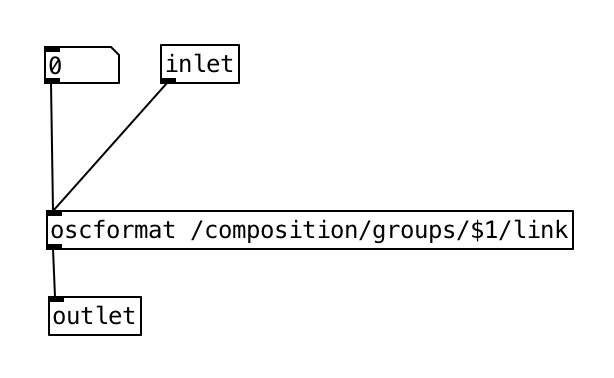
I get this osc message: ADDRESS(/composition/groups/$1/link) FLOAT(0.58)
It does not recognise the $1. I also tried packing but to no avail.
Does anyone know?
 posted in technical issues
Euclidean rhythms?
If you follow the algorithm in http://cgm.cs.mcgill.ca/~godfried/publications/banff.pdf, E(5,13) = 1001010010100, But if you use the much simpler one from @Stutter you get 1001001010010. Yes, they are the same if you ignore rotation, but in normal musical practice nobody would say they are the same--they'd say one had flipped the beat (or something). Sometimes the algorithms agree; both algorithms output the same pattern for E(3,8).
[1] Is there a base rotation for Euclidean rhythms?
[2] For arbitrary E(k,n), what is the offset between these algorithms?
 posted in patch~
get position of slider
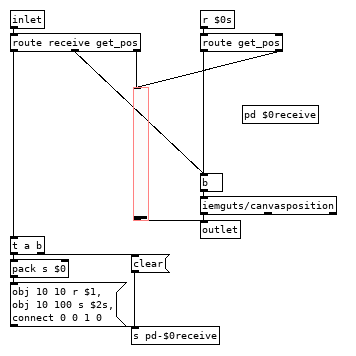
@lo94 here are the basics for using iemguts, downside is that you have to set properties through messages and you will need to save and restore those settings with [savestate]. This uses a little dynamic patching so you can also get_pos by sending to it and not just from the inlet. A vanilla way would be essentially this same patch but instead of sending a bang to [canvasposition] when it receives [get_pos( you just send it too a canvas which the vsl is sitting on top of. This canvas just needs it top left corner aligned with the top left corner of the vsl and just needs to be smaller than the width of the vsl.
It is also possible to use [iemguts/canvasobjectposition] if you know the vsl's object number, simplest way is just to make sure the vsls which you want the position of are the first objects, so before you save you copy and cut everything but the vsls and then paste everything back in, if you have 6 vsls your vsls will now be objects 0 through 5, and sending those numbers to [canvasobjectposition] will get you their position.
vsl+.pd
Edit:forgot the patch.
 posted in technical issues
Pd as an accessible programming environment?
@JoshuaACNewman said:
@ddw_music Your concerns are the opposite of those for introducing programming to kids who need to be conceptually literate in a microcontroller-saturated world.
Ohhhhh... I misunderstood the environment, my fault. I think what I said would make sense at college level, but definitely, for kids, not Java. NOT Java.
(Actually, if it's up to me, I wouldn't even subject college students to Java. I can hardly think of a better way to turn anyone off from programming.)
If they need hardcore data structures, they'll keep learning new environments and languages...
Yes and no... if the environment doesn't support rich data structures, then you might never know that they exist, and the lack of them can actually restrict the scope of questions you're able to ask. This isn't important at beginning stages, of course, but it's nice to have them around -- "huh... PriorityQueue, what's that about?" (vs Pd where I actually built a scheduler based on the priority-queue implementation from pd-container, and then someone here asked, "Well why do you need that?"  )
)
Right now, we have a society with dangerously low literacy in the machines they use all day every day. Those kids aren't all going to become computer scientists, but unless they learn that machines don't "don't want to work", but instead are following algorithmic processes that might include errors, the world is increasingly mysterious to them.
This, I 100% agree.
One thing I would note here about Pd culture is that it doesn't talk much about algorithms (except jameslo in this forum). When I have asked for resources about programming pedagogy in Pd, or tried to identify general patching patterns that can be applied to a variety of algorithms, that conversation doesn't go very far. When somebody asks e.g. how to iterate over a list, usually the answer is "giving them a fish" rather than "teaching them how to fish."
I suspect a couple of things here. One is the mystique of "it's not really programming -- it's patching" (but somehow it's just as technical and fiddly as programming). The other is perhaps a bit of a feedback loop -- if it's not really good at "standard" algorithmic thinking, then people don't do it as much, meaning its mechanisms remain underdeveloped, and so on.
This is not to say Pd is a bad choice for beginners. But, if the goal is some degree of algorithmic literacy, there's a bit of an uphill climb with patchers. Graphical patching could be excellent for pedagogy, but Max/Pd IMO are not the ideal level of abstraction for this. They both pretend to be high-level while actually requiring a lot of low-level fiddling about.
The gap between "kid languages" like Scratch and, say, Java has to do with pedagogical, philosophical blind spots in computer science, where computer scientists reproduce other computer scientists like themselves. And that means that computer science has entire areas that are underexplored, and things like Pd, SmallTalk, HyperTalk, and even Minecraft show paths not taken, with no guarantee that there are not lush forests of new kinds of understanding down those paths.
FWIW my favorite programming environment is a Smalltalk derivative (SuperCollider).
Also FWIW, I chose Pd for my college-level interactive multimedia class, even though I very much prefer SuperCollider in my own work. At least in this conservatory of music technology department, maybe 1 student per year gets into code, while 4-8 out of 50 might seriously engage with Pd/Max. I would have made my life a lot easier by forcing SuperCollider, but it was worth the effort on my part for more student engagement.
So I do get what you're saying. Students may not need hardcore programming power.
hjh
 posted in technical issues