@alexandros said:
Am I missing something, or the patch below isn't correct?
[phasor~ 1]
|
[threshold 0.5 10 0.5 10]
|
[o]
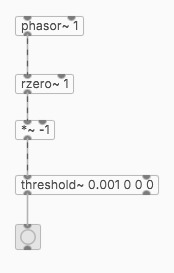
This does output a bang whenever [phasor~] resets.
Nice, provided this operates as suggested (haven't tested), this does precisely what I'm looking for.
I literally started with PD last week, so I just haven't encountered the threshold module to consider (I used Max/MSP back in the Nato.0+55+3d days, supercollider in the early 2000s, and patch modulars extensively since the Nord Modular days, but ignored PD for the most part under an impression it lacked refinement).
My aim is quite simple, embarrassingly so: I'm learning how to play back samples loaded into arrays, and wanted to test my bpm calculations after changing the phasor's speed. As a test I wanted to run a metro at the quarter note time of the new BPM, triggering a kick sample, and confirm the hits are falling where I expect them to,... but then I ran into the issue of getting my metro to start precisely in time with the looping sample (which is just freely looping endlessly via a phasor). Since the phasor~ lacked a phase output, I was stumped, and figured getting the array index = 0 = bang would be a simpler approach.
Per the randomF, the multiplicative scaling by 0.1 works, but then limits my range to 0-1. The use of a second random added to these values would fix this easily, but didn't seem as efficient as finding something that might already exist. Good to hear else has a "rand.f" (or whatever is typed above). I have this external already installed, but haven't exhaustively worked through what is included.
Thanks again, one and all.
p.s. Per the playback of arrays, I have learned a method of chopping samples with a dedicated start button using direct indexing of the slice's start in sample size values (fed as arguments into a vline module set to read from tabread4), but haven't learned how to do so when indexing via a phasor~, I suspect I'll get there in the next day or so.
The vline approach feels superior, but I'm not so sure it lends itself to rate control as easily as phasor~. Indexing via phase seems simpler too since it'll always be 0-1.