
How to use the bezier option in an array?
Arrays have an option to generate a bezier curve. In the attached patch, seven points are put into an array and displayed as a bezier curve. It looks nice, but does it have any function? When you read the array, you just get the points you put into it, not the points on the bezier curve. Is there a way to use the bezier curve as a wavetable or envelope, instead of the original seven points?
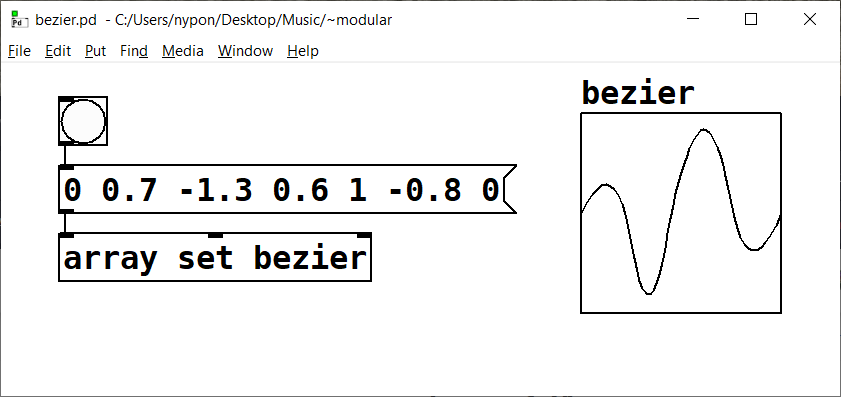
bezier.pd
 posted in technical issues
Odd behavior after saving cloned abstract
Hello all! This is my first time posting on this forum, so sorry if I did anything incorrectly.
I am trying to create a patch using modal synthesis, but I've noticed some odd behavior specifically with the sends and the bandpass filter I'm using. If I open up the clone and save it, the first time I send a bang I get a different sound from every other time I hit it. And oddly enough, I think that first time I hit it sounds better than all other times. I figure there's some under the hood processing that I'm not quite understanding. Could anyone explain to me how I can fix this issue?
Here's a quick explanation of the patch: Modal synthesis involves finding the most prominent harmonics, AKA modes, of an impulse and modeling how each one changes over time. I decided to model seven modes, so I set up three arrays with seven points. The first array sets which harmonic a given mode is on, between the first and 64th, the second sets the initial volume of each mode, and the third sets the amount of time it takes for each respective mode to decay in msec (following an attack/decay filter). The sound for each of the modes is currently a mix between an [osc~] and bandpassed noise with a very large Q.
Let me know what y'all think or if there's any other information needed.
Evelyn
 posted in technical issues
Signal logic - Clocks, Division and sequences
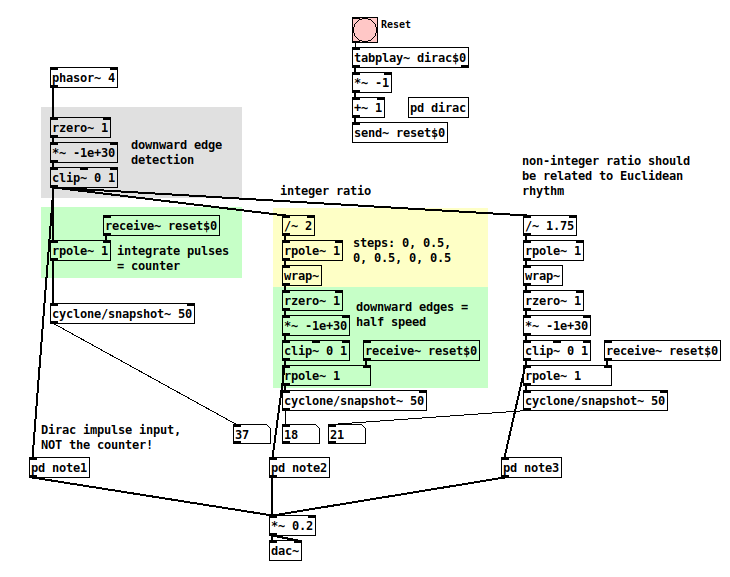
Expanded my pulse counter a bit: Dividing the pulse magnitudes, and then re-doing the edge detection works.
If the ratio is an integer, then it's more-or-less a classical modular pulse divider (though it assumes the pulses are single-sample, which [phasor~] --> {rzero~] --> multiply-and-clip does provide).
If the ratio is rational but non-integer, then you get sorta like Euclidean rhythms for free! (1.75 is producing ONE two THREE four FIVE six SEVEN ONE two ... I also tried dividing by 8/3 and got one of the standard Euclidean clave rhythms, One two three Four five six Seven eight One two three...)
hjh
 posted in technical issues
Paradigms useful for teaching Pd
Counterintuitively, this turns out to be misleading in Pd.
In Smalltalk, Javascript, etc. your list of seven integers would be a didactic example that applies to any size data structure that can fit into memory of the user's machine. The epiphany for that programmer comes when they realize they can replace those seven integers with the content of Wikipedia in its entirety.
In Pd, the epiphany starts with a stream of data coming into the patch. So you have to turn your message box 90 degrees so that it points down into the patch, with each message being sent at a different logical time.
The epiphany in Pd comes when the user learns how to efficiently analysize and synthesize the stream-- e.g., perhaps they hook into a script that sends Pd a message for every tweet that includes the string "twerk," have Pd do something in response to that message, forever to the end of time.
Iterating in zero logical time is needed, but it has severe limits on it because it happens in the DSP process. For that reason, most of the extant patches I see tend to have somewhere close to the number of list elements in your example. In other words it's no longer a didactic example, but a practical one-- in the case of your last example it's easier just to unpack the elements, test out a chain to do the mapping, then copy/paste that chain for each element and roll the overall results back into a list with [pack].
 posted in tutorials
Leap Motion Visualiser inside PD Patch
@csunflowert That's good news. Could you add the solution to your other thread please...... it could help someone in the future and that is what the forum is for.
Unsure about the possibilities for Leap motion. There are SDK's but I left university in 1974 having studied only Fortran.
There is open source softwate for the Mac for sharing video frames....... http://syphon.v002.info/ but it looks like it only provides a server for Pd....... but maybe it can talk both ways.
I have used the equivalent.... Spout....... in windows with Pd.
If you Google....... Syphon Pure Data...... you will find more info.
It was started in about 2014 I think and I don't know if it made it through the 32>64bit upheaval.
Most of what you will find will be in French.
There are a great number of French audiovisual artists and programmers using Pd for graphics.
I can help with the French if you need me, and I will try to trawl through the posts if I get the spare time...... but I have no way of testing.
Maybe you will find Syphon has been replaced by something else.
David.
 posted in I/O hardware diy
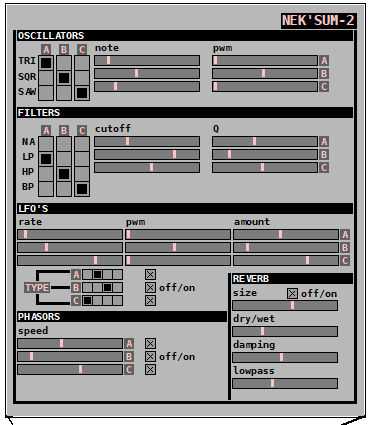
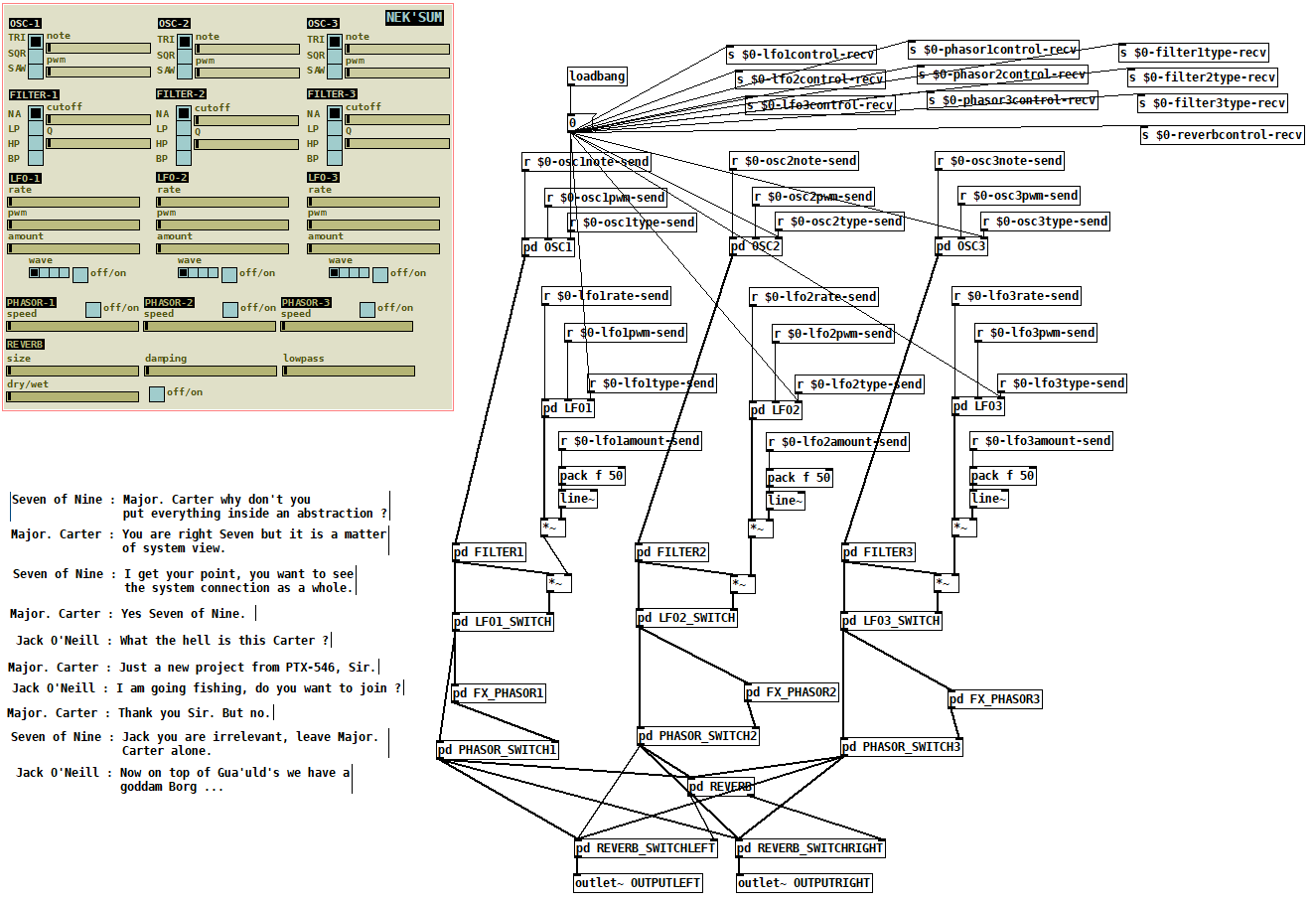
Nek'Sum - An advanced drone/texture monophonic synthesizer <- [v6.0] + // Mandarin Edition //
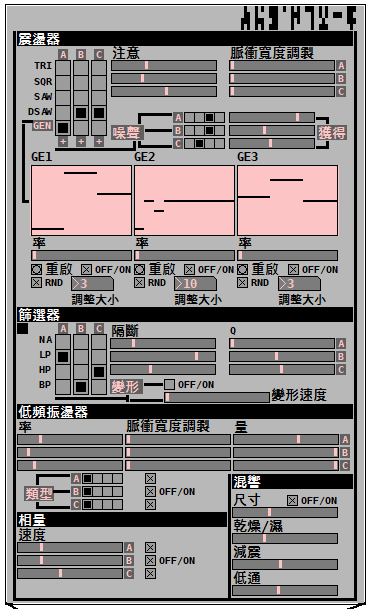
Nek'Sum-6 drone/texture monophonic synthesizer is compose of 5 stages :
First stage -> 3 main OSC with noise mixer option and generative synthesis support with 5 types of waves (tri,sqr,saw,supersaw,generative).
Second stage -> Filter stage with morph option and 4 filters types : Pass through, Lowpass, Highpass, Bandpass for the first stage.
Third stage -> 3 LFO (sin,tri,sqr,saw) modulators for the second stage.
Forth stage -> 3 Phasor's for the third stage.
Fifth stage -> 1 Deep Reverb with Lowpass filter for the forth stage.
It is capable of generating a large soundscape of drone/texture sounds inspired by The Doctor.
-UPDATE-
Thanks to Seven of Nine Nek'Sum is now at version [v6.0]
- Added Mandarin edition after cyber-brainstorming with Jade Chia-Jung [v6.0].
- Translation of the Ancient Egyption logo into obscure dialect of Anquietas language, thanks to Daniel Jackson [v6.0].
- Thanks to Nox cyberart society now the GUI is much better [v5.0].
- Added reset, randomization and resize for the generative synthesis [v5.0].
- Added generative synthesis support for each oscillator [v4.0].
- Added a noise mixer with 4 types of noise for each oscillator (orange,yellow,blue,pink) [v3.0].
- Added a morphing mechanism for filter stage [v3.0].
- This new version has a better GUI interface powered by a Borg-Casimir engine [v2.0].
-CYBERLOG-
Project manager : Oma Desala
Programming/UX design : Boran Robert Andrei
QA engineer : Anubis
Generative synthesis system design/Lead engineer : Seven of Nine
DSP engineering : Jade Chia-Jung, The Doctor
Testing/debugging system engineer : Lt. Colonel Samantha Carter
Language consultant : Daniel Jackson
Patch Download English Edition :
Nek'Sum 6.rar
Nek'Sum 5.rar
Nek'Sum 4.rar
Nek'Sum 3.rar
Nek'Sum2.rar
Nek'Sum.zip
Patch Download Mandarin Edition :
Nek'Sum 6 - Mandarin Edition.rar
Mandarin special edition :
Snapshots :
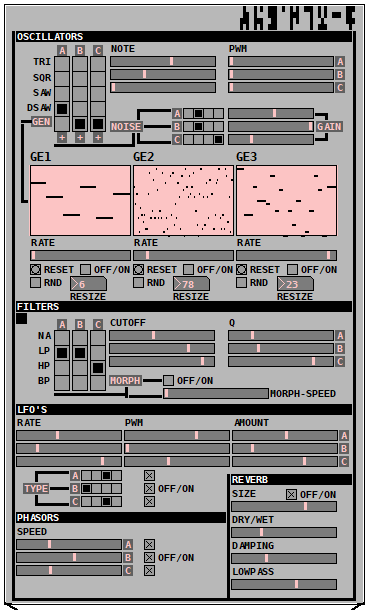
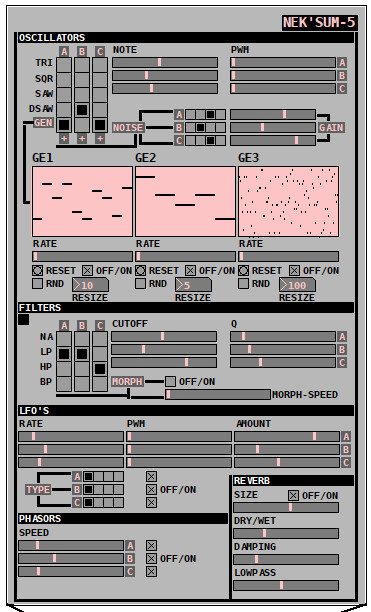
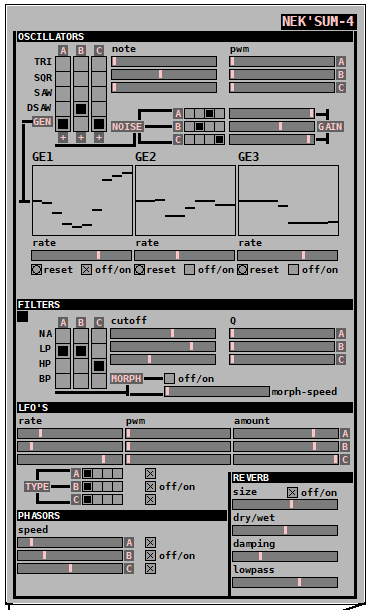
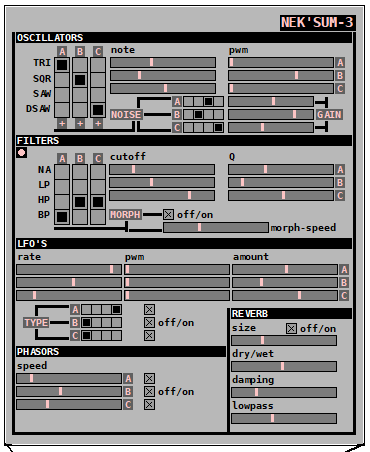
 posted in patch~
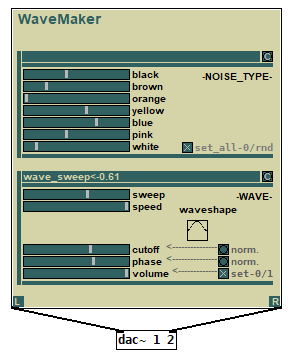
WaveMaker - A module for making waves soundscapes.
WaveMaker - is a module for making waves soundscapes using different types of filtered noise. From ocean moving waves to dark raining waves.
-- CasimirWaveMaker-2 is the third version of WaveMaker --
https://forum.pdpatchrepo.info/topic/12796/casimirwavemaker-2-module-for-making-wave-soundscapes
-- CasimirWaveMaker is the second version of WaveMaker --
https://forum.pdpatchrepo.info/topic/12791/casimirwavemaker-sequel-module-for-wavemaker-improved-by-seven-of-nine
patch download :
WaveMaker.zip
WaveMaker - snapshot :
posted in patch~
Cannot get Pyata to work
Hi,
I have tried numerous times to get Pyata to work but I have failed.
I have followed the "instructions" but they are all over the place. I have ensured that PD is executable from the command line. I tried to download as suggested (svn checkout http://pyata.googlecode.com/svn/trunk/ pyata-read-only) but that failed.
So I downloaded the source files and found a folder with the "config.properties" in it and put that in a new folder on my desktop. Inside this config file you have to change the PD_DIR which isn't there, so I guessed it was this. (PD_DIR="/Applications/Pd-0.49-1.app").
After all this I tried to run the example.pd file but it says "pd = Pd()
TypeError: 'module' object is not callable".
Please help if you can!!
 posted in technical issues
Bounce Gem Visuals to MP4
Native recording using GEM is not ideal in my experience. I think a good way to do it is using [syphon]. You can download the external for Pd then route the video to Syphon Recorder. Not exactly simple but it works.
 posted in technical issues
GEM - how to save video
@pooopsi The site has a security error....... in IExplorer I just click "ok ignore" but maybe your browser has some other way of bypassing security.
There are some objects for Spout (windows equivalent of syphon) https://puredata.info/downloads/spout-for-pd-gem (someone else might search here for that).
And for OSX...... https://puredata.info/downloads/syphon-for-pd ....... but not a stable release.
You could try VPT7........ https://groups.google.com/forum/#!topic/vpt-forum/E4ggcYU5sk4 (scroll to first post and open it) for recent versions of OSX.........
It can deal with syphon, and you can talk to it through OSC messages, Midi, DMX etc.
It is a superb video tool, that you should have on your machine anyway. No "installation" required (for windows but osx?).
Be prepared to read the detailed manual though, or you will be "lost" very quickly......
David.
posted in technical issues