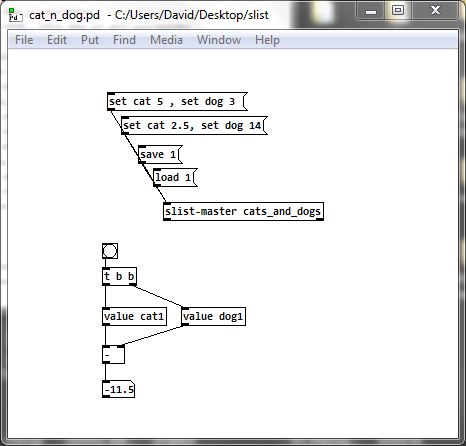
So here's what I'm thinking about. I'm not sure if this makes sense in Pd...
In SuperCollider, I can do:
s.boot;

(instrument: \something, midinote: 60, sustain: 2, amp: 0.7).play;
... and the sound comes from SC's own engine, based on a synth template named \something.
And I can also do:
MIDIClient.init;
m = MIDIOut(0).connect(0);

(type: \midi, midiout: m, midinote: 60, sustain: 2, amp: 0.7).play;
... and the same parameters midinote: 60, sustain: 2, amp: 0.7 are translated into MIDI noteon/noteoff messages, and performed by any MIDI software or hardware synth listening on that port.
A concrete benefit is: If I write some compositional algorithm and I want to decide later whether to play it within SC or using an external instrument, I don't have to change the composition logic at all. That part simply stuffs data into Event objects, and the event determines what finally happens.
In Pd, the data and the path the data take through the system are tightly coupled -- positional access to specific values is one way that this manifests, but more significantly, in a way, tight coupling is just the nature of dataflows.
So I'm wondering if this is a way to decouple: you could describe an action as a set of key-value pairs, forward the set to any event-player, and the event player would look up the data that it needs.
To some extent, you can already do this by discrete "key value" messages and [route]ing them into different parts of the player, but this isn't totally transparent: 1. If they are discrete messages, how do you know when the event is complete? Needs a sentinel. 2. [route] takes a little time to ignore irrelevant data (while a dictionary lookup would simply not look up irrelevant data). 3. If the pairs arrive out of order, math ops could be tricky, e.g. the following spits out a spurious 5 before the dog value comes through:
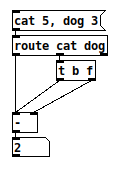
But with this hypothetical, you could control the order of access in the patch, instead of relying on well-behaved data:
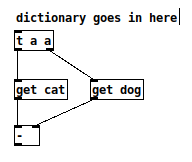
This use case suggests that a dictionary should be lightweight, like a list, easy to pass around in the system (so, different from [text] or [array]). That matches up with jancsika's use cases (passing this type of dictionary into [expr] or getting it out of [soundfiler])... but it perhaps doesn't fit easily into the current message-passing scheme.
hjh