
To Purr or not to Purr?
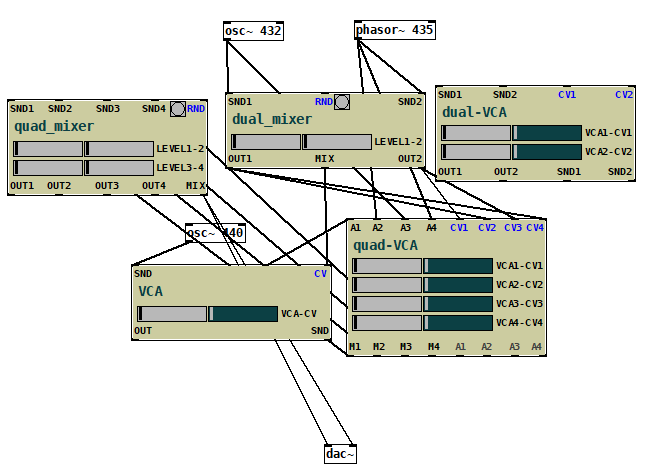
@Duckett You should start with Pure Data Vanilla first. When you know the programming language environment, then you can switch to Pure Data extended or Purr Data or Pure Data on Raspberry etc. I do not recommend jumping into a fork version of Pure Data full of many libraries because this can lead to confusion. With Pure Data Vanilla you can build externals, so you can add very complicated objects by yourself to do anything you want (but this is for a later objective). Also i recommend that you first try to use only Pure Data. Connecting Pure Data to other tools is possible but this is not fundamental. Start small and simple then go crazy and optimize and change what you know. A little note about the GUI of Pure Data Vanilla. The idea of the GUI is very smart. You can build your own GUI in a very fancy way but it requires a lot of UI knowledge (not fundamental). Here is an example snapshot of a GUI that i made with Pure Data Vanilla.
Here is something for you start with in Pure Data :
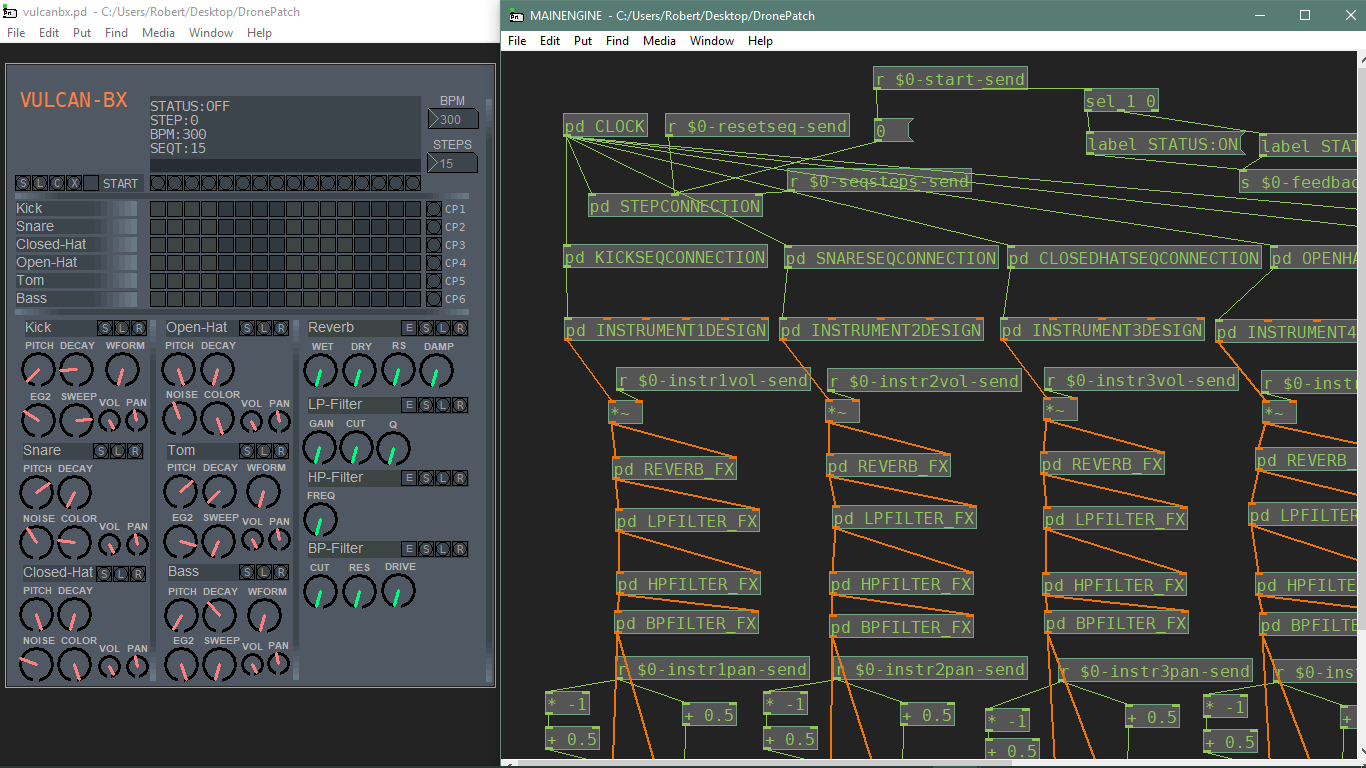
Here is a more advance GUI using Pure Data extended
You could also make this in Pure Data if you want :
 posted in technical issues
This Loop Machine (4 tracks) nearly perfect but.....
@Butahuruf I learnt "on the hoof" so I don't really have any recommendations apart from http://puredata.info/docs/manuals/pd/x2.htm (but don't even look at chapter 2.9 yet.......)
That site has a lot of other interesting pages like https://puredata.info/community/pdwiki/PdInternalMessages
and especially
https://puredata.info/dev/PdMessages
and for much later on when you understand all that
https://puredata.info/docs/developer/PdFileFormat
I should also recommend myself just once....... https://forum.pdpatchrepo.info/topic/9774/pure-data-noob/4 for understanding abstractions and $ variables in particular.
After all that you will have a good understanding of what is actually happening in Pd.... and so you will be able to read other peoples patches "easily"?..... unless they are a real mess.
Dr Hernandez made a lot of good videos (search for "Pure Data Hernandez").
The Floss manuals are good (search for "Pure Data Floss" and pick your language).
There is a lot out there.........
David.
 posted in technical issues
Purr Data on Ubuntu 18.04?
After posting about UI woes (and subsequently withdrawing that post), I started looking into Purr Data.
It appears to be quite difficult to install in Ubuntu 18.04.
At https://github.com/agraef/purr-data/releases, there is no .deb for Ubuntu 18 (only for 14 and 16). pd-l2ork-2.9.0-20190416-rev.2b3f27c-x86_64.deb fails to install:
dpkg: dependency problems prevent configuration of pd-l2ork:
 pd-l2ork depends on libgsl2; however:
  Package libgsl2 is not installed.
Ubuntu 18 does not have libgsl2. It has libgsl23 -- which is installed on my system, but does not satisfy the dependency.
https://launchpad.net/~dr-graef/+archive/ubuntu/pd-l2ork.bionic is supposedly a PPA for Ubuntu 18.04. After adding it:
$ sudo apt-get install purr-data
The following packages have unmet dependencies:
 pd-l2ork : Depends: libgsl2 but it is not installable
            Recommends: ladspa-foo-plugins but it is not going to be installed
            Recommends: slv2-jack but it is not installable
 purr-data : Depends: libavifile-0.7c2 but it is not going to be installed
             Depends: libmpeg3-2 (>= 1.8.dfsg) but it is not going to be installed
             Recommends: ladspa-foo-plugins but it is not going to be installed
E: Unmet dependencies. Try 'apt --fix-broken install' with no packages (or specify a solution).
I haven't looked into the "not going to be installed" packages, but I already know what "not installable" means -- at least, libgsl2 doesn't exist for my Ubuntu version -- https://packages.ubuntu.com/search?keywords=libgsl2 shows "Package libgsl2 -- xenial (16.04LTS)" only.
Neither agraef nor jonwwilkes' Purr Data github repositories allow issue reports (only pull requests). So I can't ask the distributors.
I guess I could try to build it myself...? But, if the currently available release packages are not really compatible with with current Ubuntu LTS, that's not a very good situation.
hjh
 posted in technical issues
Problem installing purr data on Pop_os! ( Ubuntu-based )
As a sidenote, when I usually have this problem (installing a deb I got off the internet) I can solve it 3 simple ways:
The simple method
double-click on the package file, and there is a little widget that comes up and lets you install it (and goes and finds the deps for you.)
The older, non-GUI method
sudo dpkg -i FILE.deb
# there will be errors
sudo apt-get -f install
This will grab all the deps (if they are available) and fix future apt errors.
The modern non-GUI method
You can also use the apt wrapper to do both steps:
sudo apt install ./FILE.deb
In most cases this works for things that are made for ubuntu, on Pop!OS, but in this case I get some errors (probly due to the version hard-coding):
sudo apt install ./pd-l2ork-2.9.0-20190416-rev.2b3f27c-x86_64.deb
[sudo] password for konsumer:
Reading package lists... Done
Building dependency tree
Reading state information... Done
Note, selecting 'pd-l2ork' instead of './pd-l2ork-2.9.0-20190416-rev.2b3f27c-x86_64.deb'
Some packages could not be installed. This may mean that you have
requested an impossible situation or if you are using the unstable
distribution that some required packages have not yet been created
or been moved out of Incoming.
The following information may help to resolve the situation:

The following packages have unmet dependencies:
 pd-l2ork : Depends: libgsl2 but it is not installable
            Depends: libpng12-0 (>= 1.2.13-4) but it is not installable
            Recommends: tap-plugins but it is not going to be installed
            Recommends: ladspa-foo-plugins but it is not going to be installed
            Recommends: invada-studio-plugins-ladspa but it is not going to be installed
            Recommends: blepvco but it is not going to be installed
            Recommends: swh-plugins but it is not going to be installed
            Recommends: mcp-plugins but it is not going to be installed
            Recommends: cmt but it is not going to be installed
            Recommends: blop but it is not going to be installed
            Recommends: slv2-jack but it is not installable
            Recommends: omins but it is not going to be installed
            Recommends: ubuntustudio-audio-plugins but it is not going to be installed
            Recommends: rev-plugins but it is not going to be installed
            Recommends: dssi-utils but it is not going to be installed
            Recommends: vco-plugins but it is not going to be installed
            Recommends: wah-plugins but it is not going to be installed
            Recommends: fil-plugins but it is not going to be installed
            Recommends: mda-lv2 but it is not going to be installed
E: Unable to correct problems, you have held broken packages.
 posted in technical issues
PD .48 on Raspberry Pi 3? [EDIT: updated to PD .51]
@nicnut don't know what's happend in your system. Something in your image are very very weird....
Maybe some kind of witchcraft!! 
Please confirm if all dependencies for pd compilation are installed correctly...
And your system updated, in Terminal:
sudo apt update && sudo apt upgrade
Are you using Noobs install version??? It can affect results.
If you are, I recommend to make a new image using RASPBIAN STRETCH WITH DESKTOP.
To flash it in SD card I recommend use Etcher. See the official documentation.
tar file are right.. the v argument only put tar in verbose mode...
 posted in technical issues
Problem installing purr data on Pop_os! ( Ubuntu-based )
Hi everyone,
I tried to install purr data using the last installer ( pd-l2ork-2.4.3-ubuntu_16.04-x86_64.zip ) and the setup gives me this error:
"Installation failed:
The following packages have unmet dependencies:
pd-l2ork: Depends: libgsl0ldbl but it is not installable or
libgsl2 but it is not installable
Recommends: slv2-jack but it is not installable"
i tried to install all the recommended libraries but it gives me always the same error!!
Please help me!!
 posted in technical issues
Cyclone library stopped suddenly loading (PD Vanilla/Windows 10)
@ilpoj It could be a widows10 update.
tcl ........ pd_guiprefs.tcl performs the read/writes through the "registry" object.
On a 64-bit system 32-bit apps write to the "VirtualStore" in the registry.
What is 64-bit and what is 32-bit in Pd and Tcl/Tk?
Maybe it's writing to one and reading from the other?
Tcl........ Tcl 8.6 recommended........
https://stackoverflow.com/questions/31432958/tcl-unable-to-read-variables-of-32-bit-registry-hierarchy-on-a-64-bit-machine
Widows........ Microsoft intend to bin VirtualStore and force app compatibility.....
...... have they just started this process?
https://msdn.microsoft.com/en-us/library/windows/desktop/aa965884(v=vs.85).aspx
Other software identical problem.......
http://knowledgebase.progress.com/articles/Article/UACvirtualisation
Pd_guiprefs.tcl on-going work....... 16 days ago.... maybe time to post a bug?
https://github.com/pure-data/pure-data/tree/master/tcl
Again..... Tcl 8.6 recommended.......
https://community.activestate.com/node/11350
and....
http://www.tcl.tk/cgi-bin/tct/tip/362.html
David.
posted in technical issues
PD - Plugin
Hello,
I've been working on this patch I've made for days. I am really interested in running the patch in Ableton or Logic as an Audio Unit (or VST in Ableton) but am wondering if there is a wrapper anyone knows of or can recommend that works like this. I have seen people recommending re-building the patch in Max but I am very new to Max and have had a lot of difficulty finding equivalent objects and the like. I am hoping someone can help.
Thanks in advance.
 posted in technical issues
Time Stretching Patches - any recommendations?
@whale-av http://forum.pdpatchrepo.info/topic/9909/time-stretching-patches-any-recommendations/12
Nice to hear from you again, David. Yes, I was referring to bowed contrabass, as in the example .wav I posted above: http://forum.pdpatchrepo.info/topic/9909/time-stretching-patches-any-recommendations/9
I understand now what @Johnny-Mauser was saying. As in testbass.wav, most of the samples in this library seem to have irregularities, but I can try to isolate a part that doesn't in a DAW.
@seed I didn't see your reply when posting. I'll try out your suggestions soon.
 posted in technical issues
udpsend and receive
@toddak That's a good resume...... as the Germans would say...... al ist clar....
I would recommend a separate router because it will be much easier to set up.
If for any reason it doesn't work you can borrow a spare almost immediately anywhere in the world.
Many of them (like the Linksys wrt54 series) have two aerials (diversity, more likely to get the message) and you can even plug in better aerials if you wish.
You can place it centrally to your performance space, doubling the possible size of the space.
You will be giving the Pi that you had planned to be the router less work.
Also, it might be easier to set up security so that your audience do not access your network during the show.
Yes, it's a big shame about the screens. It's a lot easier (especially when you set up for a performance) to VNC / network / putty (for windows) into them from your laptop..... and easier setting up at home as well. You can even do a remote reboot before a show if you are feeling a bit uncertain.
With vnc you can have all four of your Pi desktops on your laptop screen for control and monitoring. I would recommend setting up a vnc on them anyway for the day when you cannot get through the audience to adjust a Pi. You will need to use the X11 desktop or you will see a different desktop on your laptop from the one on your touch screen, which can be very confusing.
Through a network share you can copy/paste your patches between your laptop and the Pi's.
Through a remote terminal you can reboot / change your config files etc.
Yes, I see no reason not to switch to Jessie. Then I would put Pd-extended on the Pi's even though the extended project is not likely to evolve. There is just more stuff to play with without building externals.
OSC is great for what you want to do, so as Alexandros said, Vanilla will be ok now that osc has been added..........
For them all to receive at the same time you could broadcast to the network so they all receive the same message, or send to each Pi individually. For your current project broadcast is fine...... but if you might develop a more complex system (very likely I think) it is best to talk to them individually from the start through their individual ip addresses.
Osc messages are sent over udp, not tcp, so the sender has no idea whether the message has been received. I have never had a problem starting tracks, even on my system where there can be up to 64 musicians all adjusting their monitoring at the same time (a huge flood of osc messages). If you ever find that a Pi does not play you could set your patch to send the message two of three times in a row. The difference in start time (between Pi's) would still be less that the delays in the room that you will hear depending upon where you are sitting (with the same track on every Pi.).
I don't know the osc objects in vanilla.
In extended the easy objects for osc are...........
To receive......... [dumpOSC xxxx] where xxxx is the port number.
To send............... [packOSC] feeding it's output to [udpsend]
So with extended you would be using [udpsend].......
David.
posted in technical issues