Hi everyone,
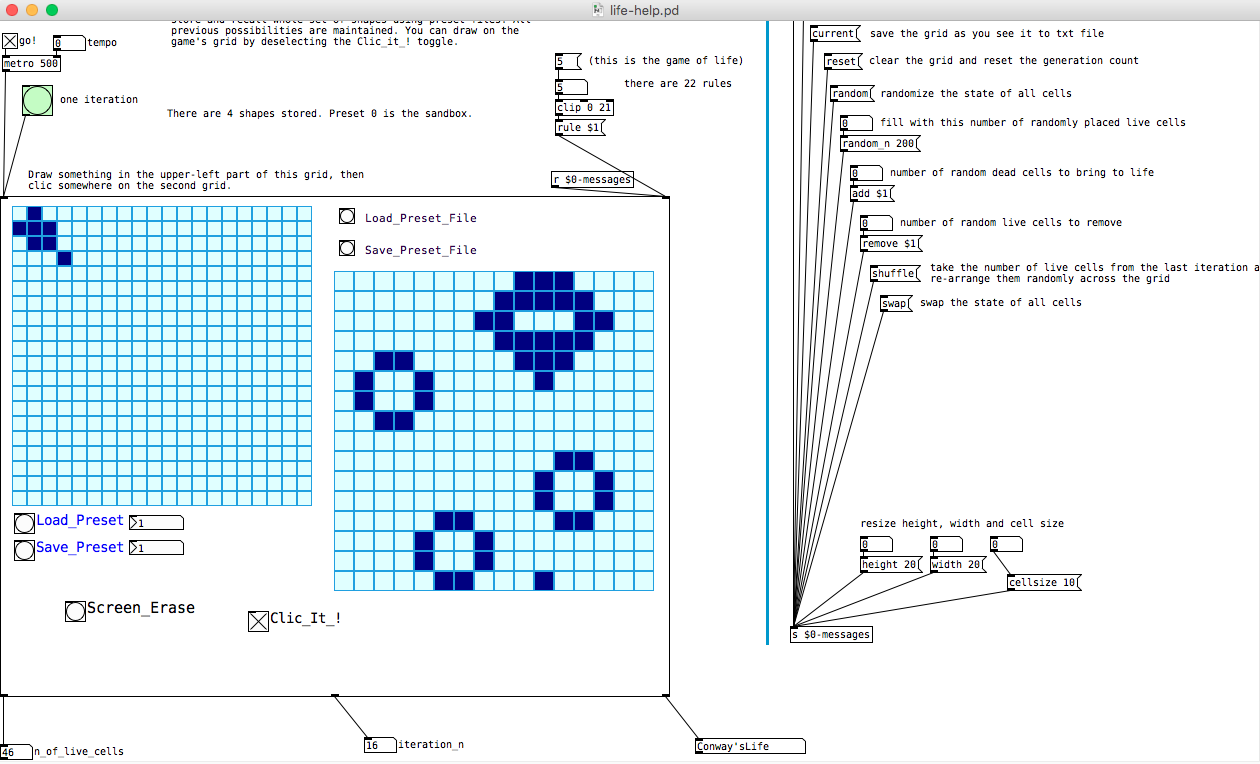
I'm aware that this has been attempted before but here's my take on implementing Conway's Game of Life using data structures. It's resizable and has outlets for values which I think are meaningful. The initial state is set by clicking some cells, and new cells can be added or removed at any time and will be included in the calculation for the next generation. It works with Pd 0.47.1 vanilla although it uses some abstractions from list-abs.
One hiccup with this implementation is that the bigger the gird the slower it is at updating the cells, so much so that for some big size/high speed combinations it's very sluggish indeed and borderline unusable, despite cpu levels being close to zero. I suspect this is due to the constant update of lots of scalars, but I have no experience with this.
UPDATE: the latest working patch v2.0 is a few posts down
A big thanks to @Jona who's helped me developing this, as well as everybody else who's given me advice on the topic. I've got to say that for a first project with data structures I definitely could've gone for something simpler, but I'm happy with the way it's turned out and I've learnt a lot.
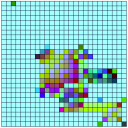




 i think you are right, you can achieve the same result with toggles and dynamic patching. i think we even started to patch with the toggle method before discovering data structures. i think data structures are still a little bit more efficient than toggles, but maybe i am wrong. they store the graphical and the visual representation at once and they can work like an array and each field is one element of the array. perhaps they are also more efficient because they carry less information, its only a pixel at a position with a color. we were exploring data structures at that time and the graphical side of the patch is roughly based on