
Analyzing & Synthesizing a Cowbell
I'm having a hard time with one of Farnell's exercises. In Chapter 29 of Designing Sound, he shows you how to synthesize an old telephone bell and in Exercise 2 he says to do your own analysis of tubular bells, cowbells or Tibeten singing bowls. I chose cowbell and found a sample online. I had it analyzed in SPEAR and Sonic Visualizer:
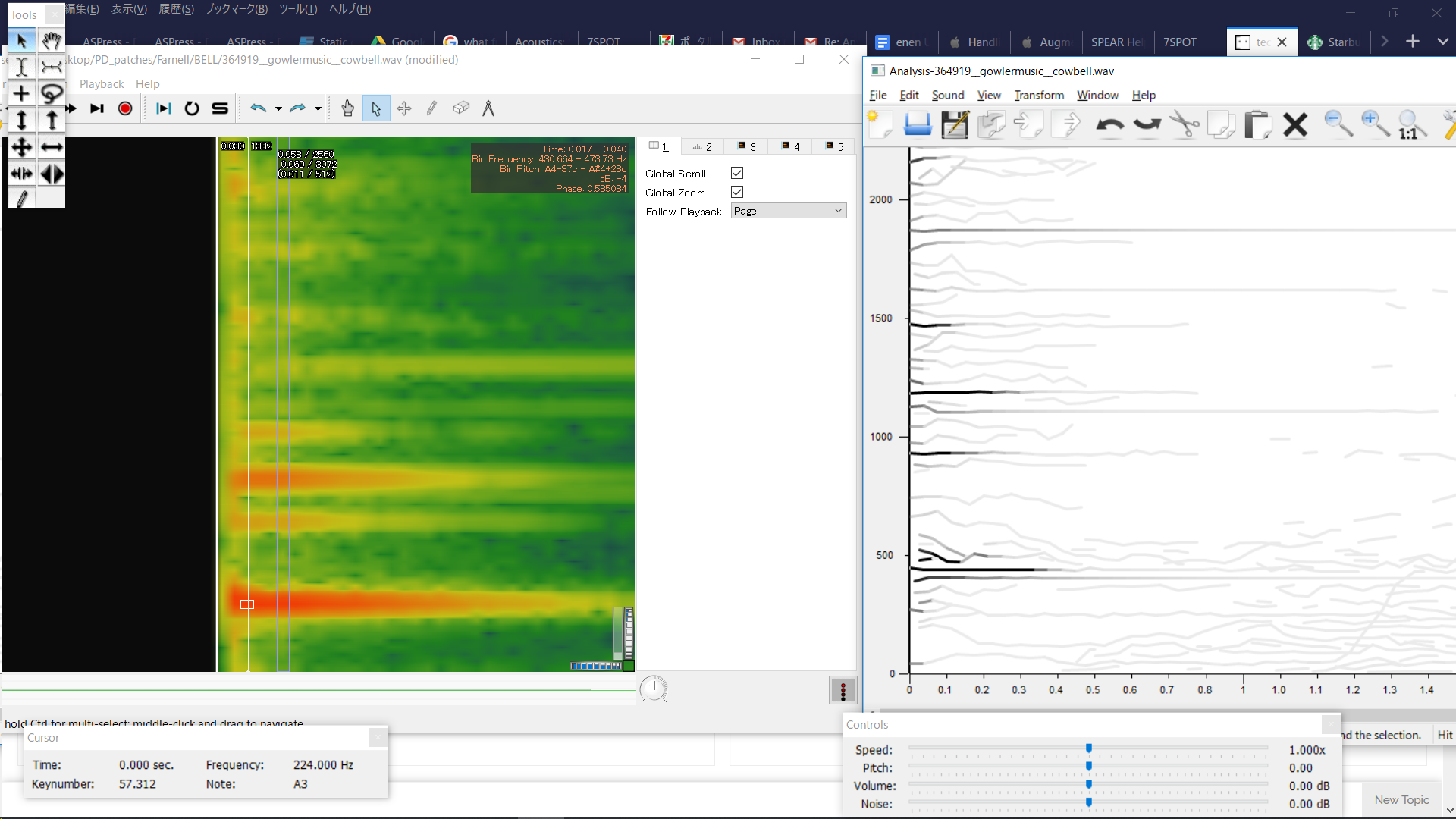
In SPEAR, some frequencies stand out more than others, which seems helpful- however, the analysis lacks detail and there's very little information about amplitudes of frequencies.
In Sonic Visualizer, there's more information, but when I see these thick vertical bands of frequencies, I'm not sure what to do- make very thick clusters with oscillators? That would mean using a lot more oscillators than are in the telephone bell patch and doesn't seem in line with the methodology set forth in the telephone bell patch. I've never used Sonic Visualizer, so it's possible I'm using the wrong analysis layer.
This zip-file contains the following two patches + necessary abstractions:
cowbell - the main patch of my resynthesis. It also has the cowbell sample in an array for comparison.
telephoneBell- Farnell's original patch synthesizing a telephone bell.
For my resynthesis, I mostly chose frequencies based on the SPEAR analysis and then looked up their amplitude with the Sonic Visualizer analysis. I also made the dynamic envelopes steeper than in the telephone bell patch. I can hear that it's wrong, and doing a rudimentary spectral comparison in PD shows that in the model file, there's much more amplitude around the 430Hz and the 1100Hz range. I'm just not sure how to derive the proper values from an analysis and where within those frequency ranges (the thick red-orange lines) I should be placing the oscillators..
Could anyone give me suggestions on how to go about this analysis/resynthesis? I've been fiddling with this/trying different things too long already and feel like I'm not getting anywhere.
 posted in technical issues
Problem loading libraries (iemguts)
Eighteen-year-old Shen Qiang says he soon thereafter began winning Canadian contests, and came in Canada in 2004. He will be a proud representative of the Canadian Olympic team this summer. While he didn't immigrate explicitly to further his table tennis career (he came with his family, who live in Toronto), he's happy with Table Tennis Canada's sports app, and is looking forward to the autumn opening of this new 24-hour training centre in Ottawa, so that he can work harder on his sport. Produced in northeast China, Shen first picked up a paddle at nine. He quit college to proceed to Harbin, a town 300 kilometers away, to train full-time and represent the province of Heilongjiang and had left home. The contest in China was extremely intense, '' he states. https://ok.ru/group/53953306755154/ The athletes trained five days a week, six hours a day; they were paid to train fulltime and compete, he says. "In China, it is very competitive because in the event you do not make results then you will be removed from the team, and if you don't have table tennis without a school, there is no future for you."
 posted in technical issues
using movie sound with pix_film
@milzyboo Hello.......
You will need to strip the sound from the video with a free tool like http://www.squared5.com/ as of course [pix_film] has no audio component......... and then the next problem is sync between the audio and the video.
Here is a patch I built that should do the job......
You will need to convert the audio track to a wrapper that can be read by Pd... "wav" or?
av-sync.pd
av sync.zip
David.
(p.s. if you are using vanilla then you will need to find another way to set the sample-rate for the audio part of the patch unless you can get the [soundfile_info] object to work.)
 posted in technical issues
Resize an array while playing without hearing stops
No, that's not my my problem. I'll explain it better.
I'm using Pure Data to manage external software, which creates a song progressively, splitted into different wav files. As soon as it creates a new wav file, I load it into an array. The idea is to start playing the song without waiting until it's completely created.
For doing it, I have two arrays: one for loading the latest wav file, and another one for loading the whole song, by copying the content of the first array.
I play the content of the second array, while new parts of the song are being added to it.
 posted in technical issues
Normal Dotted Triplet? how can i know whats what ?
If I'm not mistaken, DIY2's LFO syncs by setting the bpm in the right inlet, then banging the left inlet on the beat to sync it up. It syncs up to the beat. So if you want it to sync to bars instead, just divide the beats per minute by the number of beats per bar, and you end up with bars per minute.
I don't know if this will help or not, but I used to struggle with converting units, and understanding this helped me out a lot. When you see something like "120 beats PER minute", that "per" is like a fraction for units. So it can also be read as:
120 beats
1 minute
Units cancel out in fractions just like numbers, and division is the same as multiplying by the inversion, so:
120 beats 4 beats 120 beats 1 bars 120 beats * 1 bar
------------ / ----------- = ------------- * ----------- = ---------------------
1 minute 1 bar 1 minutes 4 beats 4 beats * 1 minute
"beats" are in the numerator and denominator, so they cancel, and so do the 1's,
120 bars
----------------- = 30 bars/minute
4 minutes
 posted in technical issues
Compiled external saying "couldn't create" when being added to PD
Greetings All
I'm having trouble getting my external to work, It compiles with 5 warnings
sineq.c:48: warning: unused variable ‘x’
sineq.c:49: warning: unused variable ‘in1’
sineq.c:50: warning: unused variable ‘in2’
sineq.c:51: warning: unused variable ‘in3’
sineq.c:52: warning: unused variable ‘in4’
It does a "make" successfully but I get this warning message
/usr/bin/ld: warning: cannot find entry symbol xport_dynamic; defaulting to 00000000000007f0
but when I try and add it in PD it says "couldn't create". I've looked at the pan~ tutorial and the d_osc.c file as recommended, which did help. I tried to take pieces from the two which I thought were applicable to my situation but I'm still having some issues.
Here's a link to the workflow (dropbox)
http://dl.dropbox.com/u/6576402/questions/pd/Sine_EQ_Diagram.jpg

Here's a link to the C code online (pastebin)
http://pastebin.com/9rK3szUE
My external is a reproduction of the sinewave equation with 4 inputs and one output my logic is to have 4 inlets one for the frequency,amplitude,phase and vertical offset and an output for the created signal. Granted this isn't the final equation but this will help me understand how to create the full equation once done. If you want to see the full equation I'll be using here's a link to it below. Basically it's a 1 second periodic signal with the sample rate at 44100 which the equation gives me control over the frequency,amplitude,phase and vertical offset.
Another question I have is what do I use for the t (time) for my final equation is that the t_sample object in PD? or do I need to create a for loop counting from 1-44100 for a 1 second 44100 sampled equation?
http://dl.dropbox.com/u/6576402/questions/eq1.txt
PS: I'm compiling on ubuntu 10.04 using gcc
 posted in technical issues
Problem with syncing audio loops
hey guys!
okay, I am using readanysf~ extension to open sound files. I created a looper abstraction.
Then I have created several loopers in a patch. Each looper has an inlet which allows to start playback and stop playback.
Let's say I have two samples: hihats and base drum. Both were recorded at 130 bpm and saved to wav files. In order to sync them on other software I would use something to trigger those files at the same time and they would be in perfect sync forever.
In this patch I've done the same thing - notice the play all button. So I load these two files into two loopers and then trigger them with play all. First 4-5 rounds loops are in sync, but then they begin to go out of sync.
The interesting thing is that if you load same file into different loopers and trigger them - they will NEVER go out of sync.
So I was wondering if I am missing something, maybe some inner workings of Pd which make audio files go out of sync.
Patch attached. Open TapeLoops16.pd
 posted in technical issues
Sysex
Hi,
im having some problems with audio in Pd. Im running extended 0.42.5 in Linux and midi is not working. The midi out test in the "midi and audio test" does not make any sound. This errors ocurrs in the inicialization:
audio I/O error history:
seconds ago error type
2.90 A/D/A sync
2.90 A/D/A sync
2.96 A/D/A sync
2.96 A/D/A sync
2.96 A/D/A sync
2.96 A/D/A sync
2.96 DAC blocked
2.96 A/D/A sync
2.96 unknown
2.96 unknown
does someone knows what is going wrong?
thanks in advance,
 posted in technical issues
\[zerox~\]
Well, the result of that would be equatable to
[phasor 880]
|
[*0.5]
The catch with the sync is that there's basically always a more efficient alternative.
If you want a construct that's equatable to
bang X frequency X times a second
you could use phase-sync.mmb.pd and add two frequency controls that calculate the ratio between the two. Then feed the phasor~ with the first frequency and send the ratio to the *~
so
frequency 1 = 440
frequency 2 = 880
440/880 = 0.5
send frequency 2 to [phasor~] and 0.5 to [*~]
like above
you don't lose anything by driving this construct with control messages or with audio rate control. The considerations are only superficially different than using bang.
It's been a while since I've looked at phase-sync.mmb.pd, so it might do this already.
If you're interested in using sync as an oscillator feature,
if you can understand this, I personally can't digest it:
http://citeseerx.ist.psu.edu/viewdoc/download?doi=10.1.1.65.1036&rep=rep1&type=pdf
otherwise, casio-style is handy:
http://en.wikipedia.org/wiki/File:Casio.CZ101.resonance.png

and if you're okay with the licencing implications, there are objects in extended that offer competent band limited sync. I forget the name, but the group that I'm thinking of has sync saw and a band limited comparator for PWM and square sync.
 posted in technical issues
DJ/VJ scratching system
First my story: (you can skip down to END OF STORY if you want)
Ever since I saw Mike Relm go to town with a DVDJ, I've wanted a system where I could scratch and cue video. However, I haven't wanted to spend the $2500 for a DVDJ. As I was researching, I found a number of different systems. I am not a DJ by trade, so to get a system like Traktor or Serrato with their video modules plus turntables plus hardware plus a DJ mixer, soon everything gets really expensive. But in looking around, I found the Ms.Pinky system and after a little bit, I found a USB turntable on Woot for $60. So I bought it. It was marketed as a DJ turntable, but I knew that it wasn't really serious since it had a belt drive, but it came with a slip-pad and the USB connection meant that I wouldn't need a preamp. And so I spend the $100 on the Ms.Pinky vinyl plus software license (now only $80). This worked decently, but I had a lot of trouble really getting it totally on point. The relative mode worked well, but sometimes would skip if I scratched too vigorously. The absolute mode I couldn't get to work at all. After reading a little more, I came to the conclusion that my signal from vinyl to computer just wasn't strong enough, so I would need maybe a new needle or maybe a different turntable and I didn't really want to spend the money experimenting. I think that the Ms. Pinky system is probably a very good system with the right equipment, but I don't do this professionally, so I don't want to spend the loot on a system.
Earlier, before I bought Ms.Pinky (about two years ago), I had also looked around for a cheap MIDI USB DJ controller and not found one. Well, about a month ago, I saw the ION Discover DJ controller was on sale at Bed, Bath & Beyond for $50. They sold out before I could get one, but Vann's was selling it for $70, so I decided that that was good enough and bought one. I had planned to try to use it with Ms. Pinky since you can hook up MIDI controllers to it. But it turns out that you can hook up MIDI controllers to every control except the turntable, so that was a no go. If I had Max/MSP/Jitter, I could have changed that, but that's also way expensive. So, how should I scratch? My controller came with DJ'ing software and there's also some freeware, like Mixxx, but none of this has video support. So I look around and find Pure Data and GEM.
And I see lots of questions about scratching, how to do it. And there are even some tutorials and small patches out there, but as I look at them, none of them are quite what I'm looking for. The YouTube tutorial is really problematic because it's no good at all for scratching a song. It can create a scratching sound for a small sample, but it's taking the turntable's speed and using that as the position in the sample. If you did that with a longer song, it wouldn't even sound like a scratch. And then there are some which do work right, but none of them keep track of where you are in the playback. So, whenever you start scratching, you're starting from the beginning of the song or the middle.
So, I looked at all this and I said, "Hey, I can do this. I've got my spring break coming up. Looking at how easy PD looks and how much other good (if imperfect) work other people have done, I bet that I could build a good system for audio and video scratching within a week." And, I have.
END OF STORY
So that's what I'm presenting to you, my free audio and video scratching system in Pure Data (Pd-extended, really). I use the name DJ Lease Def, so it's the Lease Def DJ system. It's not quite perfect because it loads its samples into tables using soundfiler which means that it has a huge delay when you load a new file during which the whole thing goes silent. I am unhappy about this, but unsure how to fix it. Otherwise, it's pretty nifty. Anyway, rather than be one big patch, it relies on a system of patches which work with each other. Each of the different parts will come in several versions and you can choose which one you want to use and load up the different parts and they should work together correctly. Right now, for most of the parts there's only one version, but I'll be adding others later.
There's a more detailed instruction manual in the .zip file, but the summary is that you load:
the engine (only one version right now): loads the files, does the actual signal processing and playback
one control patch (three versions to choose from currently, two GUI versions and a MIDI version specific to the Ion Discover DJ): is used to do most of the controlling of the engine other than loading files such as scratching, fading, adjusting volume, etc.
zero or one cueing patch (one version, optional): manages the controls for jumping around to different points in songs
zero or one net patch (one version: video playback): does some sort of add-on. Will probably most commonly be used for video. The net patches have to run in a separate instance of Pd-extended and they listen for signals from the engine via local UDP packets. This is set-up this way because when the audio and video tried to run in the same instance, I would get periodic little pops, clicks, and other unsmoothnesses. The audio part renders 1000 times per second for maximum fidelity, but the video part only renders like 30 or 60 times per second. Pure Data is not quite smooth enough to handle this in a clever real-time multithreading manner to ensure that they both always get their time slices. But you put them in separate processes, it all works fine.
So, anyway, it's real scratching beginning exactly where you were in playing the song and when you stop scratching it picks up just where you left off, you can set and jump to cue points, and it does video which will follow right along with both the scratching and cuing. So I'm pretty proud of it. The downsides are that you have to separate the audio and video files, that the audio has to be uncompressed aiff or wav (and that loading a new file pauses everything for like 10 seconds), that for really smooth video when you're scratching or playing backwards you have to encode it with a codec with no inter-frame encoding such as MJPEG, which results in bigger video files (but the playback scratches perfectly as a result).
So anyway, check it out, let me know what you think. If you have any questions or feedback please share. If anyone wants to build control patches for other MIDI hardware, please do and share them with me. I'd be glad to include them in the download. The different patches communicate using send and receive with a standard set of symbols. I've included documentation about what the expected symbols and values are. Also, if anyone wants me to write patches for some piece of hardware that you have, if you can give me one, I'll be glad to do it.
Keith Irwin (DJ Lease Def)
 posted in patch~