
Playing sound files based on numbers/sets of numbers?
@whale-av Hello, first I just want to say thank you very much for your help and sorry for not replying sooner, I read all the messages, I just didn't want to bother people before I had an actual issue or a question that I understood enough to know how to ask what to do next. So that's why I'm only replying now. And you're totally right, I have suffered and learned in the past day so my brain's kind of all over the place right now, I'm still struggling to get the hang of this and really understand the patches you sent me (thank you so much for taking the time to make them for me!).
To answer your questions, I will not be assessed for this part of the project, it doesn't matter much how I do it as long as it works because no one will look at the project anyway, the end result is what matters in this case. The only "limitation" is that it has to be done in Pd. Also, my version of Pd is Vanilla (I'm assuming that doesn't change your patch much since you said it'd work in that version), and actually no, there's not really a next stage to this project; all I'm supposed to do is get my sound files to play in a loop when I press Enter (after I've typed all my numbers) and to be able to stop the loop again with Enter. I probably should have mentioned that oops, does that mean I need another keyup object or would the one in the patch work for both starting and stopping the sound?
I actually had a patch of my own but it was very simple and mostly improvised based on what I managed to learn (like I said, completely new to this) and nothing like yours so it probably wouldn't have worked anyway... Is it ok if I use your patch as a starting point? If it is, I'm assuming the next step would be the abstractions. From what I understand, abstractions are used for referencing and reusing old patches in order to keep the new patch clean and not messy. I do need something like that, as I have 17 wav files ready to use. But not all 17 should be used in one loop. I actually only need 5 sound files per loop (like in your patch), but the total number of files I can choose from is 17. To be able to tell the program which file to play based on its corresponding number I probably need the select object, right? Would I need it within the calling patch or the patch being called, a.k.a. abstraction (if my thinking is right, it's probably the calling patch)? There's probably an easier way to do this than an x number of select objects but I'm just not familiar enough with the program, sorry... Also, what difference does it make if it's not 1-digit numbers, but 2-digit, 3-digit and 4-digit combinations? To be more precise, the first, second and fourth sound file should correspond to a 2-digit number, the third to a 3-digit number, and the fifth to a 4-digit number (and I can't change this unfortunately, it's part of the task).
Oh, and is there a way I can make this work on any computer, for example if I copy my files onto a flash drive? Or if I can't, would it drastically affect my main patch if I changed the sound file destinations later, once I know what computer is going to be doing all this? Would I need to change the file destinations in all the patches or would it be possible to do so automatically via abstractions, by changing them in the main patch only (probably not but eh I asked...)?
This is all probably waaay too advanced for a beginner (and I have no idea why they'd give me this task without any prior preparation.......) so I realize I might be asking for too much here, and maybe I'm getting ahead of myself, but I still hope you could give some advice on what to do from here, what's the next step, the elements I need to get this done etc. I'm not in too much hurry, I have time until the 5th of February, so it's ok if you don't have the time for me right now, I can wait a bit!
Thank you so so so much, even just sending me the first patch was such a huge help, thank you! And I hope you can guide me through this for a bit longer!
 posted in tutorials
Pure Data noob
Ok...... So I have been meaning to do this for a very long time......
I don't think it is the perfect "show_me_dollars" and so I will change it from time to time.
3rd attempt.........
show_me_dollars.zip
Here is a really terrifying screenshot, but I have also tried to explain it in words.
In many ways I think words ( below the screenshot) are easier to understand.
David.
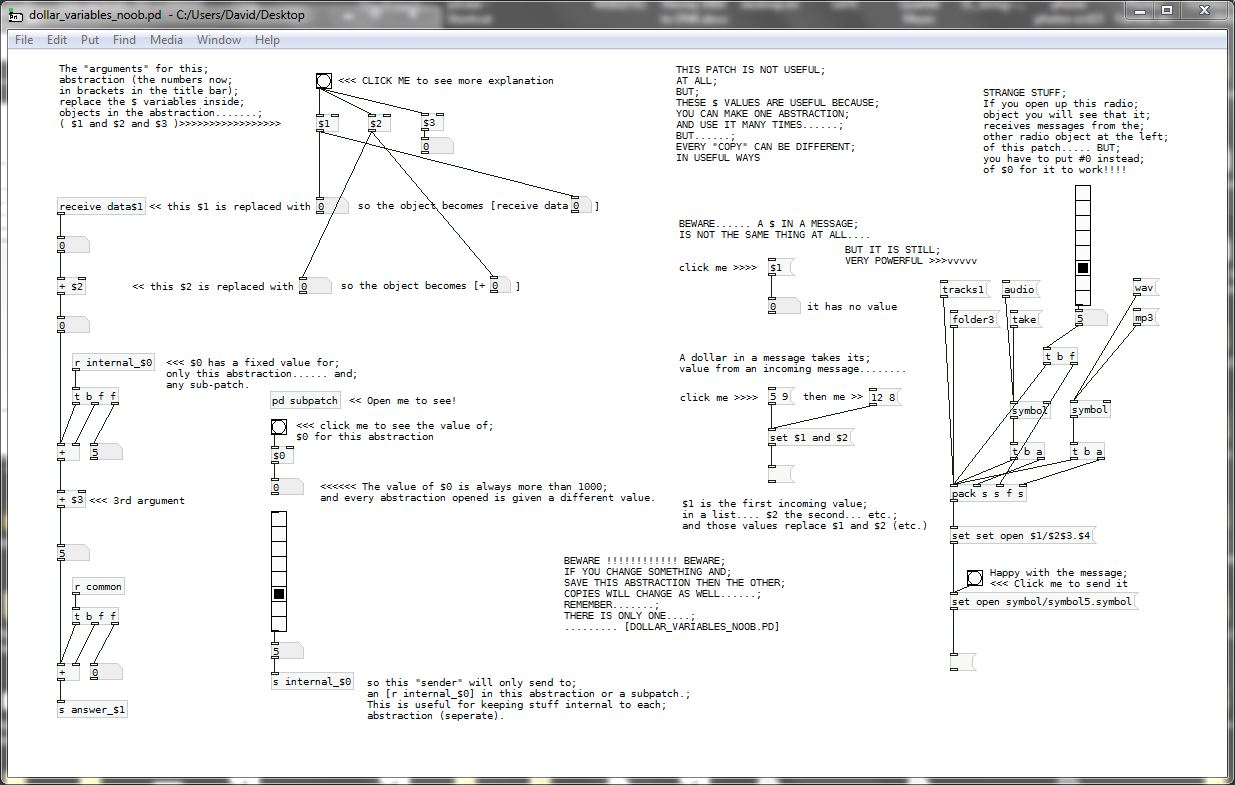
Dollar $ variables in Pure Data patches.
A dollar variable is a thing that can be given a new value.
The new value can be a float or a symbol.
- If the Dollar variable is in an [object] box
A Pd patch can be saved and used inside another patch. We then call it an abstraction.... and it is just like a programming sub-routine.
If you want to use it many times then you have a problem, that they are all the same, so if you put an object [receive woof] they will all receive any message that you send with [send woof].
That might well be what you want to do.
But what if you want to send the message to only one of them?
You can give it an [inlet], but your patch will get messy, and what if your patch needs to make its own mind up about which abstraction it wants to send the message to, maybe depending on which midi note it received?
The solution is to give the abstraction arguments... some parameters that define it and make it different to the other copies.
For example [my_abstraction]
Let’s give it some arguments [my_abstraction 5 9 woof]
Inside the abstraction, as it is created (you open its parent patch) the dollar variables will be replaced. Wherever you see $1 written IN AN OBJECT it has been replaced by the number 5.
Number 5 because 5 is the first argument and has actually replaced the $1. You still see $1, but if you bang a [$1] object it will output 5.
[f $2] will output 9
[symbol $3] will output woof
So if you have an object [receive $1-$3] then it has now become [receive 5-woof]
And if you want to send it a message from outside, from another patch or abstraction, you will need to use [send 5-woof]
Every Pd patch, which remember includes your abstractions, also has a secret number. The number is unique and greater than 1000. As Pd opens each patch it gives it the number, increased by one from the last number it gave.
That number will replace $0 as the patch is created. You can find out what the number is by banging a [$0] object and connecting its output to a number box, or [print] object.
$0 can be used in any object as part of the name or the address, which means that a message cannot escape from the abstraction. A sub-patch like [pd my-subpatch] will be given the same number.
But from outside your abstraction you don’t know what it will be when the patch is created, so it is not useful. (A lie, you can find out, but as it can change every time you open your patch it is not worth the bother).
Use it to send messages within your patch [send $0-reset] to [receive $0-reset] for example, because the message is absolutely unique to its window, so you know it cannot interfere with other abstractions.
Use it also for objects like [delwrite~ $0-buffer 100] or for an array name [array $0-array] so that in each abstraction they have a different name and you will not have problems with their being "multiply defined"...... as each name can only exist once in your patch.
- If the Dollar $ variable is in a [message( box
Dollar $ variables are also replaced, but not as the patch is created (drawn by Pd as you open it).
Dollar zero $0 has no meaning in a message box. It will produce a zero if the message is banged, but that is it.
It is a mistake, a patching error, to put a $0 in a message box.
$1 $2 $3 $4 etc. in a message box are replaced by incoming atoms (individual floats or symbols or whatever) when they arrive. $1 will be replaced by the first atom in the list, $2 the second etc.
So if you have a message box [$1 $2 $3( ..... and you send into it a list [3 48 lala( .....then it will output 3 48 lala
That is not really very useful.
But it is actually very powerful.
Make a list in a message box........ [33 12 wav(
And bang it into a message box [open my-track$2-$1.$3( and you will get the output.........
open my-track12-33.wav
Which could be just the message that you want to send to [soundfiler]
P.S. If the first item in the incoming list is a symbol then it will be dropped causing errors.
You can fix that by making the message a list by passing it through the object [list].
Unfortunately only messages starting with a float are automatically recognised as lists.
 posted in tutorials
Psychedellic Audioguide using MobMuPlat or PdParty
Hello,
I make psychedelic audioadventures, guiding multiple, synchronized people with headphones into wonderlandish stories. Sometimes leading them to crazy places that I acoustically augment with soundtracks and binaural stereorecordings from the exact places where people walk bye to create pré- and déjà-vu-ish time-flashs (iE you hear the door infront of you and the white, invisible rabbit tells you that you are too late - so you open the door, hear/feel the exact sound again...and again…). Using synchronized instructions I puppeteer multiple participants into interactions.
I used to manually synch multiple mp3-players but also worked with free gps-audioguide software. Also I have a little yet not perfect web-app-flasmobgenerator to synchronize up to an infinite amount of players with individual audio streams.
One of my biggest inspirations was the RjDj-app that was released at the beginning of the iTimes but sadly shortly after taken from the app store - and now after all this years I finally discovered the Mobmuplat and PdParty-apps and the possibility to not only play the old RjDj-scenes but also to modify them …so I decided to learn some PD! ..which is really not easy at the very beginning, but it literally opens worlds and my brain is working hard to understand all this amazing scenes and different patches out there…
First I really want to thank you from my heart for all this amazing and inspiring works - especially for sharing it! This makes me so very happy and I feel this is really the way it should be (well, a little easier maybe)!
2nd I want to apologize for my questions - i feel still so stupid PD-wise…but:
I am trying to learn how to port a PD-patch to MobMuPlat or PdParty.
Mainly I try to trigger recordings, playbacks and live-effects by a clock.
https://dl.dropboxusercontent.com/u/2643812/AlicePD.pdAlicePD.pd
Today I managed to write a patch that records two samples (A and  and to plays them back later in a different order (BA).
I found a way to let the sec counter trigger a bang to the recordings/playbacks but I still don´t know how I could add the minutes into that trigger (iE record at 3m14s for 10s)?
In one of the tutorials I´ve heard that there are different ways to record sound: one to memory and one to disk and that a disk recording might stop audio playbacks?
How could I timetrigger live-effects - iE at 4m33s the reverb for the mic-in slowly gets bigger for 1min and then fades back to normal // or the same with a delay // or with a voicepitch rising or falling // or with the volume of the unfiltered live-monitoring (adc~ -> day~) or the volume of the audiofile that plays back simultaneously ->
Is there any way to play back an mp3/or Ogg-file with PdParty or MobMuPlat? I found some unofficial patches that seem to be able to let PD stream shoutcast/or icecast mp3-streams and also sth related to ogg(unofficial), but I don´t really understand if it is possible - and HOW? And on MubMuPlat/PdParty?? It´s just that I can´t put an 1hr wav-file onto peoples iThing.
I found a LANdini tutorial patch and an Ableton-link-patch and now I am wondering if i could somehow synch multiple phones at the same time to play back different audio files at each device while applying 1. /2. and 3. …and if it is maybe even somehow possible to do that via web?!
I am a bit confused about using PD-extended or unofficial or 0.47xyz(vanilla?) …Which one is better to use for the MobMuplat/PdParty development? PdParty seems to name several objects differently, which doesn’t´t allow me to run/test the scenes on my Mac - is there any editor or sth like->
I found an old app from the RjDj development: RJC-1000, but I can´t make it work. Anyone managed to use this app? It seems so much easier then MobMuPlat-editor(+PDwrapper) to connect the patches with a user interface. Did anyone managed to create a working MobMuPlat-interface? I couldn’t´t find any tutorials on that. Would be so great to understand that part.
I also found several scenes and patches that make use of the GPS-data and I would love to learn more about that and understand those patches to use GPS as triggers for my Audiotours. Is there anyone who could help me or maybe even make a tutorial on that?
Last but not least: when switching between apps (macSierra) with cmd+tab to PD (extended and 0.47, too) I have to do it everytime twice …drives me really mad - anyone has the same problem or any idea how to solve this ?!
Is there anyone in Berlin who I could meet to learn sth?
Thank you all for your help and if you come to Berlin one day, please let me guide you to Wonderland!
BÄm
 posted in technical issues
libpd on mac: clarification requested on expected behavior of cpp sample
Thanks for those links Monetus. I'm pretty close with my existing setup and will first try to work with that when I have some more time. Some of the output from the samples/cpp/pdtest appears to be as expected.
However, from main.cpp
    cout << endl << "BEGIN Patch Test" << endl;

    // open patch
    Patch patch = pd.openPatch("pd/test.pd", ".");
    cout << patch << endl;

    // close patch
    pd.closePatch(patch);
    cout << patch << endl;

    // open patch again
    patch = pd.openPatch(patch);
    cout << patch << endl;

    // process any received messages
    //
    // in a normal case (not a test like this), you would call this in
    // your application main loop
    pd.processFloat(1, inbuf, outbuf);
    pd.receiveMessages();

    cout << "FINISH Patch Test" << endl;
the response
BEGIN Patch Test
Patch: "pd/test.pd" $0: 1003 valid: 1
Patch: "pd/test.pd" $0: 0 valid: 0
Patch: "pd/test.pd" $0: 1005 valid: 1
PD: PATCH OPENED: 1003
print: 0
PD: PATCH OPENED: 1005
print: 0
FINISH Patch Test
seems right but no patch was opened and if I already opened that patch before running the executable, none of the print messages (called later in the code) showed up in the console of pd. I'll focus on this and try to repost to the forum when I have a better idea of what is going on.
 posted in libpd / webpd
libpd on mac: clarification requested on expected behavior of cpp sample
Hi! I am running Pd-0.47-1-64bit on Mac OS 10.11.6 and libpd 0.9.2. I am trying to work with the samples/cpp/pdtest. Here's the github repo. I currently have an app that takes video and spits out a 2D array of color values for regions of interest to file. I have a pd patch that then loads those into a table and plays the corresponding pitch. I need the two (patch, c++ app) to coordinate the IPC.
I compiled the cpp code in the samples directory however, when running pdtest executable there is no patch opened. Is this by design? I was not able to find a pd-vanilla to build from source so took the most recent (pd-0.47-1-64bit.mac.tar.gz). Does libpd need to have the pd built after libpd? If so, can anyone please point me to a src file?
Here is a truncated output from running the compiled pdtest. Could someone tell me if this is what is expected?
Thank you for your help.
BEGIN Patch Test
Patch: "pd/test.pd" $0: 1003 valid: 1
Patch: "pd/test.pd" $0: 0 valid: 0
Patch: "pd/test.pd" $0: 1005 valid: 1
PD: PATCH OPENED: 1003
print: 0
PD: PATCH OPENED: 1005
print: 0
FINISH Patch Test
BEGIN Message Test
FINISH Message Test
BEGIN MIDI Test
FINISH MIDI Test
BEGIN Array Test
array1 len: 10
array1 0.0857145 0.328572 0.500001 0.57143 0.514287 0.47143 0.357144 0.285715 0.057143 0
array1 0 1 2 3 4 5 6 7 8 9
array1 10 10 10 10 10 10 10 10 10 10
FINISH Array Test
BEGIN PD Test
FINISH PD Test
Processing PD
PD: bang
PD: 100
PD: symbol test string
PD: bang
PD: 100
PD: symbol test string
PD: 1.23 a symbol
PD dollar zero: 1.23 a symbol
PD: 1.23 sent from a List object
PD: msg 1.23 sent from a List object
PD: 1.23 sent from a streamed list
PD MIDI: notein 2 60 64
PD MIDI: ctlin 2 0 64
PD MIDI: pgm 2 101
PD MIDI: midiin 1 239
PD: symbol test
PD: START MSG TEST
CPP: bang toCPP
CPP: float toCPP: 100
CPP: symbol toCPP: kaaa
CPP: list toCPP: 100 2.3 test 1 2 3 ffsfff
CPP: message toCPP: kaa 1 2.3 test ffs
PD: MSG TEST FINISH
PD: START MIDI TEST
PD: MIDI TEST FINISHED
PD: START ARRAY TEST
PD array1: 10
PD array1: 10
PD array1: 10
PD array1: 10
PD array1: 10
PD array1: 10
PD array1: 10
PD array1: 10
PD array1: 10
PD array1: 10
PD: FINISH ARRAY TEST
PD: test_abs: Hello World!
CPP MIDI: note on: 0 0 127
CPP MIDI: note on: 0 0 127
CPP MIDI: note on: 0 60 64
CPP MIDI: control change: 0 64 100
CPP MIDI: program change: 0 99
CPP MIDI: pitch bend: 0 2000
CPP MIDI: aftertouch: 0 100
CPP MIDI: poly aftertouch: 0 64 100
CPP MIDI: midi byte: 0 239
CPP: float env: 75.5457
CPP: float env: 87.9506
CPP: float env: 93.5842
...
CPP: float env: 88.5503
CPP: float env: 87.7612
print: 1
CPP MIDI: note on: 0 0 0
CPP MIDI: note on: 0 1 127
CPP: float env: 86.8932
...
CPP: float env: 41.2584
CPP: float env: 0
print: 2
CPP MIDI: note on: 0 1 0
CPP MIDI: note on: 0 2 127
...
print: 20
CPP MIDI: note on: 0 19 0
CPP MIDI: note on: 0 20 127
posted in libpd / webpd
Loading a pure data patch ( .pd file ) within a pure data patch ( .pd file )
HI!
Quick version:
My folder structure:
/mother-patch.pd ( main pure data patch first loaded and running... )
/patches/1/main.pd
/patches/2/main.pd
/patches/3/main.pd
...
How i could open /patches/1/main.pd triggered by some action in the mother-patch.pd?
How i could close /patches/1/main.pd triggered by some action in the mother-patch.pd?
Long read
I'm attempting to clone the Critter and Guitari organelle ( link ).
This instrument is basically a computer running libpd and running very cool pure data patches
You can read more about my project here ( link )
I have a mother pure data patch that it's first loaded when the device is on, this patch is doing some [send] and [receive] operations related to the knobs/keyboard/volume/led and it should be also managing the loading ( opening and closing ) of the child pure data patches ( mentioned above ). This child patches are receiving the actions from the mother patch.
If I open the mother patch and the child patches manually, everything works fine. But now I need to OPEN this CHILD PURE DATA patches with a object within the mother patch.
I've been testing [open] , for opening the main.pd of the child patches but it does not work.
I've been testing [pd] , for opening the main.pd of the child patches but it does not work.
I wouldn't like to modify the original organelle patches.
I wouldn't like to end up loading all the patches using [pd ...] and inserting a [switch] object inside every main.pd file in the patches in order to enable only the dsp of the desired patch.
It would be perfect If i could have a folder with all the patches and load them within the mother patch with some kind of object. And I would also want to be able to CLOSE the pure data patch and open another ( changing patches... )
Every little and big help woul be MUCH APRECIATED!
THANKS!!!!!!!
 posted in technical issues
Is this possible to make your own gui for pure data ?
@Master_Chang Hello again Master Chang....... if you were Bruce Lee you would do it like this.........
Sorry, sincerely........
You can make "sub-patches" appear in your patch by using what is called a "gop"...... graph on parent....
Any patch that you make can be used as an "abstraction" (I know, it is not easy) in another patch....
What that means is that there is a very powerful tool that you can use in Pd..........
If you make a patch called in this example "guts.pd" then you can use it in any other patch.
It is a bit (no..... really A LOT) like putting [osc~ 440] in a patch................
So in [my_patch] in the zip I have put an object........ [guts.pd]... You cannot see it's name because I have hidden it.......... but it is where you see the "knob". The "knob" is actually in the subpatch "guts.pd"..........
If you open it (right-click..... open) you will see its contents. You will see a red rectangle. It is there because I have right-clicked within the guts.pd patch and "ticked" a few boxes..........
............. try it!
Anything within the red box will appear on the parent patch (one level up).....
In parent_patch.pd "PUT" another object "guts" and see what you get.
It's quite exciting at this point and gets rapidly more complicated! Come back here when you get lost!!!
GOP.zip
David.
posted in extra~
Mouse coordinates within a GOP abstraction
Sorry, guys, but I think you're missing my point on what I'm trying to accomplish.
There's no single parent canvas. There can be multiple parents. And my GOP abstraction should work regardless of how many parents it has and which of the parent windows is visible.
Let's consider an example. We have a patch called patch.pd (not created by me, but by the user of my abstraction). Inside patch.pd there's a GOP subpatch: [pd $0-level1] (position and size of GOP area are arbitrary). Inside it there's my GOP abstraction [myhovertest].
Now, if I use [iemguts/canvasposition 2] in myhovertest.pd, it's going to return the position of $0-level1 relative to the top right corner of the main patch. So if we subtract this position from mouse position that we got from receivecanvas, we can get the position of the mouse relative to $0-level1's GOP area. The issue is, there seems to be no way of determining the position of GOP area programmatically, so we have no way of knowing where the mouse is relative to our abstraction [myhovertest]. [iemguts/canvasposition 1] returns position of [myhovertest] relative to $0-level1's window, but what we really need to know is the position of [myhovertest] relative to $0-level1's GOP area.
I hope I explained this well...
 posted in technical issues
New to PD, need help with notes failing to turn off.
I've been working on my first major patch for the past few months. It's a synthesizer based heavily on the tutorial on flossmanuals.net. After finally creating all of the features I wanted I started to modify the patch to make the synthesizer polyphonic. The catch is that I want to control the patch using the Mad Catz Mustang midi guitar controller. This controller works perfectly fine with the polyphonic synth in the PD help browser as well as with other polyphonic synth patches I've found online, so I do not think the controller has any problem interacting with the [poly] object.. The problem is that when I use it with my patch, some notes fail to turn off. It seems to happen most often when I quickly slur from one note to another. I did not have this issue when using the monophonic version of my patch. The amplifier subpatch is definitely receiving noteoff messages, but for some reason, they do not cause the envelope to close.
I think part of the problem has to do with the way the controller sends messages. I use the controller in 'tap mode,' meaning a noteon is sent whenever a fret button is pressed and noteoffs are sent when fret buttons are released. However noteoffs are also sent whenever any fret button is pressed in order to turn off the "open string" (A note can be played without pressing a fret button by striking the string sensors, and the only way to turn it off is by playing a fretted note). This occurs whether or not the open string is playing and I think this may be messing with [poly]'s voice allocation. I'm tempted to just say that the controller can't be worked around, but since I know it works for other patches I'm going crazy trying to fix my patch.
I understand it would be hard to duplicate this behavior without having the controller, but as I said before it works like a dream with other patches. I have tried to imitate the polyphony of these patches as best as I can. I've tried disconnecting and reconnecting objects in every order imaginable and I've tried delaying on and off messages in case they were somehow arriving to the amplifier envelope out of order.
Attached is a simplified version of my polyph[full poly help.pd] onic patch. I'd really appreciate it if anyone could give it a quick look over just in case there's anything really obvious that I'm just missing.
Thanks so much and have a great day.
EDIT: Please ignore the errors about missing {receive~}s or {catch~}es. The {send~}s and {throw~}s are for some of the features that I removed from this version of the patch for simplicity's sake but I did not remove the {send~}s and {throw~}s.
 posted in technical issues
Pure Data noob
We have all been there............
You have an abstract idea, and you are hard pressed to get ahead and build your patch!
But before you start....... you have to “know”...... at least......... that this.............
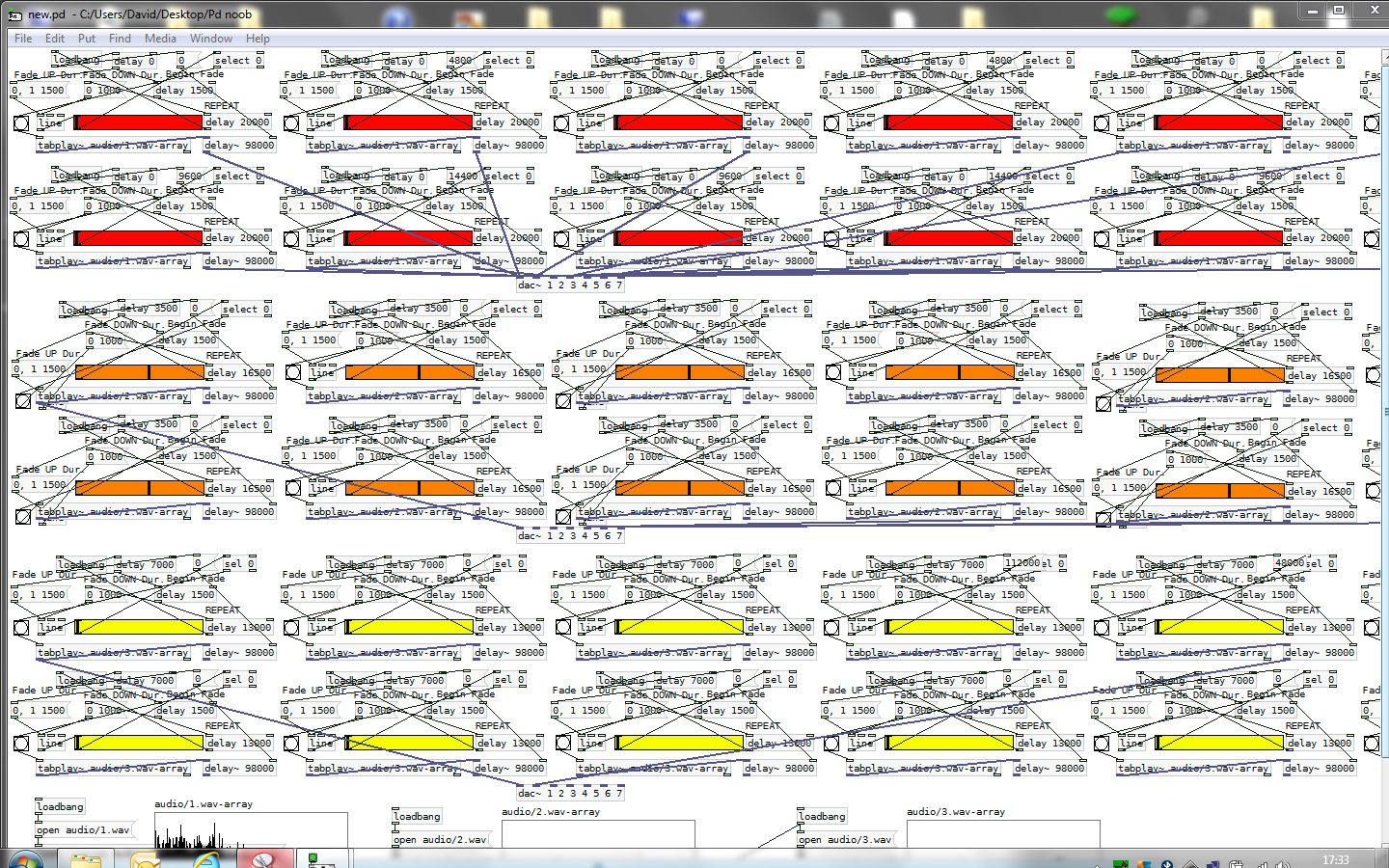
Is the same as this..........
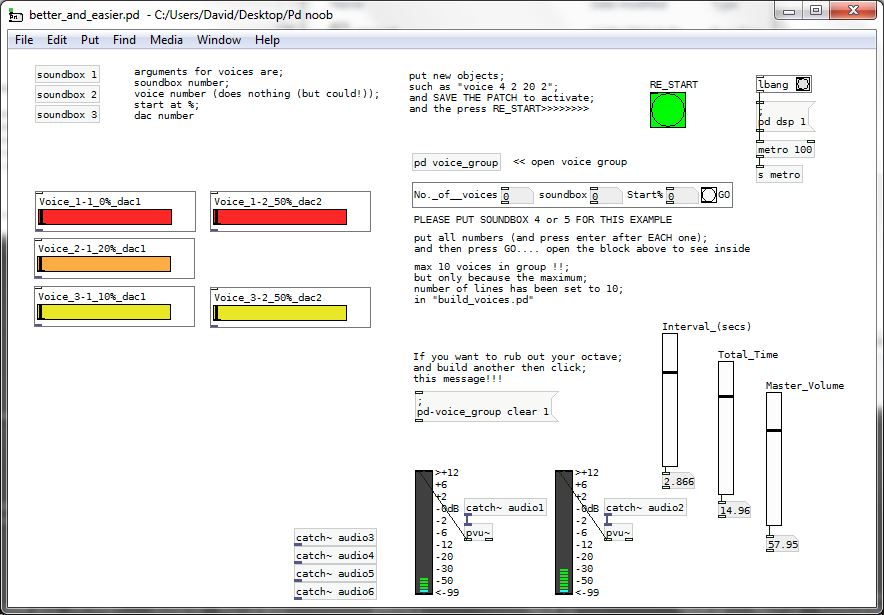
Well........nearly. There is in fact much more in the second patch.
And although the second patch is not perfect (in fact there are many mistakes), it is much easier to work with (and easier to find those mistakes).
You can build the first patch in about 2 minutes using just two components (abstractions) of the second patch. An abstraction is a patch... like a subroutine... that you can use over and over again.
Why is this important?
Because at some point your patch will become very messy, and if you are unlucky then it will stop working. You will not be able to see the mistake in the giant cobweb that you have created...... and when you finally spot that mistake you will have to fix it in 200 different places!
It is quite likely that you will then delete important items or connections by accident and cause more problems...... and not finish your project on time.
If you have a new brainwave with the first patch then you will be eating your breakfast after a sleepless night with your patch. With the second you will be hearing the result within minutes.
Please study the attached patches for as long as you can remain interested. They are difficult if you really are a complete beginner. If you have more experience then you will of course understand a lot more...........
If none of that is even remotely understandable then you have missed out on the basics.
It is much easier to use a dishwasher if you know where to put the soap and that it needs mains electricity to work at all......... http://puredata.info/docs/manuals/pd/x2.htm
DO NOT read chapter 2.9 yet.
( I have tried to explain some of the workings, especially the use of $ variables within an abstraction. (PLEASE SEE THE POST "show_me_dollars" BELOW IF YOU DO NOT UNDERSTAND THE USE OF "$"))
Try to remember while you are working that there is almost always a better (and easier) way to build your patches. Look in “soundbox.pd” as well for some $ clues!
As your project progresses you might come back here again, having found that you are able to create abstractions of your own. You will then be amazed at your understanding of what I am sure looks very difficult at this first glance!
Please do glance........it will do you good in the long run......
Pd noob.zip
David.
posted in tutorials