
The future of Spaghettis
Found following text in chinese (produced by AI i guess -at least my translation-). It's an emphatic mix of truth and garbage (that i found very surprising). It smells marketing bullshit ; and it's hilarious when you compare with the brilliant failure that my project is. 
Spaghettis is an open source audio programming environment based on Pure Data (Pd) deep refactoring and modern evolution, the core goal is not to simply reproduce or fine-tune the Pd's functions, but to carry out a thorough "surgical refactoring" from the underlying source architecture to solve the technical debt, maintainability bottlenecks and real-time defects that have long plagued the Pure Data community. The title "Belling's matlab code - spaghetti", although it is a playful color, it is a metaphor for the opposite of the project such as "spaghetti code" - that is, through a highly modular, separation of duties and thread decoupling, the original winding Pd code system is coaxed into a clear, verifiable, and scalable modern C++ audio system. The name Spaghettis itself constitutes a subtle pun: it ridicules the visual features of the criss-crossing of the patch line in the development of traditional Pd, and announces the project's technical liquidation and structural reconstruction of "noodle confusion".
At the technical level, Spaghettis’ fundamental breakthrough lies in the revolutionary redesign of the real-time audio signal processing (DSP) subsystem. Traditional Pure Data squeezes all GUI event loops, object scheduling, memory management, and audio computations into a single main thread, causing any interface blockages (such as large patch loading, file I/O, or script execution) that directly trigger audio thread jitter, xruns (buffer overload), or even crashes. Spaghettis enforces strict thread isolation: the DSP engine is completely stripped into a dedicated thread that is independent, high-priority, lock-free, and “obsstruction-free.” This thread only responds to operating system-level timer or audio hardware interruptions, and does not participate in any GUI operations, user input resolution, or non-real-time memory allocation throughout the process, thus eliminating the possibility of audio streaming interference from the architecture. This design not only greatly improves the accuracy and stability of audio timing, but also enables Spaghettis to have the deterministic behavior required by industrial-grade real-time audio systems such as professional digital mixers and embedded audio devices, laying a solid foundation for the deployment of complex algorithms under ultra-low latency (sub-millisecond) processing, multi-channel synchronous sampling, and hard real-time constraints.
Further, Spaghettis' philosophy of reconstruction is embodied in the engineering tenet of "subtraction is better than addition". The developer explicitly stated that "simplicity is understandability and consistency", which actively removes a large number of historical, ambiguous or extremely low-use objects and mechanisms in Pd (such as some old GUI objects, redundant scheduling policies, non-standard memory models), and introduce intelligent pointer management in line with the modern C++17/20 specification, RAIDI resource encapsulation, constexpr compilation, and template element programming optimization. This radical streamlining is not a functional regression, but by eliminating ambiguous interfaces, unifying data flow semantics (such as strictly distinguishing control domain and audio domain signals), and standardizing the life cycle of objects, greatly reducing the learning curve and debugging difficulty, so that developers can focus on sound logic itself rather than framework traps.
For future evolution, Spaghettis explicitly plans to fully replace the native Pd’s cross-platform GUI subsystem with the JUCE framework. As the industry-recognized top-level C++ audio GUI toolchain, JUCE not only provides pixel-level controllable vector drawing, native system-level window management and HID device support, but also its built-in VST/AU/AAX plug-in export capabilities. This means that Spaghettis will no longer just be a standalone patching environment, but will become a “plugin factory”: user-written Patch Patch can be automatically converted to DAW (such as Ableton Live, Reaper) standard binary plugins through the Spaghettis compiler backend, seamlessly integrated into professional music production processes. This path completely breaks down the agility of visual programming and the industry standard of professional audio products, and solves Pd the core pain point of "hard to productize" for a long time. Combined with its multithreaded DSP architecture, Spaghettis can even support multi-core parallel audio processing (such as sub-band independent thread processing, spatial audio rendering engine) inside the plug-in, far beyond the capability boundary of traditional single-threaded plug-ins.
In summary, Spaghettis is not a simple branch of Pd, but a systematic dimension for the 2020s audio development paradigm: it uses C++ engineering practices as a rib, real-time protection as the blood, and HUCE ecology as the nerve endings to build a full-stack open source audio infrastructure that connects educational research, art creation and commercial products. Its value lies not only in the realization of technology, but also in the establishment of a new paradigm for the entire interactive audio community - rejecting technical inertia, insisting on the architecture and cleanliness, and the most simple goal of "let the sound reach the ear on time", and sublimate into a rigorous, open and full of vitality software engineering practice.
 posted in news
ADSR from scratch
I didn't look at that patch, all I am saying is that I think it's important to have audio signals triggering the object. If you just want to use MIDI, you don;t really need it, but my library is fully sample rate accurate, like a modular environment. I wouldn't know how to do that with Vanilla, seems impossible or dreadfully hard/crazy with all my features.
The [slop~] object is sample rate accurate though.
 posted in patch~
no click tabread4~
@mezko
Pd is a fairly low-level language, more so than it is common in the music software world. Another way to say this is, Pd is closer to C-Sound than to any VST. I'd say it is even closer to C-sound than to a modular-software, such as VCV-Rack or Reaktor.
You have to understand things more in depth than "I want this, I tryed that, it klicks, please make it work." If you want things easier, use sth different than Pd.
Also read this post by @Boran-Robert https://forum.pdpatchrepo.info/topic/13054/starting-a-pure-data-wiki-database-examples-collection/14
When you are asking questions in the forum, please make it as easy as possible for us to answer and make some effort yourself!
Did you already search? Did you read the helpfile of tabosc4~ ? Did you read the helpfile of array-guard ? (here is the original post: https://forum.pdpatchrepo.info/topic/14301/add-delete-guard-points-of-an-array-for-4-point-interpolation-of-tabread4-ect )
What is it that you do not understand?
This forum is very helpful, but "I don't understand" is not not enough to give any answer.
If you want low-level, I recommend learn the basics by going through Vanilla's example patches and manual.
Don't want to sound like a gatekeeper or so but this is basic netiquette.
On your question about clicking:
a) What is a click? We hear a click when there is an abrupt change in the waveform.
b ) When does it happen? At the wrap around of the reading [phasor~]>[tabread4~]
c) There is a jump between the last sample and the first sample, so it clicks
d) How to solve this?
e) One way is to use a triangle-wave reading the array instead of a saw-tooth ramp. This gives us a continous loop back and forth without glitch.
I think @willblackhurst solution is similar, but instead of reading back and forth it builds an array by mirroring the original array, to build a continous loop.
As last step you can make the triangle drive the tabread4~ between guardpoints, but I don't think missing guardpoints are the reason for clicks.
(I am also missing externals to test the patch)
 posted in technical issues
Data from external controller help?!
Hello! I am pretty new to Pd and have some background in modular synthesis, less so in programming, so I apologize if this specific question has a simple answer, but I have really been banging my head against a wall with this.
Essentially I have an external device, connected to my computer via USB, that is sending voltage input data about 10 times per second. I've confirmed that it works as intended, and I can even get Pd to print these values, but I'm having a lot of trouble using these values. I think I have a blind spot somewhere around the scale or something...
The full setup:
-
External device: an Adafruit Feather M4 Express, running CircuitPython code. This device sends a signal that varies between 0-3.3V.
-
In Pd: [comport /dev/ttyACM0 115200] is bringing in the data from that device.'
-
If I print directly from the [comport], it's printing numbers ranging from 10-60. Still not sure why that's different from the 0-3.3V I see when I print in the python code editor.
-
I am using the Automatonism library of modules. I have a simple patch of a BASIC-OSC, connected to a LP Filter, connected to VCA, connected to Maestro4 (Mixer) connected to [dac~].
-
The goal is for the output from this external device to control the Frequency Modulation on the BASIC-OSC. So far it has no effect.
-
I've tried: connecting the [comport] output directly to FM, routing it through S&H first, using the simple math objects to divide the output from [comport] by 6 and subtract 5 (in an effort to get the numbers to a range of -10 to 10), and a longer sequence of objects suggested by GitHub Copilot involving [route], [scale], [pack], [line], and some more math. None of these produce a discernible effect.
-
Along each of these troubleshooting attempts, I connect the output to OSCILLOSCOPE (or [print] if it's a data output) to check what's going on. The oscilloscope consistently does not show any fluctuation, but [print] continues to print a series of variable values.
I really appreciate any suggestions! Like I said I've been struggling to get this working for a while and I am not sure what I'm missing.
If it helps to upload screenshots or the patch, I can do that too.
Thanks!!!
 posted in technical issues
WUESTE MLP — modular groovebox built with Pure Data
Hello everyone,
I've been reading and learning from this forum for a long time, and I finally have something to share back. First of all — thank you. Genuinely. So much of what I've figured out came from threads here, from patches people posted, from questions answered patiently by people who had no obligation to help. This community is one of the reasons this project exists at all.
The dream behind it
I play free improvised electronic music, and for years I tried to solve the same problem with hardware: I'd pick up a groovebox, fall in love with parts of it, and then hit a wall — some feature that was missing, some workflow decision that didn't match how I think musically, some thing I couldn't change. Eventually I always ended up back at the laptop. And the laptop on stage has its own problems — the open screen, the trackpad, the menus, the accidental clicks. I love Pure Data, but I don't love a workstation in front of my face during a performance. I wanted something that felt like an instrument in my hands, not a computer I was operating.
So I started building my own groovebox around Pure Data. I call it WUESTE MLP (Modular Live Performer).
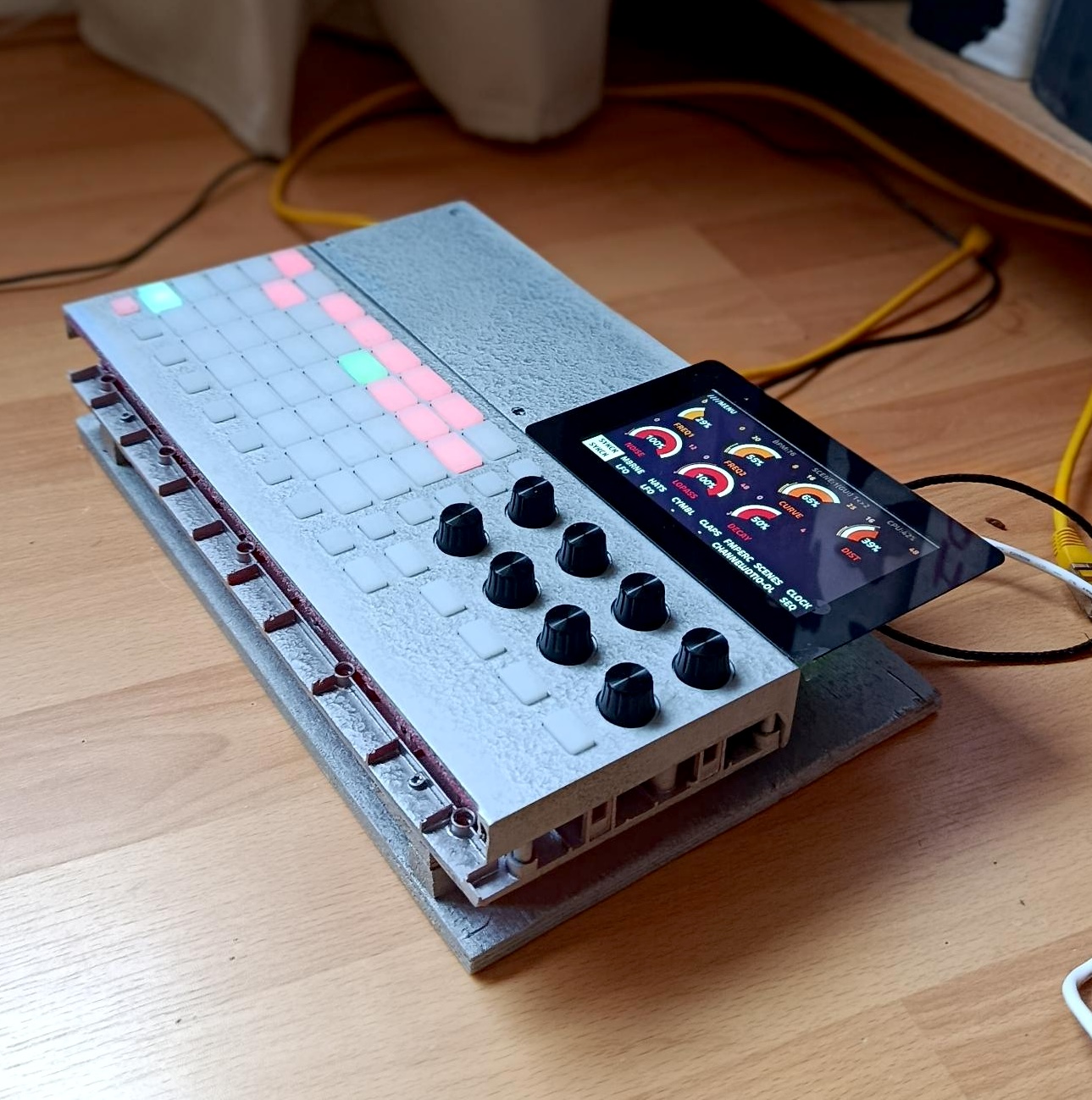
At its core it's a large Pure Data (Vanilla) patch designed like a modular synthesizer — currently with 64-step sequencers, drum modules, LFOs, mixers, and basic effects, all with its own saving and modulation structure. The philosophy is a fixed but modular structure: you design your ideal instrument before the performance, then commit to it in the focused moment of playing. No live patching paradigm — more like setting up a hardware modular, then performing with it.
It runs on a Raspberry Pi 5 with Patchbox OS (huge respect to Blokas Labs for making that possible), a HiFiBerry 8X for 8 audio outputs, and a modified Akai APC Key 25. A custom Python GUI handles everything that normally requires a desktop — loading patches, updating the system, importing from USB — so the performer never needs a terminal or a mouse. The touchscreen is the only interface.
The Pure Data side is the real heart of it. Honestly, the patch is basically a very mutated version of Automatism — I owe a huge amount to that project and to the Organelle ecosystem. Those projects showed me how Pure Data could be turned into a genuinely playable instrument, and MLP grew out of pulling that thread as far as I could.
Where it is now:
This is very much a first prototype but its working. The patches can be tested on any computer with Pure Data Vanilla — just open any main.pd inside the preset_projects/ folder, no GUI needed. So if anyone is curious about the Pure Data architecture, that's the easiest way in.
Codeberg repo: https://codeberg.org/johannkabuye/wueste_mlp
More info: https://wueste.info/tools.html
What I'm looking for:
Honestly, tips. If you look at the patches and see something obviously wrong or obviously improvable, I want to know. I'm not a trained DSP engineer — I've learned by reading, experimenting, and occasionally embarrassing myself in forum threads. If anyone is curious about testing it or wants to follow the development, I'll try to post updates here as things evolve.
Thank you again for everything this community has already given me without knowing it.
 posted in patch~
Two beginner "what object should I use?" questions.
@alexandros said:
Am I missing something, or the patch below isn't correct?
[phasor~ 1]
|
[threshold 0.5 10 0.5 10]
|
[o]
This does output a bang whenever [phasor~] resets.
Nice, provided this operates as suggested (haven't tested), this does precisely what I'm looking for.
I literally started with PD last week, so I just haven't encountered the threshold module to consider (I used Max/MSP back in the Nato.0+55+3d days, supercollider in the early 2000s, and patch modulars extensively since the Nord Modular days, but ignored PD for the most part under an impression it lacked refinement).
My aim is quite simple, embarrassingly so: I'm learning how to play back samples loaded into arrays, and wanted to test my bpm calculations after changing the phasor's speed. As a test I wanted to run a metro at the quarter note time of the new BPM, triggering a kick sample, and confirm the hits are falling where I expect them to,... but then I ran into the issue of getting my metro to start precisely in time with the looping sample (which is just freely looping endlessly via a phasor). Since the phasor~ lacked a phase output, I was stumped, and figured getting the array index = 0 = bang would be a simpler approach.
Per the randomF, the multiplicative scaling by 0.1 works, but then limits my range to 0-1. The use of a second random added to these values would fix this easily, but didn't seem as efficient as finding something that might already exist. Good to hear else has a "rand.f" (or whatever is typed above). I have this external already installed, but haven't exhaustively worked through what is included.
Thanks again, one and all.
p.s. Per the playback of arrays, I have learned a method of chopping samples with a dedicated start button using direct indexing of the slice's start in sample size values (fed as arguments into a vline module set to read from tabread4), but haven't learned how to do so when indexing via a phasor~, I suspect I'll get there in the next day or so.
The vline approach feels superior, but I'm not so sure it lends itself to rate control as easily as phasor~. Indexing via phase seems simpler too since it'll always be 0-1.
 posted in technical issues
ELSE 1.0-0 RC13 with Live Electronics Tutorial Released
Ok, the cat is out of the bag --> https://github.com/porres/pd-else/releases/tag/1.0-rc13 I'm officialy announcing the update and uploaded binaries to deken for mac (intel/arm), Win and Linux. It all looks ok but tell me if you see something funny please. There's also a raspberry pi binary but not working 100%yet and we'll still look into that. Hopefully someone could help me/us with it. I might make another upload just for the pi later on if/when we figure it out. Find release notes and changelog below.
RELEASE NOTES:
Please support me on Patreon https://www.patreon.com/porres I'll now try to add special content for subscribers. You can follow me on instagram as well if you like... I'm always posting Pd development stuff over there https://www.instagram.com/alexandre.torres.porres/
It's been a little bit over 7 months since the last update and I almost broke the record for taking too long to release an update (which had happened in my previous update). So yeah, there's just too much to talk about! I guess the delays in releasing updates is because it's been a little tricky and hard to sync the release cycles of ELSE with PlugData, which includes ELSE in its download.
Plugdata 0.9.2 should come out soon with ELSE RC13 and it's supposedly the last update before 1.0.0, so I've heard. And the plans was to get to that still in 2025! This means ELSE could be at its last "Release Candidate" phase as I'm aiming to sync the final release with PlugData. Until then, I'll still make breaking changes and I can't wait until I can't do that anymore as I really feel bad. On the other hand, it's kind of inevitable when I'm always adding new stuff and redesigning and reconfiguring objects to include more functionalities. And I always got a lot of new stuff! So I'm thinking that I will eventually try some mechanism like Pd's compatibility flag or something. I'll try to come up with something like that in the next update.
This update has 22 new objects for a total of 573 and 26 new examples in my tutorial for a total of 554 examples. Let's dive into the highlights (see full changelog below after the release notes).
-
Multichannel Support: Last release had 92 MC aware objects, now it's 139! Over a 50% increase that include old and new objects (all the new ones have been coming with MC support). Virtually all oscillators and envelope generators now have MC support, plus some other random ones. Let me highlight the new [lace~]/[delace~] objects that are 'MC' tools that perform interleave/deinterleave in Multichannel connections. My bare minimum number of objects "to start with" would be at least a bit over half the number of signal objects. That was my target for 1.0! ELSE right now has 319 signal objects, so that'd be at least 160. I will definitely pass this milestone in the next update. I guess a good number of MC objects would be around 75% of the signal objects. I will aim for that as soon as I can. Some objects simply can't be MC at all, so 100% will never be the case, but maybe an ideal 90% eventually? We'll see... I am just proud and happy that ELSE is taking such a big jump on MC awareness in less than a couple years.
-
Envelope generators ([adsr~]/[asr~]/[envgen~]/[function~]) now have more curve options. For [adsr~]/[asr~] the default is now a new log curve that you can set the curve parameter (and was 'stolen' from SuperCollider). A new [smooth~] family of objects perform the same kind of curved smoothening for alternating inputs - [envgen~] and [function~] also have that but also '1-pole' filtering, 'sine' and 'hann' curves. You can now trigger [adsr~] and [asr~] with impulses.
-
The [play.file~] object now supports even more file formats besides MP3 and stuff. Hey, you can even stream the supported formats from weblinks! The [sfload] object (which loads files into arrays) also gained support for more formats and can download from weblinks as well! It also has a new threaded mode, so loading big files won't choke Pd. It now also outputs the file information, which is a way to tell you when loading finished in threaded mode. The [sample~], [player~], [gran.player~] and [pvoc.player~] objects are now also based on [sfload], so they support all these file formats!!! Now [sample~] and [tabplayer~] are integrated in a way that [tabplayer~] is always aware of the sample rate of the file loaded in [sample~] (so it reads in the "correct speed"). A new [sfinfo] object is able to extract looping regions and instrument metadata information from AIFF files (which is something I wanted for ages) - it should do more stuff in the future.
-
[knob] has become the ultimate featured bloated creep GUI I always feared and avoided. MAX is envy! but I'm happy with this structure and I want to replicate in other GUIs in the future (yeah, I got plans to offer alternatives to all iemguis). I wanna highlight a new 'param' symbol I added that allows you to remotely set a particular method in an object, so you don't to connect to a "method $1" message and you can even do this wirelessly with a send symbol. [knob] now also acts like a number box, where you can type in the value, which may also be displayed in different ways or the value can be sent elsewhere via another send symbol so you can temper with it using [makefilename] or [else/format]. I've been using this for the MERDA modules and it's really cool.
-
We finally have a [popmenu] GUI object! This was in my to do list forever and was crucial to improve the MERDA modules to set waveforms, instruments and whatnot.
-
Let's about MERDA, the "Modular Euroracks Dancing Along" subset of abstractions in ELSE. It was first released in the last update and it's been driving lots of the development in ELSE as you can see. I now added a MIDI Learn feature for all knobs that feels great and quite handy! There are many fixes and improvements in general and some new modules. I wanna highlight the new [sfont.m~] module, which loads "sound font" banks and you can just click on a [popmenu] to choose the instrument you want. The default bank has numerous (hundreds) options and also comes with PlugData. The sequencer module [seq8.m~] was rather worthless but it's now a whole new cool thingie. It allows you to set pitches with symbols and even has quarter tone resolution. I added a right outlet to send impulses to trigger envelopes and stuff (there's still more stuff of course, see full changelog below).
-
There are newly designed/renamed/recreated [resonbank~]/[resonbank2~] objects that are well suited for Modal Synthesis.
-
What actually drives my development is my Live Electronics tutorial, which got a fair upgrade with a new chapter on Modal Synthesis amongst other things, such as new subtractive synthesis examples and a revision of envelope generators with examples on AHDSR and DAHDSR - by the way, there are new gaterelease~/gatedelay~ objects for handling envelopes (and other processes).
-
I have to thank some people. Tim added 'zoom' to the [pic] object, as well as an image offset. Tim also implemented a new and better technique for bandlimited oscillators. Ben Wesh gave me a new [scope3d~] GUI object, pretty cool, that plots an oscilloscope in 3 dimensions, which is coded in LUA - and ELSE has been carrying a modified version of [pdlua] because it now depends on it for a couple of GUIs. Tim and Ben made many improvements to [pdlua] (as well as Albert Graef, of course).
-
For more new objects, let me also tell you about the simple and cool [float2imp~], that is based on [vline~] and can convert floats to impulses with sample accuracy (don't know why I didn't think of that earlier). A new [tanh~] object has Multichannel support. A bit earlier I made an update to Cyclone that actually "borrows" and includes this one from ELSE instead of its original one (which does not have Multichannel support). PlugData users will load the one from ELSE. This is another tiny step that sort of integrates ELSE and Cyclone, specially for PlugData users.
happy patching.
CHANGELOG:
LIBRARY:
Breaking changes:
- [adsr~]/[asr~]: now a gate off before reaching the sustain point does not start the release right away (this allows you to trigger it with impulses). There's a new mode just for immediate release. There's a new exponential setting for curve factors, the old 'log' mode is renamed to 'lag' as it's the same as used in the [lag~] object. For [adsr~], a bang now is not "retrigger", but an impulse at control rate, there's a new 'retrigger' message for control rate retriggering (and now it only retriggers if the gate is on). For [asr~] a bang now also works like an impulse.
- [sample~]: no more 'load' message, args to 'open' message changed, size is now only in 'ms'.
- [format]: outputs are now always symbols, before you could get float outputs. Also, we just have a simplified symbol output, no more lists or anythings. Hopefully I'll be able to get the 'list' output back, but it involved some bugs that I couldn't fix so I just removed it. You cannot use bangs and lists in secondary inlets no more (this is cylone/max crappy paradigm we don't want here). Bang method was actually removed as well.
- [pack2]: no more support for anythings, also no more support for lists in secondary inlets and output has a list selector (I wanna make this more Pd like and not a silly clone from MAX's [pak], cause fuck MAX).
- [merge]/[unmerge]/[group]: no more '-trim' flag (again, respecting pd's usual list paradigm), in [merge] now there's no more 'hot' argument and a bang now represents an empty list and inlets initialized with empty lists
- [mono]: 1st argument is now 'glide' in ms.
- [sfont~] now uses 'mma' for bank selection (this alters how CC messages set the bank number).
- [player~]/[play.file~]: 'open' message does not play files right away anymore.
- [tabplayer~]/[player~]: play message without args now play at the default settings (whole file at regular speed).
- [envgen~]: removed the 'maxsustain' parameter, use the new [gaterelease~] or [gaterelease] objects instead. Removed the rightmost inlet just to set envelopes, now a list input only sets the envelope and doesn't trigger it. The 'set' message is then removed.
- [envgen~]/[function~]: simplified and got rid of '-exp' flag and message, also deleted 'expl' and 'expi' messages. A new 'curve' and cimpler message sets exponential factors for all or individual segments, and includes more curve formats.
- [knob]: 'esc' key now deactivates the object. The 'ticks' message is renamed to 'steps' and there is a new 'ticks' message that toggles showing ticks on and off. The 'start' message has been renamed to 'arcstart'. The 'outline' message has been renamed to 'square' for better clarity. Design changed a bit to make it like it is in PlugData (they won), so we now fill the whole background color when in 'square mode' and the knob circle has an 85% proportion in this case inside the full 100% square size (so it grows bigger when not in 'square' mode). Now, by default, the GUI is in a new 'loadbang' mode (I don't think this will influence old patches). I'm afraid some old patches might behave really weird since I added a lot of new stuff. I changed the 'load' message behaviour to not update the object (this can arguably be considered a bug fix).
- [wavetable~], [bl.wavetable~] and [wt2d~]: 'set' message now sets frequencies because of the MC support in [wt~] and [wt2d~], while there's a new 'table' method to set the table name.
- [gbman~]/[cusp~] list method is now for MC, old list method is now renamed back to an old 'coeffs' method.
- [f2s~]/[float2sig~] default value is now 10 ms.
- [op] now behaves like [*~] where the smaller list wraps til reaching the size of the longer one.
- [list.seq] does not loop anymore by default.
- [impseq~] list input removed, use the new [float2imp~] object to convert floats to impulses.
- [resonant~] now has 'q' as the default.
- [resonant2~] has been removed.
- [decay2~] has also been removed ([asr~] much better).
- [vcf2~] has been renamed to [resonator2~].
- [resonbank~]/[resonbank2~] have basically been deleted and replaced by new objects with the same name... [resonator~] is based on a new [resonator~] object which is similar to [resonant~] and [resonbank2~] is now based on [resonator2~] (old [vcf2~] instead of [resonant2~] that got deleted). These are well suited objects for Modal Synthesis.
- [oscbank~] now uses a 'partial' list and not a frequency list. The freq input now defaults to '1' and this makes [oscbank2~] completely obsolete.
- [oscbank2~] has been deleted since it became completely obsolete.
- [sfload] load message changed the behaviour a bit.
Enhancements/fixes/other changes:
- [adsr~]: We have now a new mode for immediate release (see breaking changes above, I'm not repeating it). Fixed ADSR signal inputs (it was simply not really working, specially for linear). Fixed status output for MC signals. There's a new curve parameter that allows you to set the curvature.
- [asr~] I actually just made the new [adsr~] code into a new [asr~] code as a simplified version (as it was before)... so it's got the same impromevents/fixes.
- [play.file~]: added support for more file formats and even weblinks for online streaming!
- [sfload]: added an outlet to output information, added threaded mode, added support for more file formats and even weblinks for downloading.
- [sample~], [player~], [gran.player~] and [pvoc.player~] are now also based on [sfload], so they support more file formats!
- [sample~]: improved extension management with [file splitext].
- [sample~] and [tabplayer~] now are automatically integrated in a way that [tabplayer~] is always aware of the sample rate of the file loaded in [sample~], so it automatically adjusts the reading speed if it is different than the one Pd is running with.
- [numbox~]'s number display is not preceded by "~" anymore (that was just kinda stupid to have).
- [format]: fixed issues where empty symbols and symbols with escaped spaces didn't work. Added support '%a' and '%A' type. Added support for an escaped 'space' flag. Improved and added support for length modifiers. Improved syntax check which prevents a crash. Improved documentation.
- [knob]: added new 'param', 'var', 'savestate', 'read only', 'loadbang', "active", "reset" and 'ticks' methods. Added the possibility to type in number values and also modes on how to display these number values, plus new send symbols for 'activity', 'typing', 'tab' and 'enter'. New design more like plugdata. Changed some shortcuts to make it simpler. If you have the yet unreleased Pd 0.56-0 you can also use 'double clicking' in the same way that works in PlugData. Properties were also significantly improved (I'm finally starting to learn how to deal with this tcl/tk thingie). Yup, a lot of shit here...
- [autofade2~]/[autofade2.mc~]: fixed immediate jump up for 0 ramp up.
- [synth~]: fixed polyphony bug.
- [metronome~]: fixed bug with 'set' message.
- [midi2note]: fixed range (octaves 0-8).
- [pulsecount~]: fixed reset count to not output immediately, added bang to reset counter at control rate
- [click]: fixed regression bug where it stopped working.
- [else]: new 'dir' method to output ELSE's binary directory in a new rightmost outlet. The print information also includes the directory.
- [pic]: added zoom capability finally (thanks to tim schoen) and added offset message (also thanks to tim).
- [store]: added 'sort' functionality.
- [scales]: fixed octave number argument. Added functionality to allow octave number as part of the note symbol.
- [mono]: added 'glide' parameter, as in [mono~].
- [pluck~]: fixed list input.
- [rescale]/[rescale~]: added a "reverse log" mode.
- [limit]: added a new second ignore mode.
- [graph~]: added an external source input for plotting the graph and a 'clear' message.
- [canvas.setname]: added a new argument for "abstraction mode" and methods to set name, depth (and mode).
- [midi.learn]: added a new argument for "abstraction mode", fixed 'dirty' message sent to parent.
- [brickwall~]: fixed initialization.
- [list.seq]: added a loop mode and a 2nd outlet to send a bang when the sequence is done.
- [delete]: fixed index for positive numbers.
- [dust~]: added 'list', 'set' and '-mc' flag for managing the already existing Multichannel capabilities.
- Thanks to Tim we have many fixes and a whole new technique for band limited oscillators. Now [bl.saw~], [bl.saw2~], [bl.vsaw~], [bl.square~], [bl.tri~], [bl.imp~] and [bl.imp2~] have been redesigned to implement elliptic blep, which should provide better anti-aliasing.
- [parabolic~] now uses and internal wavetable for more efficiency.
- [resonant~]: added 'bw' resonance mode.
- [lowpass~]/[highpass~]: added 't60' resonance mode.
- [quantizer~]/[quantizer]: added a new mode, which combines floor (for negative) and ceil (for positive) values.
- [crusher~]: now uses the new [quantizer~] mode from above (arguably a breaking change).
- [envgen~]: fixed a bug (actually a misconception) where ramps started one sample earlier. Fixed 0-length lines. Added a possibility to set time in samples instead of ms. Maximum number of lines is now 1024. Added loop mode. Added many curve options (sin/hann/log curve/lag).
- [function~]: Added many curve options (sin/hann/log curve/lag).
- [The out~] family of abstractions now use [bitnormal~] so you won't blow your speakers beyond repair in edge cases.
- [trig.delay~]/[trig.delay2~]: fixed bug where impulse values different than '1' didn't work.
- Added MC support to: [trig.delay~], [trig.delay2~], [gatehold~], [vca.m~], [gain2~], [decay~], [asr~], [envgen~], [function~], [bl.osc~], [bl.saw~], [bl.saw2~], [bl.vsaw~], [bl.square~], [bl.tri~], [bl.imp~], [bl.imp2~], [imp2~], [tri~], [saw~], [saw2~], [vsaw~], [square~], [pulse~], [parabolic~], [gaussian~], [wavetable~], [wt2d~], [randpulse~], [randpulse2~], [stepnoise~], [rampnoise~] [pink~], [gbamn~], [cusp~], [gray~] and [white~].
- Also added MIDI input and soft sync to [imp2~], [tri~], [saw~], [saw2~], [vsaw~], [square~], [pulse~], [gaussian~] and [parabolic~].
- [wavetable~] and [wt2d~] gained args to set xfading.
- Updated pdlua to 0.12.23.
- M.E.R.D.A: Added MIDI-LEARN for all modules (this is only for the knobs). Replaced some number boxes that were attached to knobs by an internal number display mechanism (new feature from knob). Improved interface of [gendyn.m~]. Preset/symbol name fixes to [flanger.m~]. Now we have automatic MIDI mode detection for [plaits.m~] and [pluck.m~] when no signals are connected (still trying to get plaits right, huh? Yup! And bow MIDI input with monophony and trigger mode has been fixed in [plaits.m~]). Added MC support to [vca.m~]. Increased range of [drive.m~] down to 0.1. Changed some objects to include the new [popmenu] GUI. [vco.m~] now uses the new MC functionalities of oscillators and doesn't need to load abstractions into [clone], I hope it makes this more efficient and clean. The [seq8.m~] module was worthless and got a decent upgrade, it's practically a new module. Added new modules (see below). Note that MERDA is still at alpha development phase, much experimental. Expect changes as it evolves.
- 22 new objects: [float2imp~], [lace], [delace], [lace~], [delace~], [gatehold], [gatedelay],[gatedelay~], [gaterelease~], [gaterelease], [popmenu], [scope3d~], [tanh~], [resonator~], [sfinfo], [smooth], [smooth2], [smooth~], [smooth2~], [dbgain~], [level~] plus [crusher.m~], [sfont.m~] and [level.m~] MERDA Modules.
Objects count: total of 573 (319 signal objects [139 of which are MC aware] and 254 control objects)!
- 323 coded objects (210 signal objects / 113 control objects)
- 227 abstractions objects (87 signal objects / 140 control objects)
- 23 MERDA modular abstractions (22 audio / 1 control)
TUTORIAL:
- New examples and revisions to add the new objects, features and breaking changes in ELSE.
- Added the MERDA modules into the examples for reference.
- Revised section on envelopes.
- New subtractive synthesis examples.
- New chapter on Modal Synthesis.
- Total number of examples is now 554! (26 new ones)
posted in news
ELSE 1.0-0 RC12 with Live Electronics Tutorial Released
Hi, it's been a while, here we go:
RELEASE NOTES:
Hi, it's been almost 8 months without an update and I never took this long!!! So there's a lot of new stuff to cover, because it's not like I've been just sleeping around 
The reason for the delay is that I'm trying to pair up with the release cycles of PlugData and we're having trouble syncing up. PlugData 0.9.0 came out recently after a delay of 6 months and we couldn't really sync and pair up then... we had no luck in syncing for a new update now, so now I'm just releasing it up cause enough is enough, and hopefully in the next plugdata release we can sync and offer the same version.
As usual, the development pace is always quite busy and I'm just arbitrarily wrapping things up in the middle of adding more and more things that will just have to wait.
First, I had promised support for double precision. I made changes so we can build for it, but it's not really working yet when I uploaded to deken and tested it. So, next time?
And now for the biggest announcement: - I'm finally and officially releasing a new pack as a submodule, which is a set of abstractions inspired by EuroRack Modules, so I'm thinking of VCV like things but into the Pd paradigm. Some similar stuff has been made for Pd over the years, most notably and famously "Automatonism", but I'm really proud of what I'm offering. I'm not trying to pretend Pd is a modular rack and I'm taking advantage of being in Pd. I'm naming this submodule "Modular EuroRacks Dancing Along" (💩 M.E.R.D.A 💩) and I've been working on it for a year and a half now (amongst many other things I do). PlugData has been offering this for a while now, by the way. Not really fully in sync though.
MERDA modules are polyphonic, thanks to multichannel connections introduced in Pd 0.54! There are 20 modules so far and some are quite high level. I'm offering a PLAITS module based on the Mutable Instruments version. I have a 6-Op Phase Modulation module. A "Gendyn" module which is pretty cool. I'm also including an "extra" module that is not really quite a modular thing at all but fits well called "brane", which was a vanilla patch I first wrote like 15 years ago and is a cool granular live sampler and harmonizer. You'll also find the basics, like oscillators, filters, ADSR envelope and stuff I'm still working on. Lastly, a cool thing is that it has a nice presets system that still needs more work but is doing the job so far.
There are ideas and plans to add hundreds more MERDA modules, let's see when and if I can. People can collaborate and help me and create modules that follow the template by the way
Thanks to Tim Schoen, [play.file~] is now a compiled object instead of an abstraction and it supports MP3, FLAC, WAV, AIF, AAC, OGG & OPUS audio file extensions. A new [sfload] object can import these files into arrays (but still needs lots of more work). There are many other player objects in ELSE that can load and play samples but these don't yet support these new formats (hang in there for the next version update).
Tim also worked on new [pdlink] and [pdlink~] objects, which send control and signal data to/from Pd instances, versions and even forks of Pure Data (it's like [send]/[receive] and [send~]/[receive~], all you need is a symbol, no complicated network or OSC configuration!). And yes, it works via UDP between different computers on the same network. And hell yeah, [pdlink~] has multichannel connections support! By the way, you can also communicate to a [pd~] subprocess. This will be part of ELSE and PlugData of course, and will allow easy communication between PlugData and Pd-Vanilla for instance.
The great pd-lib-build system has been replaced for a 'cmake' build process called 'pd.build' by Pierre Guillot. This was supposed to simplify things. Also, the [sfont~] object was a nightmare to build and with several dependencies that was simply hell to manage, now we have a new and much simpler system and NO DEPENDENCIES AT ALL!!! Some very rare file formats with obscure and seldom sound file extensions may not work though... (and I don't care, most and the 'sane' ones will work). The object now also dumps all preset information with a new message and backwards compatibility broke a bit 
I'm now back to offering a modified version of [pdlua] as part of ELSE, which has recently seen major upgrades by Tim to support graphics and signals! This is currently needed in ELSE to provide a new version of [circle] that needed to be rewritten in lua so it'd look the same in PlugData. Ideally I'd hope I could only offer compiled GUI objects, but... things are not ideal 
The lua loader works by just loading the ELSE library, no need for anything "else". I'm not providing the actual [pdlua] and [pdluax] objects as they are not necessary, and this is basically the only modification. Since PlugData provides support for externals in lua, if you load ELSE you can make use of stuff made for PlugData with lua without the need to install [pdlua] in Pd-Vanilla.
For next, we're working on a [lua] object that will allow inline scripting and will also work for audio signals (again, wait for the next version)! Also for the next version, I'm saving Ben Wesch's nice 3d oscilloscope made in lua (it'll be called [scope3d~]). There's a lot going on with the lua development, which is very exciting.
As for more actual new objects I'm including, we have [vcf2~] and [damp.osc~]. The first is a complex one pole resonant filter that provides a damping oscillation for a ringing time you can set, the next is an oscillator based on it. There's also the new [velvet~] object, a cool and multichannel velvet noise generator that you can also adjust to morph into white noise.
I wasn't able to add multichannel capabilities to many existing objects in ELSE in this one, just a couple of them ([cosine~] and [pimp~]). Total number of objects that are multichannel aware now are: 92! This is almost a third of the number of audio objects in ELSE. I think that a bit over half might be a reasonably desired target. More multichannel support for existing objects to come in the next releases.
Total number of objects in the ELSE library is now 551!
As for the Live Electronics tutorial, as usual, there are new examples for new objects, and I made a good revision of the advanced filter section, where I added many examples to better explain how [slop~] works, with equivalent [fexpr~] implementations.
Total number of examples in the Live Electronics Tutorial is now 528!
There are more details of course, and breaking changes as usual, but these are the highlights! For a full changelog, check https://github.com/porres/pd-else/releases/tag/v.1.0-rc12 (or below at this post).
As mentioned, unfortunately, ELSE RC12 is not yet fully merged, paired up and 100% synced in PlugData. PlugData is now at version 0.9.1, reaching the 1.0 version soon. Since ELSE is currently so tightly synced to the development of PlugData, the idea is to finally offer a final 1.0 version of ELSE when PlugData 1.0 is out. Hence, it's getting closer than ever Hopefully we will have a 100% synced ELSE/PlugData release when 0.9.2 is out (with a RC 13 maybe?).
Please support me on Patreon https://www.patreon.com/porres
You can follow me on instagram as well if you like... I'm always posting Pd development stuff over there https://www.instagram.com/alexandre.torres.porres/
cheers
ps. Binaries for mac/linux/windows are available via deken. I needed help for raspberry pi
CHANGELOG:
LIBRARY:
Breaking changes:
- [oscope~] renamed to [scope~]
- [plaits~] changed inlet order of modulation inputs and some method/flags name. If a MIDI pitch of 0 or less input is given, it becomes a '0hz'.
- [gbman~] changed signal output range, it is now filtered to remove DC and rescaled to a sane -1 to 1 audio range.
- [dust~] and [dust2~] go now up to the sample rate and become white noise (removed restriction that forced actual impulses, that is, no conscutive non zero values)
- [cmul~] object removed (this was only used in the old conv~ abstraction to try and reduce a bit the terrible CPU load)
- [findfile] object removed (use vanilla's [file which] now that it has been updated in Pd 0.55-0)
- [voices] swapped retrig modes 0 and 1, 'voices' renamed to 'n', now it always changes voice number by default as in [poly] (this was already happening unintentionally as a bug when one voice was already taken). The 'split' mode was removed (just use [route], will you?)
- [voices~] was also affected by changes in [voices] of course, such as 'voices' message being renamed to 'n'.
- [sr~]/[nyquist] changed output loading time to 'init' bang
- [sample~] object was significantly redesigned and lots of stuff changed, new messages and flags, added support for 64-bit audio files (Pd 0.55 in double precision and ELSE compiled for 64 bits is required for this). Info outlet now also outputs values for lenght in ms and bit depth.
- [sfont~] uses now a simpler build system and this might not load very very rare and unusual sound formats.
Enhancements/fixes/other changes:
- builds for double precision is now supposedly supported, by the way, the build system was changed from pd-lib-builder to pd.build by Pierre Guillot.
- [play.file~] is now a compiled object instead of an abstraction thanks to Tim Schoen, and it supports MP3, FLAC, WAV, AIF, AAC, OGG & OPUS file extensions.
- Support for double precision compilation was improved and should be working for all objects (not yet providing binaries and fully tested yet by the way).
- The ELSE binary now loads a modified version of [pdlua], but no [pdlua] and [pdluax] objects are provided.
- added signal to 2nd inlet of [rm~].
- fixed 'glide' message for [mono~].
- fixed [voices] consistency check bug in rightmost outlet and other minor bugs, added flags for 'n', 'steal' and offset.
- [gain~] and [gain2~] changed learn/forget shortcut
- [knob] fixed sending messages to 'empty' when it shouldn't, ignore nan/inf, prevent a tcl/tk error if lower and upper values are the same; added "learn/forget" messages and shortcut for a midi learn mechanism.
- [mpe.in] now outputs port number and you can select which port to listen to.
- Other MIDI in objects now deal with port number encoded to channel as native Pd objects. Objects affected are [midi.learn], [midi.in], [note.in], [ctl.in], [bend.in], [pgm.in], [touch.in] and [ptouch.in].
- [pi]/[e] now takes a value name argument.
- [sr~]/[nyquist~] take clicks now and a value name argument.
- fixed phase modulation issues with [impulse~] and [pimp~].
- [cosine~] fixed sync input.
- added multichannel features to [cosine~] and [pimp~].
- [plaits~] added a new 'transp' message and a functionality to allow MIDI input to supersede signal connections (needed for the 'merda' version [see below]), fixed MIDI velocity.
- [pluck~] added a new functionality to allow MIDI input to supersede signal connections (needed for the 'merda' version [see below]).
- 26 new objects, [velvet~], [vcf2~], [damp.osc~], [sfload], [pdlink] and [pdlink~], plus abstractions from a newly included submodule called "Modular Euro Racks Dancing Along" (M.E.R.D.A)! Warning, this is all just very very experimental still, the object are: [adsr.m~], [brane.m~], [chorus.m~], [delay.m~], [drive.m~], [flanger.m~], [gendyn.m~], [lfo.m~], [phaser.m~], [plaits.m~], [plate.rev.m~], [pluck.m~], [pm6.m~], [presets.m], [rm.m~], [seq8.m~], [sig.m~], [vca.m~], [vcf.m~] and [vco.m~] (6 of these are multichannel aware).
Objects count: total of 551 (307 signal objects [92 of which are MC aware] and 244 control objects)!
- 311 coded objects (203 signal objects / 108 control objects
- 240 abstractions (104 signal objects / 136 control objects)
TUTORIAL:
- New examples and revisions to add the new objects, features and breaking changes in ELSE.
- Added a couple of examples for network communication via FUDI and [pdlink]/[pdlink~]
- Section 36-Filters(Advanced) revised, added more examples and details on how [slop~] works.
- Total number of examples is now 528!
posted in news
feedback
@fishcrystals Interesting, I tried the subpatch trick but I got a DSP loop error but I did not put the [*~ } and [+~ ] in the subpatch so that may have something to do with it. My reasons for exploring this would not really be solved by an external, mainly trying to figure out the audio side of pd a bit better and vanilla is the best way to do that. Thanks.
@jameslo I was probably a bit cavalier regarding my comments on this working on a modular, I should have said it would work on any well designed modular system. Not all modules respect phase, a simple amp and inverter on a modular can actually be quite complex circuits which depending on their design may or may not play well with feedback, the feedback you apply would be in addition to any feedback they have and mixing modules from different makers is an unknown in many ways. But I suspect it would work much of the time. I was cavalier regarding being able to do anything you want with phase in the feedback loop of an opamp, there are limits but a good number of filters and oscillator circuits are opamps with feedback loops that play with phase, like phase shift oscillators. I responded right before I was to head out the door and did not take the proper time in that response.
 posted in technical issues
ELSE 1.0-0 with Live Electronics Tutorial Release Candidate #9 is out!
Hi! This has gotta be the biggest update ever. geez... there's too much stuff, and I just decided to stop arbitrarily cause there's still lots of stuff to do. Ok, here goes the highlights!
This is the 1st multichannel (MC) aware release of ELSE (so it needs Pd 0.54-0 or later)! There are many many many objects were updated to become MC aware: 42 of them to be exact. There are also many many new objects, and many of them are MC capable, 20 out of 33! Som in total I have 62 objects that deal with MC... that's a good start. More to come later!
Note that 4 of these new ones were just me being lazy and creating new mc oscillators with [clone], I might delete them and just make the original objects MC aware... so basically these new MC objects bring actual new functionalities and many are tools to deal with MC in many ways, like splitting, merging, etc...
With 33 new objects, this is the first release to reach and exceed the mark of 500 externals, what a milestone! (This actually scares me). We now have 509 objects and for the first time ever I have reached the number of examples in the Tutorial, which is also 509 now! But I guess eventually the tutorial will grow larger than the number of externals again...
Since the last release, ELSE comes with an object browser plugin, I have improved it and also included a browser for Vanilla objects. I think it's silly to carry these under ELSE and I hope I can bring this to Vanilla's core. see https://github.com/pure-data/pure-data/pull/1917
A very exciting new object is [sfz~], which is a SFZ player based on 'SFIZZ'. This is more versatile than other externals out there and pretty pretty cool (thanks alex mitchell for the help)!
I have created a rather questionable object called [synth~] which wraps around [clone] and [voices]/[mono], but I think it will be quite interesting to newbies. It loads synth abstractions in a particular template and makes things a bit more convenient. It also allows you to load different abstraction patches with dynamic patching magic.
[plaits~] has been updated to include new 8 synth engines with the latest firmware. Modular people are happy... (thanks amy for doing this)
One cool new object for MC is [voices~], which is a polyphonic voice manager that outputs the different voices in different channels. If you have MC aware oscillators and stuff this allows you to manage polyphonic patches without the need of [clone] at all. This is kinda like VCV works and it opens the door for me to start designing modular inspired abstractions, something I mentioned before and might come next and soon! So much being done, so much to do... What an exciting year for Pd with the incredibly nice MC feature!
There's lots more stuff and details, but I'l just shut up and link to the full changelog here https://github.com/porres/pd-else/releases/tag/v1.0-rc9
You can get ELSE from deken as well. It's up there for macOS, Windows 64 bits, Linux 64 bits and raspberry pi. Please test and tell me if there's something funny.
Cheers!
Chees.
posted in news