-
-
kyro
posted in technical issues • read moreI have no standalone sample patch. Sorry. Be very patient please.
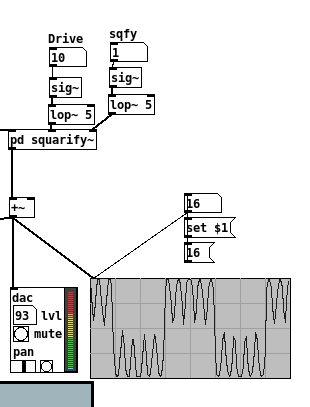
Basically an input sine going throug asine turns to triangle which from a sine point of view looks a lot like a saw and gives a sine again. If you multiply the triangle from asine by a drive>1 the sine folds quite gently. Then there's a dry/wet crossover to add some folded waveform to the input. It adds a partial to a sine and I used that for a hack of a bandlimited squarewave. Then I stopped tinkering with wavefolders.
-
posted in technical issues • read more
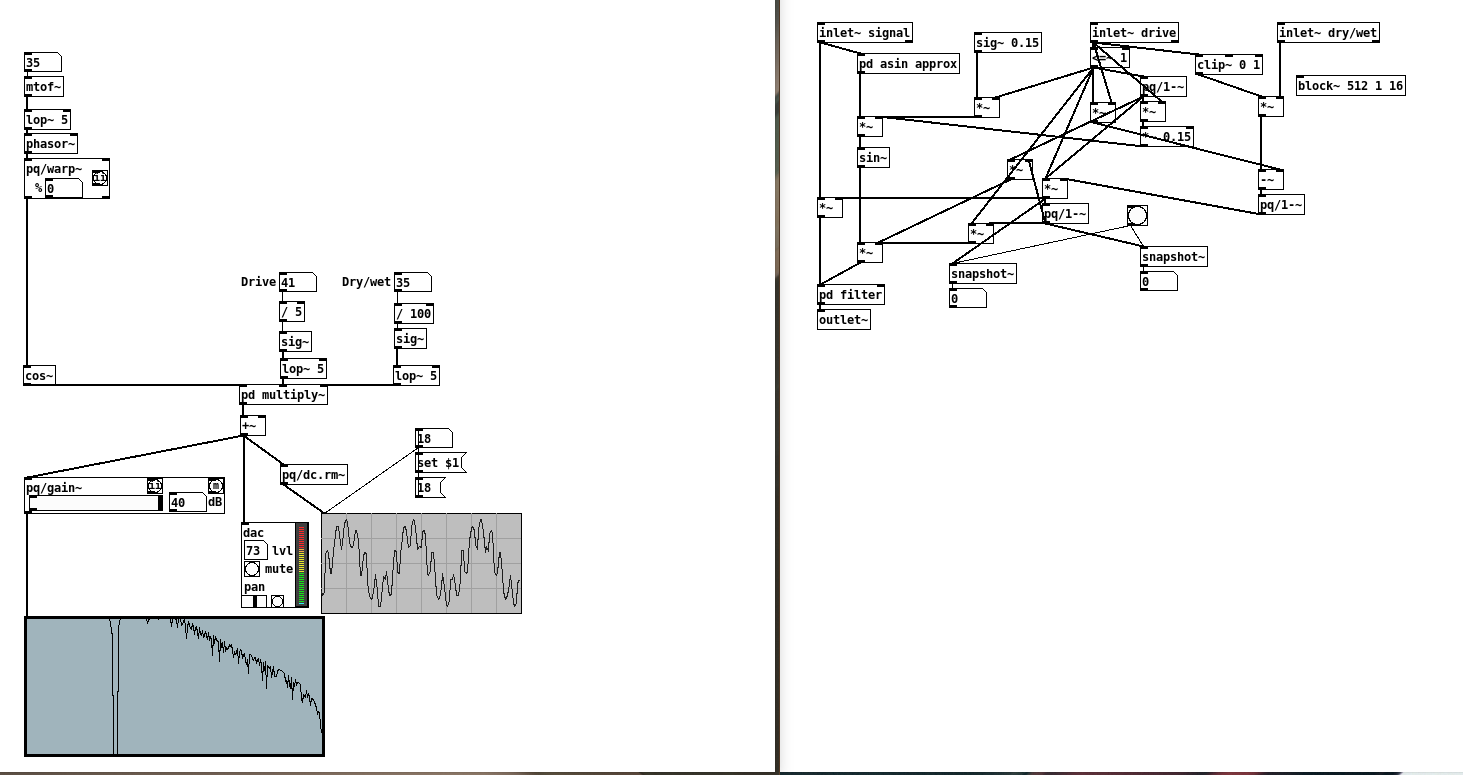
One day I saw a 0-coast video displaying the waveform changes from it's "multiply" knob (the wavefolder of the synth). I came up later with a way to somehow replicate it:
input => asin => ×amount => sin~
-
posted in technical issues • read more
Symbols can be used in data structures. However, you can't just feed [append] (or even plain [set]) with symbols. The workaround is to use the pointer of the created data structure to edit its symbols with a [set] to which you give the
-symbolargument. -
posted in technical issues • read more
Well, unfortunately, as the help says, "with a 512 sample delay, it begins to attenuate at about 110Hz". To keep decent low frequencies I have to use at least 2048 according to my quick test. No easy solution to the problem I guess.
-
posted in technical issues • read more
Hello,
I can't find the source to it anymore, but to remove DC offset I use
[rzero~1]
|
[rpole~ 0.995]which is practically perfect for my use, except it messes with waveforms due to inherent phase shift. Is there any way to cancel/revert this phase shift with, say, an allpass filter ? If so, how should I tune that?
-
posted in technical issues • read more
Maybe should you have
[loadbang}
|
[float 6]
|
[until]instead? Anyway, you can execute pd with the -noloadbang option to edit your patch.
-
posted in technical issues • read more
@oid said:
Non-linear elements in the feedback path can be fun and do some interesting things but far from a general purpose filter, no clue if pd will play well with that sort of abuse.
In my humble experience: very well. I've been working on an "acoustic feedback" patch for a while now. With allpass/diffusion, peak filter and basic distortion in the loop, it was quite lively and convincing.