
-
 high_output-5000
posted in abstract~ • read more
high_output-5000
posted in abstract~ • read more@dreamer
Thanks you're right about that. I must have mixed libraries up when I was getting it to work in standard subpatches. Was doing that for both the hv and RjDj libraries. I'll change the patch comments for clarity. -
high_output-5000
posted in abstract~ • read more
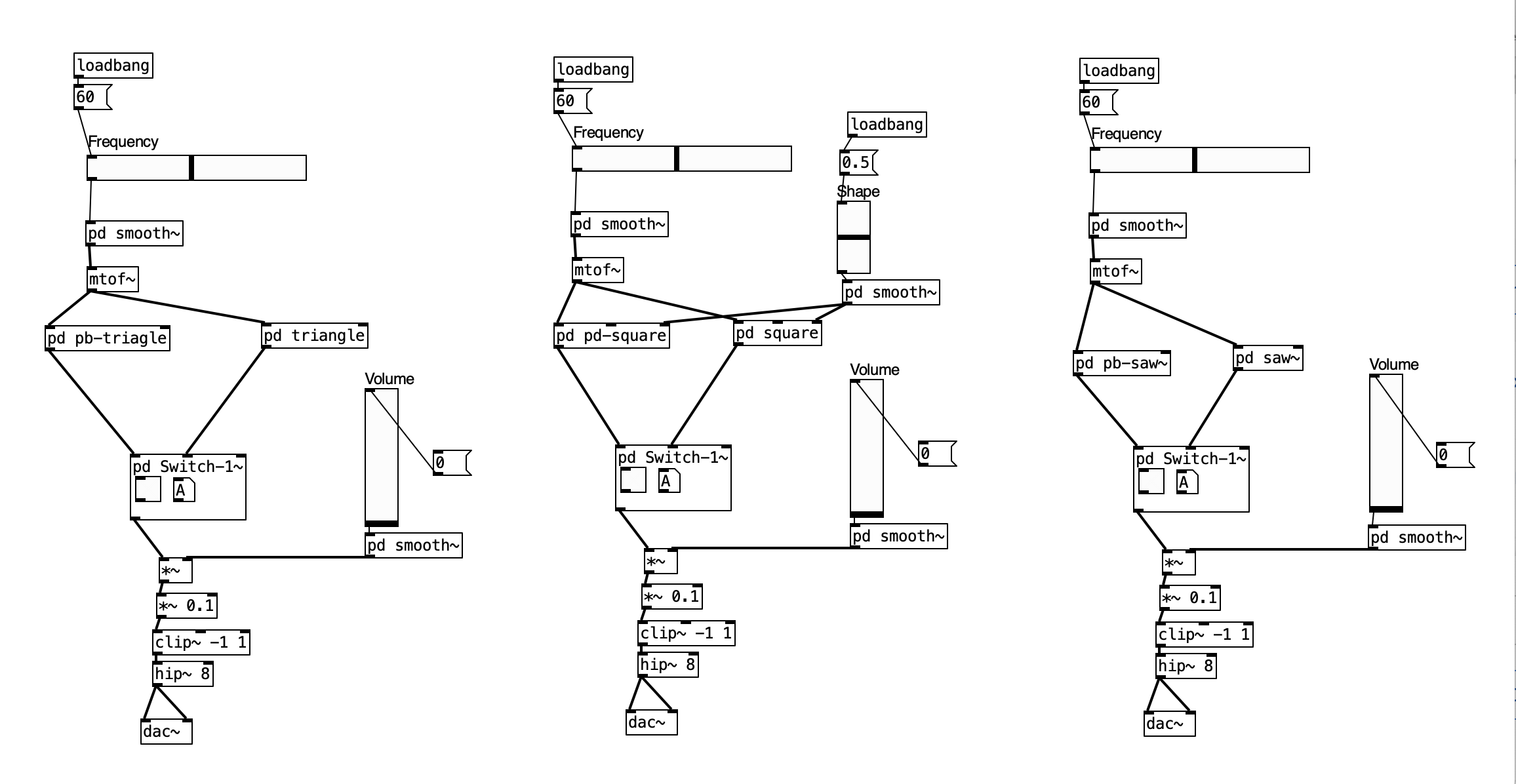
PolyBLEP oscillators are just totally awesome. I haven't found a more CPU efficient way to get basic oscillators free of aliasing or artifacts. This patch lets you compare the sounds of polyblep oscillators with their standard counterparts.
The polyblep triangle which I cobbled together may be of most interest as both the square and the saw are found in the heavy library.
The triangle works by feeding a pb-square into an integrator. The integrator could probably be used on its own for purposes like envelopes or experimental feedback. Note that there's an audio loop with send and receive objects so you may want to use the integrator in an abstraction or change the s/r names if using multiple triangles in the same patch. -
high_output-5000
posted in technical issues • read more
@Jwif said:
Couldn't resist a bit of thread necromancy!

Here's a way of generating randomised permutations of any input list
Additional necromancy! I found this patch to be helpful. A lot of interesting stuff in the RJDJ library it draws from as well. Just wanted to share a vanilla version as it takes some time to put all those abstractions into subpatches:
: vanilla permutation.pd -
high_output-5000
posted in patch~ • read more
Here's an updated version of the patch with the correct chord voicing:
Also wanted to share this electronics project. Stefan Vorkoetter designed a version of the chord egg using modern ICs.
https://www.stefanv.com/electronics/chord-egg-2015-remaking-a-paia-classic.html
-
high_output-5000
posted in patch~ • read more
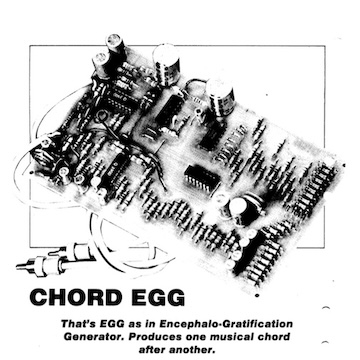
The PAiA Chord EGG creates an endless stream of majestic tones.
As soon as you turn it on, it instantly sends the listener on a trip to the underground oceans of the Europa.
The circuit was made by the American synthesizer company PAiA in 1978, and was distributed in electronics magazines for DIY builders.
Detailed schematics for it are still available online, but unfortunately one of the ICs is obsolete and difficult to obtain.After studying the schematics and listening to recordings of it, I decided to make a version in PD.
The Chord EGG randomly selects between four chords. Importantly, each note in a chord is faded in and out by a random slope generator, which I made by filtering a sample & hold source. The complete output is then made stereo by a pair of bandpass filters, which also have a random slope controlling cutoff.No abstractions are needed, but it can be used as an abstraction within other patches in addition to a stand alone patch.
Enjoy!
All credit for the original circuit design goes to PAiA, John S. Simonton, Jr. and Craig Anderson.IMG_2287.jpgchord-egg-low-res.jpgPAiA-Chord-EGGv002.pd
-
high_output-5000
posted in technical issues • read more
I've recently been thinking about using a Turing machine type module in Pure Data to add sequencers. Some of the Eurorack designs look pretty cool but, I'm not finding a lot of info on versions of these in pd. Any good examples or tips to design one?
-
high_output-5000
posted in technical issues • read more
Thanks! The toggle patch works like a charm!! This will save years of my life!
I'll just make a copy and send a message to the toggle objects to clear the receive of one and the send of the other.
-
high_output-5000
posted in technical issues • read more
@jameslo That sounds interesting! How do you set up the clone architecture?
-
high_output-5000
posted in technical issues • read more
I'm a beginner currently working on a 24/24 Toggle matrix to use as a general purpose tool for patching.
The Toggles are organized in a square grid inspired by a design used by a few vintage synths to connect modules together. The toggles basically function as ON/OFF switches for patching signals in a synthesizer.For example, if the output of a sine wave oscillator is sent to horizontal row ( 4 ) and the input of a filter is connected to vertical row ( e ) they can be connected together by triggering the toggle e4.
By sending (send) or (receive) messages in a message box I was able to give several toggles the same row name. I started manually numbering these but then realized that I’d have to name 1152 of them! Half of them sending and the other half receiving with different letter and number combinations.
Is there a way to give the toggles a two part message that includes the numerical row and the alphabetical row so I don’t have to manually add a number?
Or do some kind of row check similar to a button matrix?