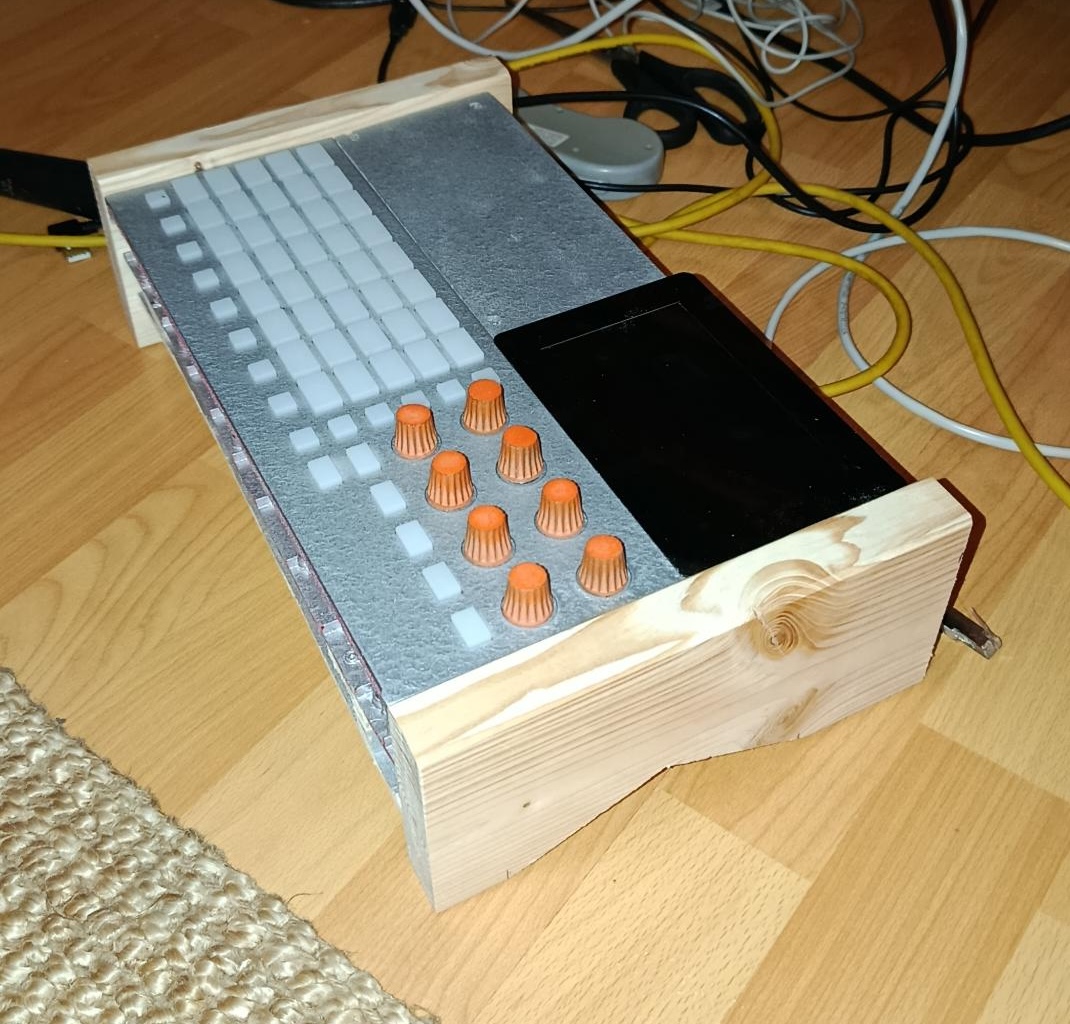
Hello everyone,
I've been reading and learning from this forum for a long time, and I finally have something to share back. First of all — thank you. Genuinely. So much of what I've figured out came from threads here, from patches people posted, from questions answered patiently by people who had no obligation to help. This community is one of the reasons this project exists at all.
The dream behind it
I play free improvised electronic music, and for years I tried to solve the same problem with hardware: I'd pick up a groovebox, fall in love with parts of it, and then hit a wall — some feature that was missing, some workflow decision that didn't match how I think musically, some thing I couldn't change. Eventually I always ended up back at the laptop. And the laptop on stage has its own problems — the open screen, the trackpad, the menus, the accidental clicks. I love Pure Data, but I don't love a workstation in front of my face during a performance. I wanted something that felt like an instrument in my hands, not a computer I was operating.
So I started building my own groovebox around Pure Data. I call it WUESTE MLP (Modular Live Performer).
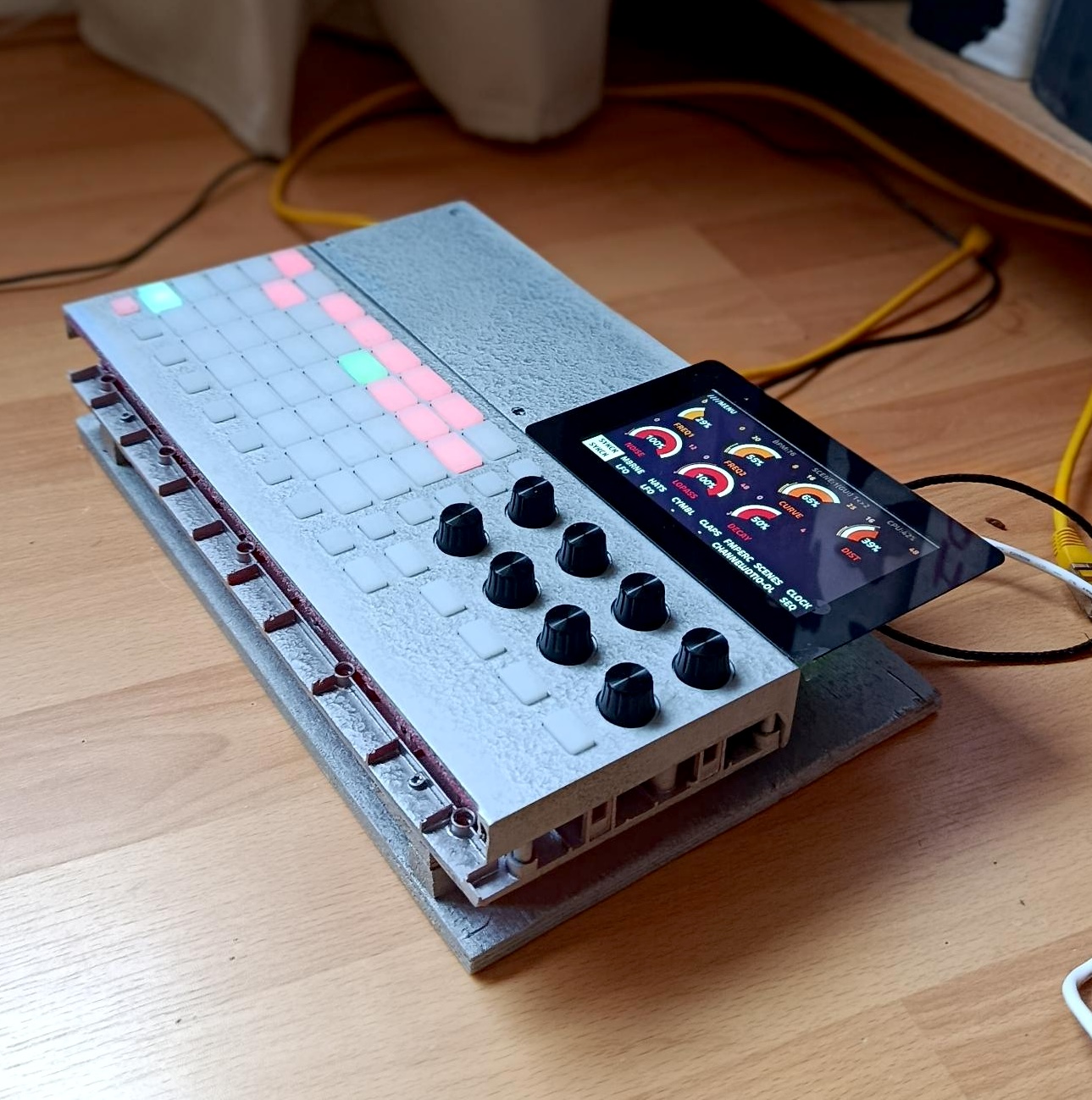
At its core it's a large Pure Data (Vanilla) patch designed like a modular synthesizer — currently with 64-step sequencers, drum modules, LFOs, mixers, and basic effects, all with its own saving and modulation structure. The philosophy is a fixed but modular structure: you design your ideal instrument before the performance, then commit to it in the focused moment of playing. No live patching paradigm — more like setting up a hardware modular, then performing with it.
It runs on a Raspberry Pi 5 with Patchbox OS (huge respect to Blokas Labs for making that possible), a HiFiBerry 8X for 8 audio outputs, and a modified Akai APC Key 25. A custom Python GUI handles everything that normally requires a desktop — loading patches, updating the system, importing from USB — so the performer never needs a terminal or a mouse. The touchscreen is the only interface.
The Pure Data side is the real heart of it. Honestly, the patch is basically a very mutated version of Automatism — I owe a huge amount to that project and to the Organelle ecosystem. Those projects showed me how Pure Data could be turned into a genuinely playable instrument, and MLP grew out of pulling that thread as far as I could.
Where it is now:
This is very much a first prototype but its working. The patches can be tested on any computer with Pure Data Vanilla — just open any main.pd inside the preset_projects/ folder, no GUI needed. So if anyone is curious about the Pure Data architecture, that's the easiest way in.
Codeberg repo: https://codeberg.org/johannkabuye/wueste_mlp
More info: https://wueste.info/tools.html
What I'm looking for:
Honestly, tips. If you look at the patches and see something obviously wrong or obviously improvable, I want to know. I'm not a trained DSP engineer — I've learned by reading, experimenting, and occasionally embarrassing myself in forum threads. If anyone is curious about testing it or wants to follow the development, I'll try to post updates here as things evolve.
Thank you again for everything this community has already given me without knowing it.