
Box number - [notein]
@atux said:
I tried [makenote] but I think something's missing...
Now I managed it without using [makenote]. The goal was to make each note persist until I change the number. In this way, by moving the slider, you obtain tied notes.
Now it works.
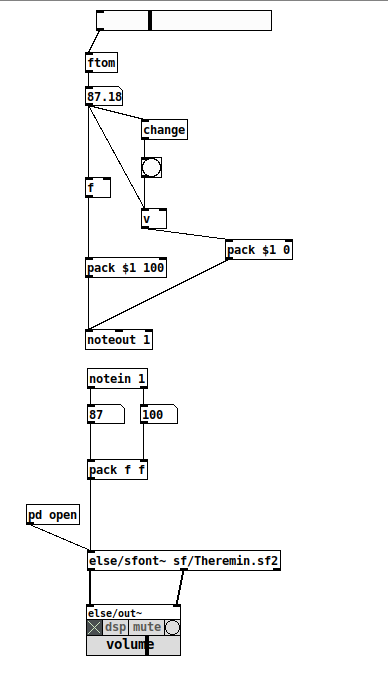
notein_3.pd
But now the problem is this: for example, the values 60.0, 60.1, 60.2 inside the number box always get the same note. Is there a way to make all the notes sound at their true frequencies? In this way you can obtain a true continuous glissando.
Thanks for any tips,
a.
 posted in technical issues
Box number - [notein]
@willblackhurst said:
look at "make note" you connect makenote to noteout
I tried [makenote] but I think something's missing... 
I mean, it works, but the durations are fixed... instead I need to figure out how to make the note off only happen when I change the number...
Any tips?
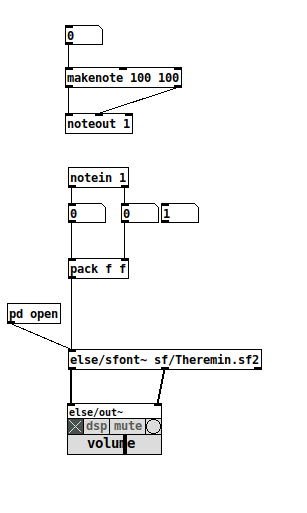
notein_2.pd
Thanks,
a.
posted in technical issues
Beginner midi sync question
Hello,
I'm away from my studio, but inspired to put an idea into effect that would necessitate bridging the divide between PD and my larger studio.
I have worked with the noteout and makenote, but for this experiment I'll need to have PD generating the master clock to some Elektron boxes. I've yet to find a sync module, nor have I found any tutorials that cover this.
What modules should I investigate? Is there something that takes metro output and resolves that as midi sync?
Sorry for such a basic question. Again, I'm not at a system that has Pure Data loaded to explore.
 posted in technical issues
Box number - [notein]
look at "make note" you connect makenote to noteout
. also, note out doesnt send to note in.
 posted in technical issues
help! can't output "note on velocity 0"
@willblackhurst said:
dont put length probably. note-on doesnt use length. makenote uses length.
Nobody has mentioned length in this thread... cause of the problem was already found anyway.
hjh
 posted in technical issues
help! can't output "note on velocity 0"
dont put length probably. note-on doesnt use length. makenote uses length.
posted in technical issues
record polyphonic notes into a table
@impression said:
I can’t really use [clone] for my synth setup.
I'm curious, why is that? There's probably a solution. If it's the first time you're using [clone], I can see how it might be tricky to figure out, but "haven't figured it out" may not be the same as "can't use it."
I’d basically need to generate my own note on and note off messages manually.
That's probably the [makenote] object.
hjh
posted in technical issues
record polyphonic notes into a table
@impression said:
Lets say I want 32 polyphony, that would be an insane effort.
IMO this all comes down to data structure design. A bad design will require insane effort. A good design will scale up to any amount of polyphony you need.
What's the input? From your MIDI keyboard?
What do you need to do with the notes afterward? Just spit the MIDI events back out, or quantize them, etc etc?
[text sequence] is a nice way to store note sequences. Each entry starts with the time delta before this note, followed by the note data, which may be anything you want (e.g., note number, sustain time, velocity, suitable for [makenote] when playing back).
It would really help if you could explain the goal, to help design a way to un-insane the insane effort.
hjh
posted in technical issues
knee compressor
@oid Analogue world sometimes semi-soft clips as you say... especially on magnetic tape, but in the digital world you cannot clip without distortion. So maybe add metering and an input gain.
If you add expansion to your compressor then you should add output metering and gain reduction as the final stage
Some digital compressors also mimic old analogue compressors and add "makeup" gain after the compressor, but that I find hard to work with in a live environment. In the studio it can be useful.
A meter showing the gain reduction of the compressor would also be a nice touch.... visual confirmation of the depth of the effect.
David.
 posted in technical issues
playing video in pd and internal midi sound
@KMETE said:
Any example for a simple midi player in Pd?
I'm not completely sure what you mean by "simple MIDI player," but I'll assume you want some Linux software that will play General MIDI sounds.
AFAICS from a quick web search, you would probably have to install a GM soundfont, e.g. sudo apt-get install fluid-soundfont-gm, and play it using software such as FluidSynth.
On my system, it took a little hunting, but I found /usr/share/sounds/sf2/FluidR3_GM.sf2 -- fluid, check, GM, check.
You'd probably have to connect Pd MIDI out to FluidSynth MIDI in. That should do it.
Is there any transport and tempo object in PD same as in max?
"Same as Max" -- well, no. Does Pd have its own way of handling tempo? Yes.
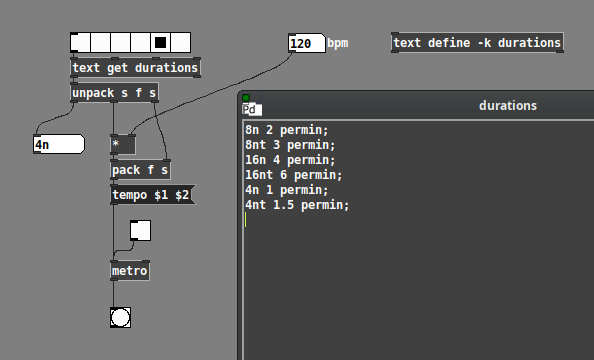
[metro] and [delay] objects respond to "tempo" messages -- see their help files. (Though unfortunately, some other timing-related objects such as [pipe] and [makenote] do not respond to tempo messages.)
Pd doesn't have a global transport. You could make your own bars/beats counter and [send] those values around in the patch. (I'm not sure if you need a master scheduler -- if so, there's one in https://github.com/jamshark70/hjh-abs .)
This appears to handle the different subdivisions.
hjh
posted in technical issues