
Trying to build a basic neural net with ann
Ok, nice patch. How many hidden layers do you use? maybe more of them could make a difference.
Also, here is a quote from ann manual :
"
Tip: inputs should be 0 centered
the example of chord recognition should not work well (hard to train)
because possible input values go from 30 to 90, you should remap them so
they go from -30 to 30
Notice how the inputs in ann/examples/ann_mlp_example2 go from -1 to 1
If you can't make inputs 0 centered they should at least start from 0
Tip: inputs should be normalized
If you have one input that goes from -10 to 10 and another input that goes
from -1 to 1 the first input will be more important than the second input
OUTPUTS:
Each "meaning" you want your ANN to detect should have its own output.
Notice ann/examples/ann_mlp_example2:
"Calm" and "chaos" have their outputs even if they are related.
I could have set only 1 output 0 for calm and 1 for chaos.
But having separated outputs I can see if my ANN has been trained well or
not, but also could be that a situation is neither calm nor chaotic, or
somehow calm AND chaotic.. " // davide morelli
I cannot say from the patch you've made if you had read it or not, in this case I thougt you'd be interested.
 posted in technical issues
MobMuPlat Ready Effects Collection (i.e. 30 Vanilla-compliant MMP effects) w GUI
"The PD trees sometimes bear unexpected fruit."
The zip below includes 29+1(raw) standardized effects (esp.) for use with MobMuPlat.
They all work and have been standardized in the following manner:
- all are MMP-compliant (so include only objects which MMP supports)
- have 3 inlets and 1 outlet~
- the inlets are (from left to right): the incoming signal (i.e. inlet~), the parameters(3), and a switch~
- the effects have all been finessed to only include <= 3 parameters
- the parameters are sent to the second inlet via [0 $1(, [1 $1(, and [2 $1(
- the switch is a toggle so 0|1
and - each window is 186x116 pixels.
I have included an .mmp file to listen to and test them with either adc~ | randomnotes. It also includes a bypass toggle , three parameter knobs (which load the parameter name to each label once an effect is chosen), and a gain. Only the selected effect's switch is turned "on" so it is very low on the cpu.
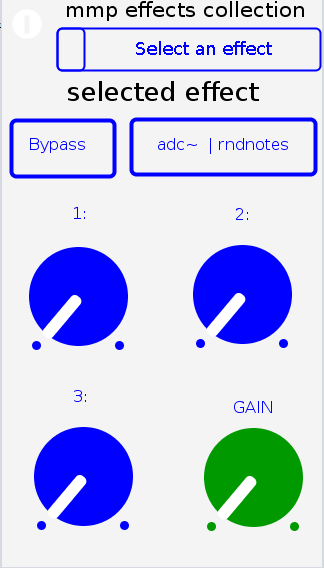
The MMP file, in and of, itself may prove useful to someone as it packages in a single place a 30-effect "pedal-box".
That however is not why I am sharing it.
Since the effects are standardized and mmp-compliant, my hope/thinking is others may include them in their work no matter what it may be and thus build their patches, apps, etc., using the effects as building-blocks.
I have accredit the original effects designers by adding a suffix (in parenthesis) to each effect as follows (in alpha-order):
d=DIY2 Collection
g=Guitar Extended
s=Stamp Album Collection
v=scott vanya (me)
The included effects (basically the best I could find that lent themselves to 3 parameters) are as follows:
audioflow(v).pd
beatlooper(v).pd
bodyresonance(d).pd
chorus(s).pd
delay(3tap)(d).pd
delay(fb)(d).pd
delay(pitch)(v).pd
delay(push)(v).pd
delay(revtap)(g).pd
delay(spect)(d).pd
delay(stag)(v).pd
delay(tbr)(v).pd
delay(wavey)(v).pd
detuning(g).pd
distortion(d).pd
filter(s).pd
flanger(s).pd
hexxciter(g).pd
looper(fw-bw)(v).pd
octaver-harmonizer(p).pd
phaser(s).pd
pitchshifter(d).pd
reverb(pure)(d).pd
ringmod(g).pd
shaper(d).pd
stepvibrato(g).pd
streamStretch(v)-help.pd
streamStretch(v).pd
tremolo(d).pd
vcf(d).pd
vibrato(d).pd
vibrato(step)(g).pd
wah-auto(v).pd
wavedistort(d).pd
Note: there are too many effects to go into detail about what each parameter does. So I leave that for you to either figure out/discover on your own or post here your question and I will answer it as time/energy/etc allow.
Peace and Loving Music Through us all.
Sincerely,
Scott
 posted in patch~
ArguScore
Here is an updated version
arguscore-update.zip
and a few Purr Data compatibility replacement objects: purr-data-compatible-replacements.zip
A creation argument only object driven system for instant music making;
Objects so far;
Required;
globaltimer - outputs a 10ms bang to drive all objects;
globalsync - resets all objects to zero or start;
audio~ - dac~ catcher~ for all throws~, output level, mute;
Sound Objects
By default sound objects start playing at the bpm of the first argument
basspump - args - bpm note distortion duration
wood - args - bpm note duration
tremsaw - args - bpm note vibrato distortion duration
tremsine - args - bpm note vibrato noise duration
noisy - args - bpm note vcfq duration
kauplus - args - bpm note string-resonation duration
Effect Objects
sqr - args - 16 required(0 or 1) bpm (starts playing by default)
overides sound objects autoplay
2 optional args for cursor offset and pitch if font different
has 16 outlets to send 0 or 1
echo-delay-bpm - args - bpm feedback(0 to 100) level(0 to 100)
echo-delay-ms - args - millisecs feedback(0 to 100) level(0 to 100)
pan-level - args - pan (-100 to 100) level (0 to 100)
autopan - args - width (0 to 100) frequency (* 0.01) level (0 to 100)
fade - args - millisecs to fade-in pecentage of level to drop to (0 to 100) millisecs to fade-out
filter - args - highpass (midi note to frequency) lowpass (midi note to frequency)
(0 to 135 equates to approx 8Hz to 19912Hz)
start-delay-secs - args - seconds (delays the autostart of the connected object)
start-delay-bpm - args - bpm (delays the autostart of the connected object)
stop-delay-secs - args - seconds (outputs a one at the end of the delay which can connect to a globalsync)
stop-delay-bpm - args - bpm (delays the autostart of the connected object)
isolator - sits between two sqr's and sends a signal to start/stop the receiving sqr
seqnotes - four pairs of note & velocity that receive sqr ones to fire a connected sound object
Notes
Can crash Pd when making lots of edits to arguments, particularly while playing, so save often
There is a [declare -path objects] hiding behind the audio~ object
Fixed missing note and velo message for tremsaw
Two more arguscore patches can be open at the same time providing only one patch contains the globaltimer and audio~ objects (see arguscore-2.pd and arguscore-2-b.pd)
new objects
kauplus, autopan, fade, filter, stop-delay-secs, stop-delay-bpm;
 posted in patch~
Audio Ideas (AI) Collection (placeholder, currently only links)-effects, controllers, mmp, etc.
Audio Ideas (AI) Collection (placeholder) currently only links
per @LiamG 's kind suggestion I have begun the process of consolidating my abs and patches, etc. into a single location/zip file or for possible upload to github.
Just to get the ball/me rolling and scope the work I got the links for my shares into a single location to later be consolidated into the single AI Collection.
For now at least, please, bare with me (and the links below) as ideas I am more passionate about currently are demanding my attention. (Which  funnily enough will probably also be included in the set, where ever they are shared.)
Thanks, for your patience and all you do for the Pure Data Family.
Sincerely,
Scott
abstract~
pushdelay-envelope-env-driven-delay-line-with-both-delay-time-and-feedback-dependent
numpad-abstraction-for-entry-of-large-numbers-via-click-instead-of-sliders-includes-basic-calculator
abs_delay_fbw-feedbackwards-lifo-last-in-first-out-delay
abs_sequences_by_formula-sequences-by-formula-abstraction-ex-collatz
abs_effects_router-60-effects-in-one-abstraction-router-from-diy2-stamp-album-my-abs
visualcontrolsurface-vsl-values-set-by-their-location-on-the-screen-req-ggee-shell
abs_4-8-14_way_toggle-pair-2-toggles-resulting-in-4-8-or-14-states
audioflow-delay-to-forward-backward-looper-using-speed-control
5-band-equalizer-with-bezier-controller-eq5_mey_w_bezier_sv-pd-updated-to-8-band-below
forward-backward-looper-orig-abs-from-residuum-whale-av
abs_rgb2hex-rgb-0-255-colors-to-hexadecimal-values
pseudo-12-string-effect-6-string-guitar-to-sound-like-a-12-string
jack_midi2pd_2sys_connector_sv-jack-midi_out-to-pd-sys_playback-switcher
abs_4to16pads_bin_conv_sv-convert-4-midi-pads-from-a-binary-value-to-a-decimal-for-rerouting
abs_automatedslider_sv-automated-control-changer-pd-and-mobmuplat-editor-versions
idea-for-effects-stack-ing-technique-control-mother
micin-_abs-abstraction-convert-signal-to-notein-ex-using-a-midi-synth-as-a-guitar-pedal
curve_abs-tri-way-curve-switch-to-change-control-values-in-either-linearly-convex-or-concave-manner
a-preset-control-abstraction-for-saving-parameters-presets-to-text-files
4-tap-delay-with-pitch-shifter-per-delay-line-adaptation-of-diy2-patches
patch~
extra
the-15-owl-faust-patches-compiled-as-32bit-linux-externals-attached
libpd
mmponboardeditortemplate-mmp-for-creation-of-mobmuplat-files-directly-on-the-handheld-android-only
3d-synth-webpd-tree-js-webgl_camera_cinematic-html-example
Off topic
posted in patch~
pushdelay~ - envelope [env~] driven delay line with both delay time and feedback dependent
As I mentioned in a previous post: "idea: "riding the wave"delay length triggered by env~ size (link http://forum.pdpatchrepo.info/topic/10557/idea-riding-the-wave-delay-length-triggered-by-env-size)", I had been wondering about controlling a delay line via the env~.
pushdelay~_sv-help.pd
pushdelay~_sv.pd
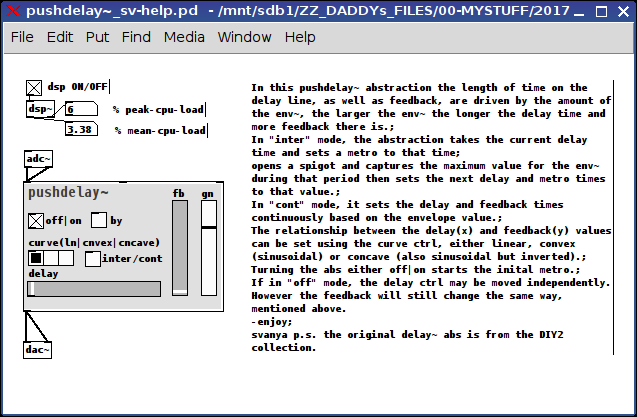
My idea had been to mimic the "power" of a wave (akin to what I have been suspecting we will do once we figure out how to harness the power of gravity waves): the larger the amplitude > the further the auditory "ripple" and the longer it lasts.
The abstraction below, pushdelay~, is my incarnation of that idea.
Ciao!
Much merriment thru you and yours.
Scott
-help (from the -help comments):
In this pushdelay~ abstraction the length of time on the delay line, as well as feedback, are driven by the amount of the env~, the larger the env~ the longer the delay time and more feedback there is.;
In "inter" (interval) mode, the abstraction takes the current delay time and sets a metro to that time;
opens a spigot and captures the maximum value for the env~ during that period then sets the next delay and metro times to that value.;
In "cont" mode, it sets the delay and feedback times continuously based on the envelope value.;
The relationship between the delay(x) and feedback(y) values can be set using the curve ctrl, either linear, convex (sinusoidal) or concave (also sinusoidal but inverted).;
Turning the abs either off|on starts the inital metro.;
If in "off" mode, the delay ctrl may be moved independently. However the feedback will still change the same way, mentioned above.
-enjoy;
svanya
p.s. the original delay~ abs is from the DIY2 collection.
posted in abstract~
GEM error
I know this has been asked a few hundred thousand times- i know because i've been reading everything i can find. But most of the documentation and posts are apparently outdated, or don't seem to work for me.
I had been learning pure data for a few weeks about a year ago using pd extended, but noticed that the libs haden't been updated for a long time, so when i got back into it yesterday i decided to start with the nonextended version.
At first i didn't realize that Gem isn't a standard library, so downloaded it, installed, eventually found that someone suggested to go to edit/preferences/startup, make a new entry and just type "gem" and add it. I did that, restarted. The log window still shows a lot of error messages, it looks like PD is searching for two files:
gem.dll
Gem.m_i386
There are a lot of lines that indicated tried and failed for both, but eventually i see "succeeded" for gem.dll, but not for Gem.m_i386.
Anyway i 'put' an object called gemwin and two messages, create and destroy and link them both to gemwin after creating a new project, then switch to run mode ctrl-e and click on create. Nothing happens. It should make a black, empty gem window, but it doesn't.
In the log window, there are no entries added after clicking on create/destroy, i don't know what i'm doing wrong, can someone suggest what to do?
I've been reading for hours, a lot of pages suggest where to look, but have dead links, or the suggestion didn't help, any ideas?
I pasted below the full startup log (the full log using the "all" option).
Thanks:)
Rob T
------------------ done with main ----------------------
input channels = 2, output channels = 2
Default font: DejaVu Sans Mono
tried ./Gem.m_i386 and failed
tried C:/Users/me/AppData/Roaming/Pd/Gem.m_i386 and failed
tried C:/Program Files (x86)/Common Files/Pd/Gem.m_i386 and failed
tried C:/Program Files (x86)/pd/extra/Gem.m_i386 and failed
tried ./Gem.dll and failed
tried C:/Users/me/AppData/Roaming/Pd/Gem.dll and failed
tried C:/Program Files (x86)/Common Files/Pd/Gem.dll and failed
tried C:/Program Files (x86)/pd/extra/Gem.dll and failed
tried ./Gem/Gem.m_i386 and failed
tried C:/Users/me/AppData/Roaming/Pd/Gem/Gem.m_i386 and failed
tried C:/Program Files (x86)/Common Files/Pd/Gem/Gem.m_i386 and failed
tried C:/Program Files (x86)/pd/extra/Gem/Gem.m_i386 and failed
tried ./Gem/Gem.dll and failed
tried C:/Users/me/AppData/Roaming/Pd/Gem/Gem.dll and failed
tried C:/Program Files (x86)/Common Files/Pd/Gem/Gem.dll and failed
tried C:/Program Files (x86)/pd/extra/Gem/Gem.dll and succeeded
GEM: Graphics Environment for Multimedia
GEM: ver: 0.93.3
GEM: compiled: Nov 10 2011
GEM: maintained by IOhannes m zmoelnig
GEM: Authors : Mark Danks (original version)
GEM: Chris Clepper
GEM: Cyrille Henry
GEM: IOhannes m zmoelnig
GEM: with help by Guenter Geiger, Daniel Heckenberg, James Tittle, Hans-Christoph Steiner, et al.
GEM: found a bug? miss a feature? please report it:
GEM: homepage http://gem.iem.at/
GEM: bug-tracker http://sourceforge.net/projects/pd-gem/
GEM: mailing-list http://lists.puredata.info/listinfo/gem-dev/
GEM: compiled for SIMD architecture: SSE2 MMX
GEM: using SSE2 optimization
The Pd window filtered 40 lines
The Pd window filtered 41 lines``` posted in technical issues
Variable delay patch - need help
Hi,
The attached patch dsdelay is supposed to be a variable delay line with a moving write point. vd~ uses a moving read point which is acceptable for most applications but not what I am working on. I have implemented my moving write point delay line in MATLAB and it works reasonably well. However I am experiencing issues with PD implementation.
The patch uses a table to store the delay line values and is supposed to use a circular delay line method (i.e. the read/write points shift with time instead of the actual elements of the delay line). The intention is that the read point shifts along the delay line by one sample per sample, and the write point does the same whilst the delay is not being altered. The write point uses a simple two point extrapolation to allow writing at fractional table indices.
I'm having two problems:
1. I can't find a satisfactory method of wrapping signal values in an arbitrary range. I want to be able wrap a signal value between 0 and 44100 for example, but using
|
[/~ 44100]
|
[wrap~]
|
[*~ 44100]
|
gives rise to rounding errors which create artifacts in the output. This is why in the current state, the output is intermittent rather than continuous.
2. For some reason the 2 point extrapolation seems to be not working correctly. I'm getting a ring modulation type effect on the output. In MATLAB the addition of the two point extrapolation helped to minimise artifacts when the delay time was being altered. Altering the delay time gives rise to horrible artifacts at the moment though.
Any pointers on how to get this working properly would be greatly appreciated.
Thanks
Ben
 posted in technical issues
HID elements problem
Hi,
I'm getting the same element code for two of the analogue channels on my HID, does anyone have a solution?
Here is the device info that PD is giving me:
TYPE_CODE_________#____EVENT NAME___________
abs abs_x 0 Miscellaneous Input, X-Axis
abs abs_y 0 Miscellaneous Input, Y-Axis
abs abs_z 0 Miscellaneous Input, Z-Axis
abs abs_rx 0 Miscellaneous Input, X-Rotation
abs abs_ry 0 Miscellaneous Input, Y-Rotation
abs abs_rz 0 Miscellaneous Input, Z-Rotation
abs abs_ry 1 Miscellaneous Input, Dial
abs abs_throttle 0 Miscellaneous Input, Slider
I don't have an issue with other software which recognises it as "Dial", which PD is doing, but i can't access this tag...
Thanks!
Yas
 posted in technical issues
Export patch as rtas?
@Maelstorm said:
If you're on OSX, jack can be used as an insert plug-in so you can avoid the separate tracks, but you still get the latency.
which you can, depending on your host, eliminate by setting the track delay for the track with the plugin. So if the buffer is 512 sample/11.82 ms then set the delay to that and it should be spot on.
I've had the whole Jack graph latency explained to me numerous times by Stephane Letz and it still doesn't go in.....Heres what he told me...
> > Its the Pd > JAck > Ableton latency. (Ableton has otoh 3 different
> > ways of manually setting latency compensation - I'm just not very
> > clear on where to start with regards to input from JAck)
> >>>>
>
> This is NO latency introduced in a Pd > JAck > Ableton kind of
> chain; the JACK server activate each client in turn (that is Pd *then*
> Ableton in this case) in the *same* given audio cycle.
>
> Remember : the JACK server is able to "sort" (in some way) the graph
> of all connected clients to activate each client audio callback at the
> right place during the audio cycle. For example:
>
> 1) in a sequential kind of graph like IN ==> A ==> B ==> C ==> OUT,
> JACK server will activate A (which would typically consume new audio
> buffers available in machine audio IN drivers) then activate B (which
> would typically consume "output" just produced by A) , then activate
> C , then produce the machine OUT audio buffers.
>
> 2) in a graph will parallel sub-graph like : IN ==> A ==> B ==> C
> ==> OUT and IN ==> D ==> B ==> C ==> OUT (that is both A and D are
> connected to input and send to, then JACK server is able to
> activate A and D at the same time (since the both only depends of IN)
> and a multi-core machine will typically run A and D at the same time
> on 2 different cores. Then when A *and* D are finished, B can be
> activated... and so on.
>
> The input/output latency of a usual CoreAudio application running
> is: driver input latency + driver input latency offset + 2
> application buffer-size + driver output latency + driver output
> latency offset.
>
this next part is the important bit i think...
> For a graph of JACK clients: driver input latency + driver input
> latency offset + 2 JACK Server buffer-size + ( one extra buffer-
> size ) + driver output latency + driver output latency offset.
>
> (Note : there is an additional one extra buffer-size latency on OSX,
> since the JACK server is running in the so called "asynchronous" mode
> [there is also a "synchronous" mode without this one extra buffer-size
> available, but it is less reliable on OSX and we choose to use the
> "asynchronous" mode by default.])
>
> Stephane
>
 posted in technical issues
Different ways of Implementing Delay Loops
Ta Toxonic - I'll take a look at the patch tonight. Good of you to take the time. Apologies if I've misunderstood though, but I think what you're describing is not quite what I mean: The pitch shift is separated out from the delay time - you're running a pitch shift effect into a separate delay line, which is not going to give the same effect. The delay time will not shorten as the pitch rises. I'll take a look at your patch tonight though as I may have misunderstood what you're getting at.
Maelstorm - thanks also. I understand why the pitch changes on a delay pedal. The pitchshifter patch was a bit of a red herring - though of course it's the same principle. The difference between what you're (both, I think) talking about and what I'm talking about is the way that the pitch changes.
Assuming a stable C tone playing into the delay:
With the standard simple PD delay set up, if you move the read point of a vd~ then you get a glissando as it accellerates, a constant pitch change as it moves at constant speed. So if you turn the knob to change the delay time in the middle of a tone you start with a constant pitch (C), then get a rise of pitch, then it levels out at a new pitch (as you turn then stop turning the knob),
_
___/
If you feed back into the delay, the glissando is repeated as the read speed changed while the write speed was constant:
_ _ _ _
/ |/ |/ |/ |
The effect I'm looking to emulate on the other hand is more akin to changing the speed of a phasor~ reading an array - the pitch change is not a blip, but a stable interval's transposition - eg: you turn the knob, the pitch of the repeats rise by a given interval and stays at that pitch as it repeats (now more quickly):
______
___/
If you play a constant C tone, then speed up the delay until it is a major third higher, you get a major third diad (until the delay dies away), rather than a C tone with a repeating squiggle overlaid.
The effect is the same as you get by speeding up a tape loop delay (though the pedal I'm trying to imitate is a digital delay) which is why I think the rate of the write and read heads are being increased by the same amount.
[edit, just tried to make this clearer and removed a couple of errors]
 posted in technical issues