
Poor performance in Sequencer
@ionicle I agree with oid....... windows wish is not great.
To make up for my bad post above....... here is your patch using abstractions...... seqo.zip
It automatically saves your patterns, and you can easily add more drum sounds without the screen becoming cluttered.
You might find it hard to understand how the abstractions work. There is some help for that here...... https://forum.pdpatchrepo.info/topic/9774/pure-data-noob and then especially further down that thread... here....https://forum.pdpatchrepo.info/topic/9774/pure-data-noob/4
Once you understand the use of abstractions you will be able to build patches faster and more easily..!
David.
 posted in technical issues
I need an object to unpack an incoming midi chord (midi in, note in )
@whale-av said:
@gentleclockdivider "Let's recap , a chord ( thus separate incoming midi notes perceived as a chord ) goes into pure data , I want to extract the midi note values .
UNpack -only unpacks last received note+velocity , that's why I wrote that an object that detects the time between incoming events could be the solution .
SO let's say I play a simple c min (midiin) , which has the midi note nr's 48 , 51 , 55 ....I want these these to appear in separate numboxes ."[unpack] produces all the note numbers...... but you only see the last..... a [print] will show them.
As I said at the start of this thread, [poly] will separate them for you as it indexes the notes.
You could then use [route] to separate them but [clone] is more useful as you can clone a synth inside if you wish.
The indexes from [poly] can be used to allocate the notes to the clones, and [poly] then ensures that you have no hanging notes as the noteoff messages are allocated the same index.As the idea of a chord is human and has no meaning in Pd, midi, or even on a keyboard, why would you need to group the notes together with a timer or a threshold.... I am just curious...
To correct bad keyboard technique...?The method using [poly] and [route] is shown in your Pd/doc folder....... Pd/doc/7.stuff/synth/1.poly.synth.pd .... since at least 2011.
David.
I reall think we have a communication error here .
I know that a chord does not exist in pure data -midi etc...and that it's a sequential message of single notes , I have expresed that in my first post .
I am also aware that only the last of the messages is shown by the unpack module .
- quote-
As the idea of a chord is human and has no meaning in Pd, midi, or even on a keyboard, why would you need to group the notes together with a timer or a threshold.... I am just curious...
To correct bad keyboard technique...?
-unquote -
Bad keyboard technique ??
I just wanted pure data to SHOW all incoming midi notes that make up the chord , not in the console but in the structure view ., , your treshold value example did that .
Why is it so bizarre to ask for that , max msp has a dedicated object for exactly that , says enough .
 posted in technical issues
I need an object to unpack an incoming midi chord (midi in, note in )
@gentleclockdivider "Let's recap , a chord ( thus separate incoming midi notes perceived as a chord ) goes into pure data , I want to extract the midi note values .
UNpack -only unpacks last received note+velocity , that's why I wrote that an object that detects the time between incoming events could be the solution .
SO let's say I play a simple c min (midiin) , which has the midi note nr's 48 , 51 , 55 ....I want these these to appear in separate numboxes ."
[unpack] produces all the note numbers...... but you only see the last..... a [print] will show them.
As I said at the start of this thread, [poly] will separate them for you as it indexes the notes.
You could then use [route] to separate them but [clone] is more useful as you can clone a synth inside if you wish.
The indexes from [poly] can be used to allocate the notes to the clones, and [poly] then ensures that you have no hanging notes as the noteoff messages are allocated the same index.
As the idea of a chord is human and has no meaning in Pd, midi, or even on a keyboard, why would you need to group the notes together with a timer or a threshold.... I am just curious...
To correct bad keyboard technique...?
The method using [poly] and [route] is shown in your Pd/doc folder....... Pd/doc/7.stuff/synth/1.poly.synth.pd .... since at least 2011.
David.
posted in technical issues
How to keep number until turn knob
@ytt Perhaps this? It lacks the fault of the [expr] version which can leave you not being able to reach min or max rotation without altering the other value but it means the knob does nothing until you reach its old value. Error in the pic ([i] and [change] are reversed) but fixed in the file.
knob.pd
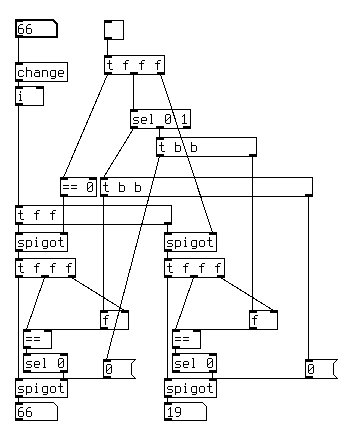
Edit: The [i ] -> [change] might be less then ideal and may not work at all depending on the output of your knob, if it outputs a float between 0 and 1 then this will not work as patched. Few different ways to fix this issue, depends on what exactly pd recieves from the knob and what your needs are.
 posted in technical issues
How to keep number until turn knob
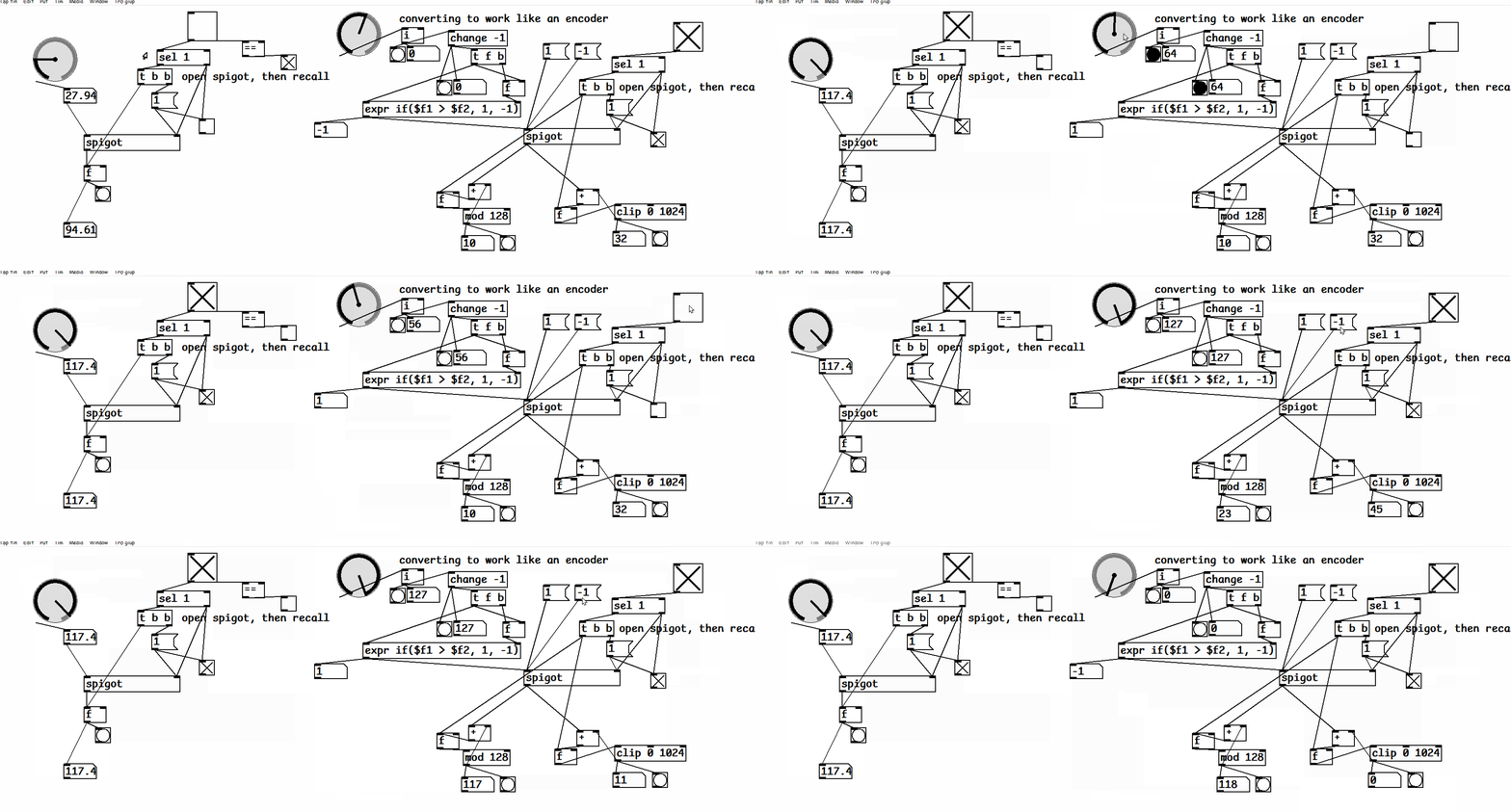
it gets in the weeds - basically you got a problem if your knob isn't a digital encoder which sends things like +1 or -1 to move numbers - typically these also have a push button.
if your knob is a potentiometer/slider/knob/pot like on an electric guitar - these only give discrete values and will Jump like on the left.
if you use one of those like I am on the right - and I apologize for it seeming messy, I'm cleaning up little problems - but the knob is still a potentiometer, so even tho I changed it into something that compares if its going higher or lower it ends up at weird places - so to do it right these needs to be an encoder type of knob - (which I'm simulating by just hitting the 1 and -1, a little surprised acting like an encoder isn't in [knob] yet.)knob-problems-pot-vs-encoder.pd
 posted in technical issues
how would you recreate this mixer channelstrip abstraction?
@oid said:
@esaruoho If you are trying to save CPU than I would just separate UI and DSP, run the UI in its own instance of PD and DSP in another, communicate between them with [netsed]/[netreceive], there comes a time in PD when you just have to either separate UI and DSP or sacrifice. Beyond that it is difficult to say, I do not know what your needs are and what sacrifices are acceptable. What are your requirements? I can optimize these patches in a dozen different ways but I have no idea if any of them will meet your needs since I do not know what your needs are or even why you are trying to change things beyond a vague notion of there possibly being something better.
ok. i have heard about this UI DSP separation. so.. is it a case of every single slider for instance needs to do a [netsend] to some other abstraction that only does DSP? or have two separate patches altogether, one for UI and one for DSP? sorry, i'm really vague on this.
So, my main painpoints with the current channelstrip is that when I set up 16 "LFOs" to "breathe" up and down the volume slider (which also has slider-color-changing while it is moved from 0 to 1) - when i have more than 4 of these LFO counters cycling from 0...1 on the channelstrips, all sliders stop updating. it might be 4, 8 or 12, but by the time i try to get all 16 of the looper volumes to cycle from 0...1 (my "breather" has a setup of cycling from "min-max every 2 seconds" to "min-max every 60 seconds") -- and that to me makes me think that the UI is not as optimized as possible.
i keep hearing that ELSE library supposedly has some larger crossmatrix/channelstrip that i could use, but i have not looked at it.
so ideally i'd prefer to take the channelstrip even further, i.e. have all effect sends be modulatable (well, that word where the effects have LFO modulation) so i could have even larger more complex things going on where the channelstrips that receive audio from loopers, are sent to specific sends like reverbs, delays and so on. this kind of larger modulation on all parameters would be really useful.
the way the channelstrip is built is that the dwL and dwR go to a separate [diskwrite~] abstraction which i use to record audio. the "p" (and p1-p8) defines that any channelstrip that has p enabled, is sending to all the other loopers - so in that case, any audio that goes to a channelstrip, can be sampled into the 64kb loopers (16 of them).
also i have thechannelstrip labels (i.e. volume slider name) dynamically written to, so i can always have them easily understandable / informative.
here's the "init state". i use bunches and bunches of loadbang -> message -> senders to get them to a specific state. .

one thing i've been toying around as an idea is to incorporate highpass and lowpass filters to the channelstrips, and EQ. but i haven't figured out how to solve the EQ issue so that the single band peak EQ could be incorporated into such a small formfactor ( the width is only 38 and height is 189 so it's hard to conceive how an EQ could be usable there).
i also have for the 16 channelstrip looper instances, BCR2000 + BCF2000 volume slider control and so on. but i'm willing to take the whole setup "to the dock" and rewrite it, if i could be sure that it will be lighter on the cpu..
so yeah, i do only have a vague notion of "maybe it could be better, i'm not sure?".. but i've not yet seen much netsend + netreceive stuff so i'm not entirely familiar how it could be done and how much i need to rewrite (i.e. does everything need to be netsend+netreceived with a complete split of DSP and UI, to reap the benefits, or can i just try it with the 16 loopers and see what happens?
 posted in technical issues
Midi Rotary Knob Direction Patch/Algorythm?
@oid said:
@Bangflip
Edit. you are trying to emulate a relative encoder with an absolute encoder, which will not work well, you will run out of knob, depending on the parameter you are editing and the knob movements you make, the knob could very well end up at min or max even though the parameter has not. You would probably be best off updating the knob value after every change, set to midvalue, detect change, determine if it is up or down, set back to mid value. Also make sure your controller can not be set to relative values for the encoders, many can and then all this will be unneeded.
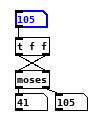
Thank you for your answer. Id did know moses already, it is very helpful. Unfortunately the Houston only is sending absolute values: "The 8 x Rotary-Encoders send MIDI ‘Controller’ MSB/LSB absolute position". There is no option to change that as far as I know. It is an 20 years old controller and the support was dropped years ago.
Yes exacly. I am updating the knob value after every change. But I struggle to get the the up, down detection.
 posted in technical issues
Midi Rotary Knob Direction Patch/Algorythm?
Hey everybody,
Sorry, for a lot of text. But the bold text at the bottom is my main question. The rest will help you to get a better understanding of my situation.
you helped me so much, with my last question here (the Faders are working dope now):
https://forum.pdpatchrepo.info/topic/13849/how-to-smoothe-out-arrays/25
I am doing a Steinberg Houston to Mackie Control emulation at the moment, to use my controller with other DAWs than Cubase/Nuendo. Will upload it to the internet community, when I am finished for the handful of people that maybe are also using this controller.
I made good progress:
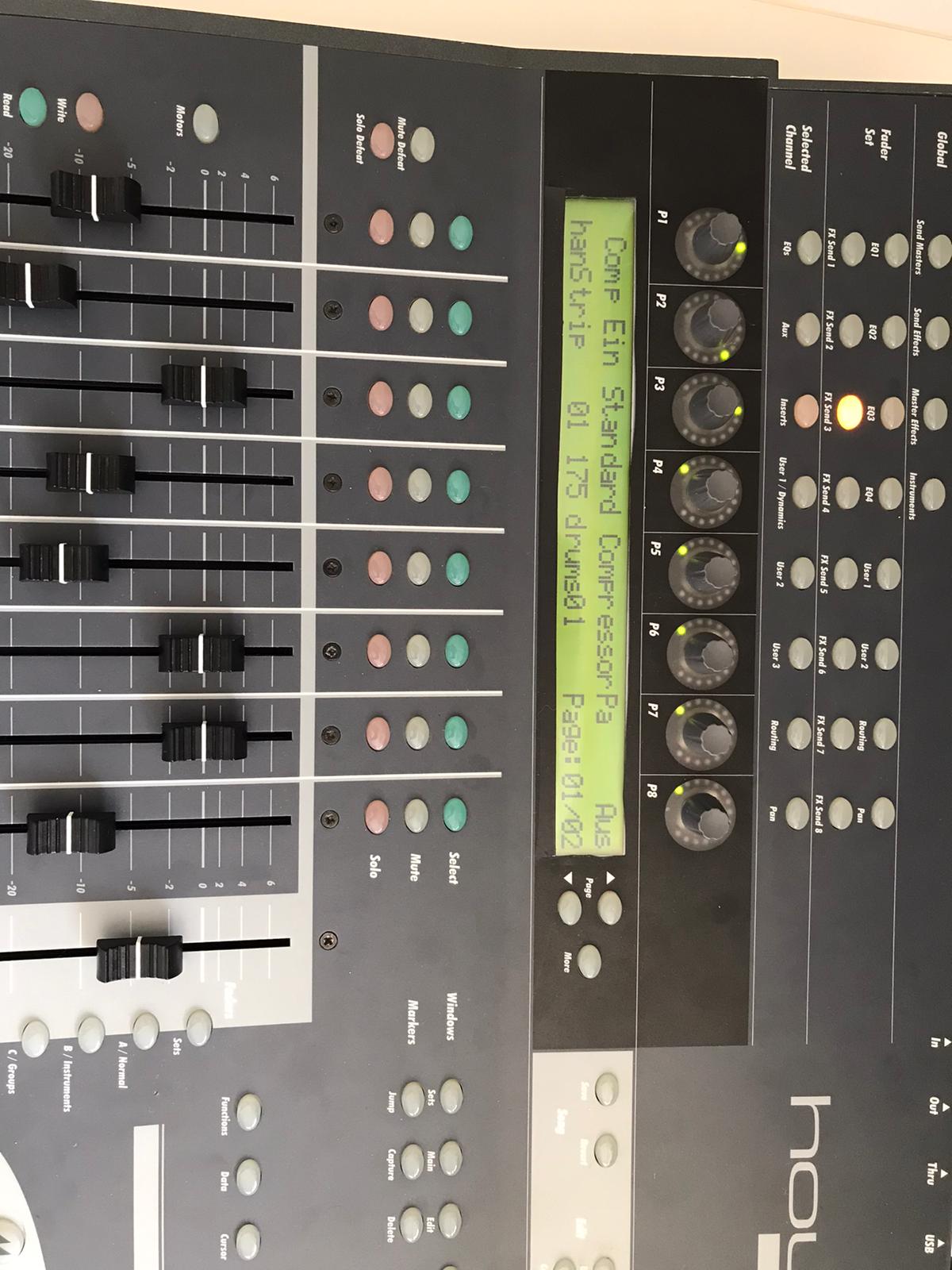
I got the Faders and the normal knobs to work. And the display puts out information. But it is with bugs, because the LCD Screen of the Houston has 40 characters for one line and the Mackie Universal Pro has 56 Characters. So i did a list algorithm, which deletes spaces of the mackie message until the message fits on the 40 character line. Maybe there is a method wich will work better but this subject eats too much time for me at the moment and it works rough okay. One defenitely get's some helpful information on the screen from the DAW.
The Faders and Rotary Knobs and normal knobs are the most important of this controller I guess. The Faders are working fine as I mentioned above, but there is a problem with the rotary knobs, wich I can't handle alone and hope you can help me. 
The problem is, that the Mackie Controller send simple clicks to the DAW. If you are turning a rotary knob, it sends out a number of midi messages:
If you turn it right, it sends midi messages wich contains the value 1 and if you turn it down it sends messages wich are containing the value 65.
"When the VPots are rotated rapidly, a message equal to the number of clicks is sent."
BUT the Houston controller instead is sending values like it's faders with 15 (MSB) and 128(LSB) values. AND it is updating the rotary limit by itself. So if I turn a rotary, it will update it's LEDs and stops sending midi messages when it reaches the maximum or minimum value. So, I did this patch as a momentary state:
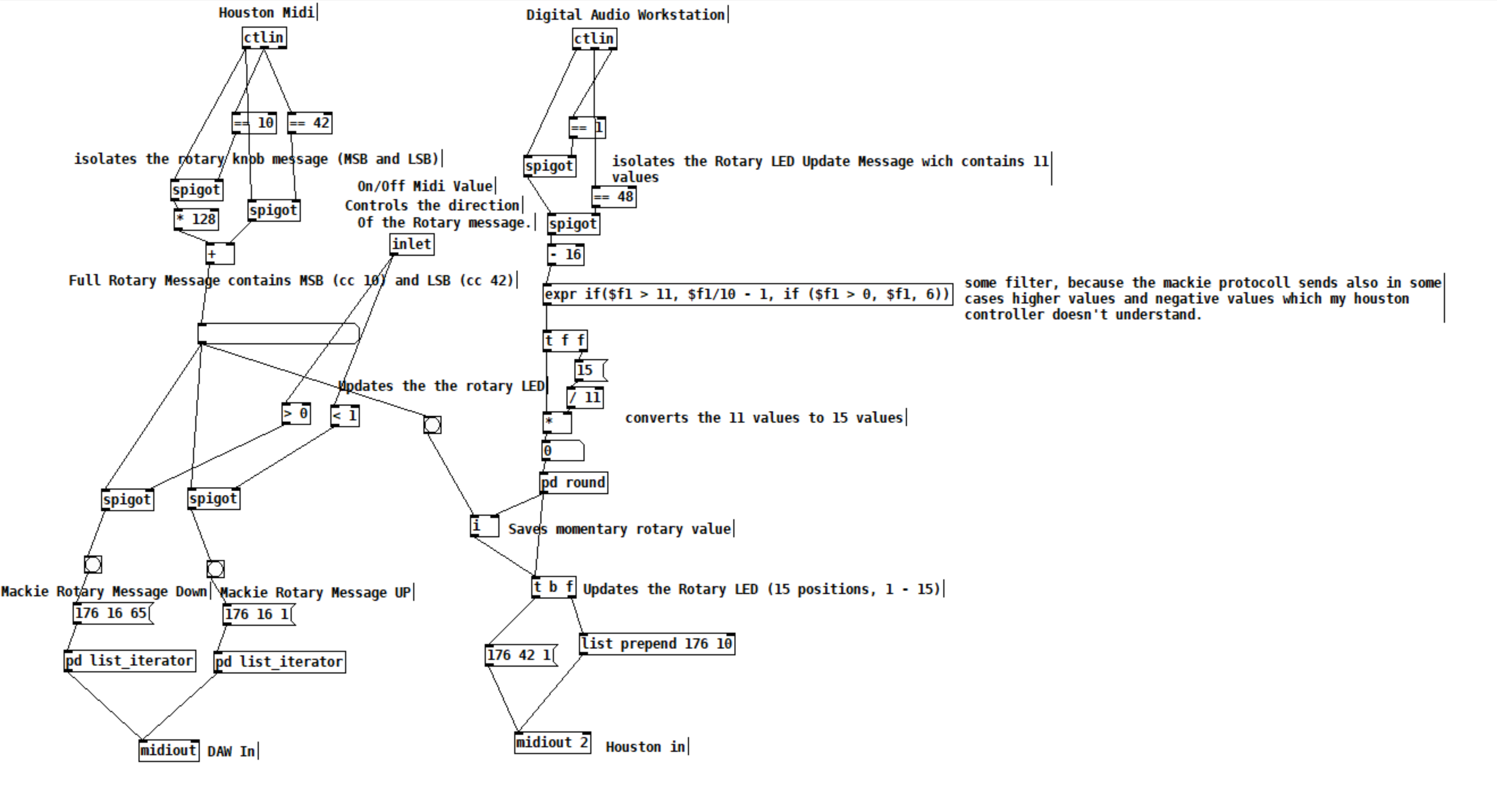
The DAW sends 11 values for the Houston LEDs. 11 is max and 1 is min. This is good, I send this values to my houston controller and can update the rotary values and LEDs.
With this updated values from the DAW, I can force my rotary knobs, that they don't stop to send values, because they are set to the values, which the DAW sends, every time I turn a knob. With this method I got it to work to imitate a Mackie Rotary knob. Everytime the Houston Rotary value changes, it sends Mackie "midi click values" according to the amount of midi value changes of the houston.
BUT the problem is, that this is working only in one direction. Now my main question:
How can I make pure Data know, if I am turning my knob in the left direction or in the right direction? There is also the problem, which I mentioned above, that I set the momentary value everytime, I move the rotary, so that I get a unlimited amount of possible rotary move "clicks". Also the midi values which the houston sends arent perfect smooth. It works fine, but it isn't like that, that if you move a rotary in one direction, every value one by another is perfectly lower or higher.
I think I maybe need a algorythm, which looks if the values in a time period are getting higher or lower and then send out bangs on two seperate outlets. For example the left outlet for lower values and the right outlet for higher values. And it should also detect, if I move the rotary fast or slow. So a constant smoothing or clocked bang is also not an option. This is defenitely to complicated for me. I have no idea and what I tried didn't worked.
Would be super cool, if you could help me out again. 
posted in technical issues
Building on Windows - works from Git source, not from tarball
I wanted to build PD on Windows 10 to get ASIO support. I failed when I used the "Source" files from the PD website. I succeeded when I used source that I cloned from Github. I followed the same instructions from the wiki both when I failed and when I succeeded. (They are the same as in the manual, just a little more concise.)
I am sharing below my terminal output from the failed build attempts from the downloaded source code (the tar.gz file). Some of these messages suggest that there might be errors in the makefiles. I don't know anything about makefiles, so I can't really interpret the errors. But I did want to pass them along, in case a developer might find them useful. Here you go:
bhage@LAPTOP-F1TU0LRH MINGW64 /c/Users/bhage/Downloads/pd-0.51-4
$ ./autogen.sh
libtoolize: putting auxiliary files in AC_CONFIG_AUX_DIR, 'm4/config'.
libtoolize: linking file 'm4/config/config.guess'
libtoolize: linking file 'm4/config/config.sub'
libtoolize: linking file 'm4/config/install-sh'
libtoolize: linking file 'm4/config/ltmain.sh'
libtoolize: putting macros in AC_CONFIG_MACRO_DIRS, 'm4/generated'.
libtoolize: linking file 'm4/generated/libtool.m4'
libtoolize: linking file 'm4/generated/ltoptions.m4'
libtoolize: linking file 'm4/generated/ltsugar.m4'
libtoolize: linking file 'm4/generated/ltversion.m4'
libtoolize: linking file 'm4/generated/lt~obsolete.m4'
configure.ac:166: warning: The macro `AC_LIBTOOL_DLOPEN' is obsolete.
configure.ac:166: You should run autoupdate.
aclocal.m4:8488: AC_LIBTOOL_DLOPEN is expanded from...
configure.ac:166: the top level
configure.ac:166: warning: AC_LIBTOOL_DLOPEN: Remove this warning and the call to _LT_SET_OPTION when you
configure.ac:166: put the 'dlopen' option into LT_INIT's first parameter.
../autoconf-2.71/lib/autoconf/general.m4:2434: AC_DIAGNOSE is expanded from...
aclocal.m4:8488: AC_LIBTOOL_DLOPEN is expanded from...
configure.ac:166: the top level
configure.ac:167: warning: The macro `AC_LIBTOOL_WIN32_DLL' is obsolete.
configure.ac:167: You should run autoupdate.
aclocal.m4:8523: AC_LIBTOOL_WIN32_DLL is expanded from...
configure.ac:167: the top level
configure.ac:167: warning: AC_LIBTOOL_WIN32_DLL: Remove this warning and the call to _LT_SET_OPTION when you
configure.ac:167: put the 'win32-dll' option into LT_INIT's first parameter.
../autoconf-2.71/lib/autoconf/general.m4:2434: AC_DIAGNOSE is expanded from...
aclocal.m4:8523: AC_LIBTOOL_WIN32_DLL is expanded from...
configure.ac:167: the top level
configure.ac:168: warning: The macro `AC_PROG_LIBTOOL' is obsolete.
configure.ac:168: You should run autoupdate.
aclocal.m4:121: AC_PROG_LIBTOOL is expanded from...
configure.ac:168: the top level
configure.ac:182: warning: The macro `AC_HEADER_STDC' is obsolete.
configure.ac:182: You should run autoupdate.
../autoconf-2.71/lib/autoconf/headers.m4:704: AC_HEADER_STDC is expanded from...
configure.ac:182: the top level
configure.ac:213: warning: The macro `AC_TYPE_SIGNAL' is obsolete.
configure.ac:213: You should run autoupdate.
../autoconf-2.71/lib/autoconf/types.m4:776: AC_TYPE_SIGNAL is expanded from...
configure.ac:213: the top level
configure.ac:235: warning: The macro `AC_CHECK_LIBM' is obsolete.
configure.ac:235: You should run autoupdate.
aclocal.m4:3879: AC_CHECK_LIBM is expanded from...
configure.ac:235: the top level
configure.ac:276: warning: The macro `AC_TRY_LINK' is obsolete.
configure.ac:276: You should run autoupdate.
../autoconf-2.71/lib/autoconf/general.m4:2920: AC_TRY_LINK is expanded from...
m4/universal.m4:14: PD_CHECK_UNIVERSAL is expanded from...
configure.ac:276: the top level
configure.ac:168: installing 'm4/config/compile'
configure.ac:9: installing 'm4/config/missing'
asio/Makefile.am: installing 'm4/config/depcomp'

bhage@LAPTOP-F1TU0LRH MINGW64 /c/Users/bhage/Downloads/pd-0.51-4
$ autoupdate
configure.ac:182: warning: The preprocessor macro `STDC_HEADERS' is obsolete.
  Except in unusual embedded environments, you can safely include all
  ISO C90 headers unconditionally.
configure.ac:213: warning: your code may safely assume C89 semantics that RETSIGTYPE is void.
Remove this warning and the `AC_CACHE_CHECK' when you adjust the code.

bhage@LAPTOP-F1TU0LRH MINGW64 /c/Users/bhage/Downloads/pd-0.51-4
$ ^C

bhage@LAPTOP-F1TU0LRH MINGW64 /c/Users/bhage/Downloads/pd-0.51-4
$ ./configure
configure: loading site script /etc/config.site
checking for a BSD-compatible install... /usr/bin/install -c
checking whether build environment is sane... yes
checking for a race-free mkdir -p... /usr/bin/mkdir -p
checking for gawk... gawk
checking whether make sets $(MAKE)... yes
checking whether make supports nested variables... yes
checking build system type... x86_64-w64-mingw32
checking host system type... x86_64-w64-mingw32
configure: iPhone SDK only available for arm-apple-darwin hosts, skipping tests
configure: Android SDK only available for arm-linux hosts, skipping tests
checking for as... as
checking for dlltool... dlltool
checking for objdump... objdump
checking how to print strings... printf
checking whether make supports the include directive... yes (GNU style)
checking for gcc... gcc
checking whether the C compiler works... yes
checking for C compiler default output file name... a.exe
checking for suffix of executables... .exe
checking whether we are cross compiling... no
checking for suffix of object files... o
checking whether the compiler supports GNU C... yes
checking whether gcc accepts -g... yes
checking for gcc option to enable C11 features... none needed
checking whether gcc understands -c and -o together... yes
checking dependency style of gcc... gcc3
checking for a sed that does not truncate output... /usr/bin/sed
checking for grep that handles long lines and -e... /usr/bin/grep
checking for egrep... /usr/bin/grep -E
checking for fgrep... /usr/bin/grep -F
checking for ld used by gcc... C:/msys64/mingw64/x86_64-w64-mingw32/bin/ld.exe
checking if the linker (C:/msys64/mingw64/x86_64-w64-mingw32/bin/ld.exe) is GNU ld... yes
checking for BSD- or MS-compatible name lister (nm)... /mingw64/bin/nm -B
checking the name lister (/mingw64/bin/nm -B) interface... BSD nm
checking whether ln -s works... no, using cp -pR
checking the maximum length of command line arguments... 8192
checking how to convert x86_64-w64-mingw32 file names to x86_64-w64-mingw32 format... func_convert_file_msys_to_w32
checking how to convert x86_64-w64-mingw32 file names to toolchain format... func_convert_file_msys_to_w32
checking for C:/msys64/mingw64/x86_64-w64-mingw32/bin/ld.exe option to reload object files... -r
checking for objdump... (cached) objdump
checking how to recognize dependent libraries... file_magic ^x86 archive import|^x86 DLL
checking for dlltool... (cached) dlltool
checking how to associate runtime and link libraries... func_cygming_dll_for_implib
checking for ar... ar
checking for archiver @FILE support... @
checking for strip... strip
checking for ranlib... ranlib
checking command to parse /mingw64/bin/nm -B output from gcc object... ok
checking for sysroot... no
checking for a working dd... /usr/bin/dd
checking how to truncate binary pipes... /usr/bin/dd bs=4096 count=1
checking for mt... no
checking if : is a manifest tool... no
checking for stdio.h... yes
checking for stdlib.h... yes
checking for string.h... yes
checking for inttypes.h... yes
checking for stdint.h... yes
checking for strings.h... yes
checking for sys/stat.h... yes
checking for sys/types.h... yes
checking for unistd.h... yes
checking for vfork.h... no
checking for dlfcn.h... no
checking for objdir... .libs
checking if gcc supports -fno-rtti -fno-exceptions... no
checking for gcc option to produce PIC... -DDLL_EXPORT -DPIC
checking if gcc PIC flag -DDLL_EXPORT -DPIC works... yes
checking if gcc static flag -static works... yes
checking if gcc supports -c -o file.o... yes
checking if gcc supports -c -o file.o... (cached) yes
checking whether the gcc linker (C:/msys64/mingw64/x86_64-w64-mingw32/bin/ld.exe) supports shared libraries... yes
checking whether -lc should be explicitly linked in... yes
checking dynamic linker characteristics... Win32 ld.exe
checking how to hardcode library paths into programs... immediate
checking whether stripping libraries is possible... yes
checking if libtool supports shared libraries... yes
checking whether to build shared libraries... yes
checking whether to build static libraries... yes
checking for gcc... (cached) gcc
checking whether the compiler supports GNU C... (cached) yes
checking whether gcc accepts -g... (cached) yes
checking for gcc option to enable C11 features... (cached) none needed
checking whether gcc understands -c and -o together... (cached) yes
checking dependency style of gcc... (cached) gcc3
checking for g++... g++
checking whether the compiler supports GNU C++... yes
checking whether g++ accepts -g... yes
checking for g++ option to enable C++11 features... none needed
checking dependency style of g++... gcc3
checking how to run the C++ preprocessor... g++ -E
checking for ld used by g++... C:/msys64/mingw64/x86_64-w64-mingw32/bin/ld.exe
checking if the linker (C:/msys64/mingw64/x86_64-w64-mingw32/bin/ld.exe) is GNU ld... yes
checking whether the g++ linker (C:/msys64/mingw64/x86_64-w64-mingw32/bin/ld.exe) supports shared libraries... yes
checking for g++ option to produce PIC... -DDLL_EXPORT -DPIC
checking if g++ PIC flag -DDLL_EXPORT -DPIC works... yes
checking if g++ static flag -static works... yes
checking if g++ supports -c -o file.o... yes
checking if g++ supports -c -o file.o... (cached) yes
checking whether the g++ linker (C:/msys64/mingw64/x86_64-w64-mingw32/bin/ld.exe) supports shared libraries... yes
checking dynamic linker characteristics... Win32 ld.exe
checking how to hardcode library paths into programs... immediate
checking whether make sets $(MAKE)... (cached) yes
checking whether ln -s works... no, using cp -pR
checking for grep that handles long lines and -e... (cached) /usr/bin/grep
checking for a sed that does not truncate output... (cached) /usr/bin/sed
checking for windres... windres
checking for egrep... (cached) /usr/bin/grep -E
checking for fcntl.h... yes
checking for limits.h... yes
checking for malloc.h... yes
checking for netdb.h... no
checking for netinet/in.h... no
checking for stddef.h... yes
checking for stdlib.h... (cached) yes
checking for string.h... (cached) yes
checking for sys/ioctl.h... no
checking for sys/param.h... yes
checking for sys/socket.h... no
checking for sys/soundcard.h... no
checking for sys/time.h... yes
checking for sys/timeb.h... yes
checking for unistd.h... (cached) yes
checking for int16_t... yes
checking for int32_t... yes
checking for off_t... yes
checking for pid_t... yes
checking for size_t... yes
checking for working alloca.h... no
checking for alloca... yes
checking for error_at_line... no
checking for fork... no
checking for vfork... no
checking for GNU libc compatible malloc... (cached) yes
checking for GNU libc compatible realloc... (cached) yes
checking return type of signal handlers... void
checking for dup2... yes
checking for floor... yes
checking for getcwd... yes
checking for gethostbyname... no
checking for gettimeofday... yes
checking for memmove... yes
checking for memset... yes
checking for pow... yes
checking for regcomp... no
checking for select... no
checking for socket... no
checking for sqrt... yes
checking for strchr... yes
checking for strerror... yes
checking for strrchr... yes
checking for strstr... yes
checking for strtol... yes
checking for dlopen in -ldl... no
checking for cos in -lm... yes
checking for CoreAudio/CoreAudio.h... no
checking for pthread_create in -lpthread... yes
checking for msgfmt... yes
checking for sys/soundcard.h... (cached) no
checking for snd_pcm_info in -lasound... no
configure: Using included PortAudio
configure: Using included PortMidi
checking that generated files are newer than configure... done
configure: creating ./config.status
config.status: creating Makefile
config.status: creating asio/Makefile
config.status: creating doc/Makefile
config.status: creating font/Makefile
config.status: creating mac/Makefile
config.status: creating man/Makefile
config.status: creating msw/Makefile
config.status: creating portaudio/Makefile
config.status: creating portmidi/Makefile
config.status: creating tcl/Makefile
config.status: creating tcl/pd-gui
config.status: creating po/Makefile
config.status: creating src/Makefile
config.status: creating extra/Makefile
config.status: creating extra/bob~/GNUmakefile
config.status: creating extra/bonk~/GNUmakefile
config.status: creating extra/choice/GNUmakefile
config.status: creating extra/fiddle~/GNUmakefile
config.status: creating extra/loop~/GNUmakefile
config.status: creating extra/lrshift~/GNUmakefile
config.status: creating extra/pd~/GNUmakefile
config.status: creating extra/pique/GNUmakefile
config.status: creating extra/sigmund~/GNUmakefile
config.status: creating extra/stdout/GNUmakefile
config.status: creating pd.pc
config.status: executing depfiles commands
config.status: executing libtool commands
configure:

    pd 0.51.4 is now configured

    Platform:             MinGW
    Debug build:          no
    Universal build:      no
    Localizations:        yes
    Source directory:     .
    Installation prefix:  /mingw64

    Compiler:             gcc
    CPPFLAGS:
    CFLAGS:               -g -O2 -ffast-math -funroll-loops -fomit-frame-pointer -O3
    LDFLAGS:
    INCLUDES:
    LIBS:                 -lpthread

    External extension:   dll
    External CFLAGS:      -mms-bitfields
    External LDFLAGS:     -s -Wl,--enable-auto-import -no-undefined -lpd

    fftw:                 no
    wish(tcl/tk):         wish85.exe
    audio APIs:           PortAudio ASIO MMIO
    midi APIs:            PortMidi


bhage@LAPTOP-F1TU0LRH MINGW64 /c/Users/bhage/Downloads/pd-0.51-4
$ make
CDPATH="${ZSH_VERSION+.}:" && cd . && /bin/sh '/c/Useras/bhage/Downloads/pd-0.51-4/m4/config/missing' aclocal-1.16 -I m4/generated -I m4
configure.ac:170: error: AC_REQUIRE(): cannot be used outside of an AC_DEFUN'd macro
configure.ac:170: the top level
autom4te: error: /usr/bin/m4 failed with exit status: 1
aclocal-1.16: error: autom4te failed with exit status: 1
make: *** [Makefile:451: aclocal.m4] Error 1

bhage@LAPTOP-F1TU0LRH MINGW64 /c/Users/bhage/Downloads/pd-0.51-4
$ make app
CDPATH="${ZSH_VERSION+.}:" && cd . && /bin/sh '/c/Users/bhage/Downloads/pd-0.51-4/m4/config/missing' aclocal-1.16 -I m4/generated -I m4
configure.ac:170: error: AC_REQUIRE(): cannot be used outside of an AC_DEFUN'd macro
configure.ac:170: the top level
autom4te: error: /usr/bin/m4 failed with exit status: 1
aclocal-1.16: error: autom4te failed with exit status: 1
make: *** [Makefile:451: aclocal.m4] Error 1
 posted in technical issues
Ganymede: an 8-track, semi-automatic samples-looper and percussion instrument based on modulus instead of metro
Ganymede.7z (includes its own limited set of samples)
Background:
Ganymede was created to test a bet I made with myself:
that I could boil down drum sequencing to a single knob (i.e. instead of writing a pattern).
As far as I am concerned, I won the bet.
The trick is...
Instead of using a knob to turn, for example, up or down a metro, you use it to turn up or down the modulus of a counter, ie. counter[1..16]>[mod X]>[sel 0]>play the sample. If you do this then add an offset control, then where the beat occurs changes in Real-Time.
But you'll have to decide for yourself whether I won the bet.  .
.
(note: I have posted a few demos using it in various stages of its' carnation recently in the Output section of the Forum and intend to share a few more, now that I have posted this.)
Remember, Ganymede is an instrument, i.e. Not an editor.
It is intended to be "played" or...allowed to play by itself.
(aside: specifically designed to be played with an 8-channel, usb, midi, mixer controller and mouse, for instance an Akai Midimix or Novation LaunchPad XL.)
So it does Not save patterns nor do you "write" patterns.
Instead, you can play it and save the audio~ output to a wave file (for use later as a loop, song, etc.)
Jumping straight to The Chase...
How to use it:
REQUIRES:
moonlib, zexy, list-abs, hcs, cyclone, tof, freeverb~ and iemlib
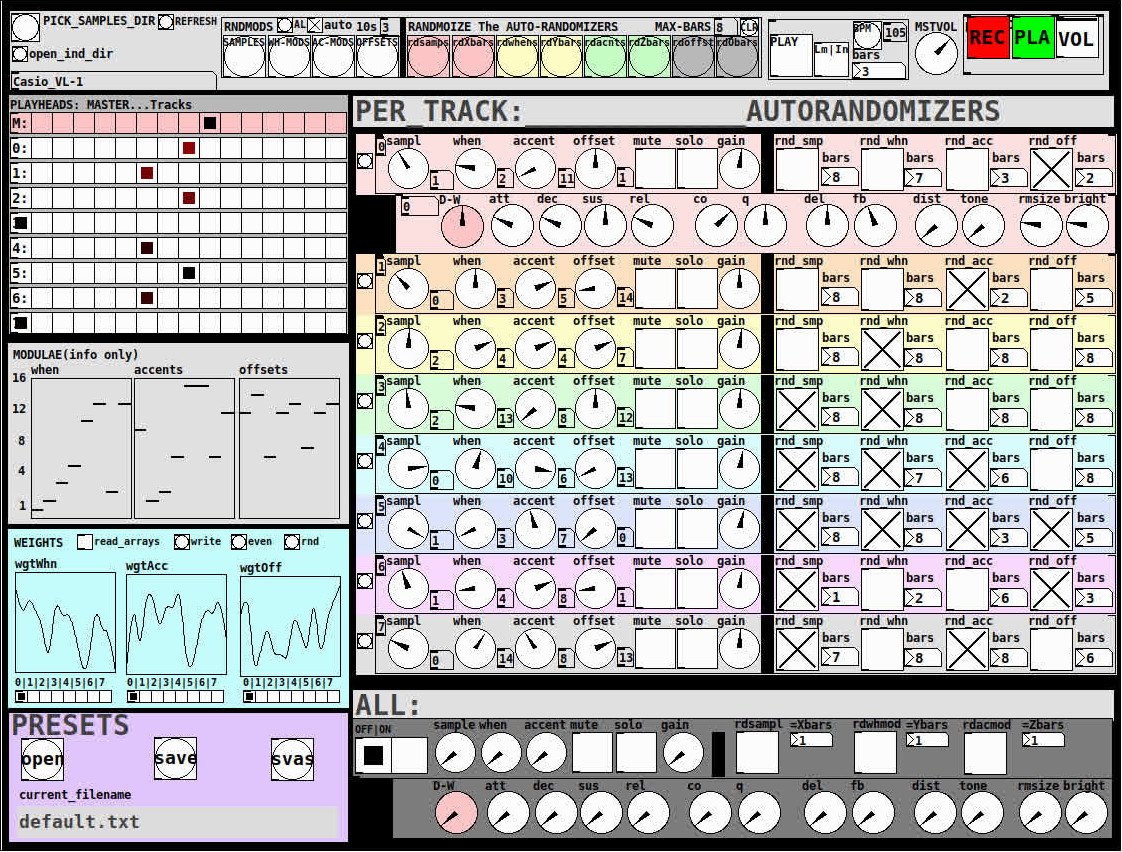
THE 7 SECTIONS:
- GLOBAL:
- to set parameters for all 8 tracks, exs. pick the samples directory from a tof/pmenu or OPEN_IND_DIR (open an independent directory) (see below "Samples"for more detail)
- randomizing parameters, random all. randomize all every 10*seconds, maximum number of bars when randomizing bars, CLR the randomizer check boxes
- PLAY, L(imited) or I(nfinite) counter, if L then number of bars to play before resetting counter, bpm(menu)
- MSTVOL
- transport/recording (on REC files are automatically saved to ./ganymede/recordings with datestamp filename, the output is zexy limited to 98 and the volume controls the boost into the limiter)
- PLAYHEADS:
- indicating where the track is "beating"
- blank=no beat and black-to-red where redder implies greater env~ rms
- MODULAE:
- for information only to show the relative values of the selected modulators
- WEIGHTS:
- sent to [list-wrandom] when randomizing the When, Accent, and Offset modulators
- to use click READ_ARRAYS, adjust as desired, click WRITE, uncheck READ ARRAYS
- EVEN=unweighted, RND for random, and 0-7 for preset shapes
- PRESETS:
- ...self explanatory
-
PER TRACK ACCORDION:
- 8 sections, 1 per track
- each open-closable with the left most bang/track
- opening one track closes the previously opened track
- includes main (always shown)
- with knobs for the sample (with 300ms debounce)
- knobs for the modulators (When, Accent, and Offset) [1..16]
- toggles if you want that parameter to be randomized after X bars
- and when opened, 5 optional effects
- adsr, vcf, delayfb, distortion, and reverb
- D-W=dry-wet
- 2 parameters per effect
-
ALL:
when ON. sets the values for all of the tracks to the same value; reverts to the original values when turned OFF
MIDI:
CC 7=MASTER VOLUME
The other controls exposed to midi are the first four knobs of the accordion/main-gui. In other words, the Sample, When, Accent, and Offset knobs of each track. And the MUTE and SOLO of each track.
Control is based on a midimap file (./midimaps/midimap-default.txt).
So if it is easier to just edit that file to your controller, then just make a backup of it and edit as you need. In other words, midi-learn and changing midimap files is not supported.
The default midimap is:
By track
CCs
| ---TRACK--- | ---SAMPLE--- | ---WHEN--- | ---ACCENT--- | --- OFFSET--- |
|---|---|---|---|---|
| 0 | 16 | 17 | 18 | 19 |
| 1 | 20 | 21 | 22 | 23 |
| 2 | 24 | 25 | 26 | 27 |
| 3 | 28 | 29 | 30 | 31 |
| 4 | 46 | 47 | 48 | 49 |
| 5 | 50 | 51 | 52 | 53 |
| 6 | 54 | 55 | 56 | 57 |
| 7 | 58 | 59 | 60 | 61 |
NOTEs
| ---TRACK--- | ---MUTE--- | ---SOLO--- |
|---|---|---|
| 0 | 1 | 3 |
| 1 | 4 | 6 |
| 2 | 7 | 9 |
| 3 | 10 | 12 |
| 4 | 13 | 15 |
| 5 | 16 | 18 |
| 6 | 19 | 21 |
| 7 | 22 | 24 |
SAMPLES:
Ganymede looks for samples in its ./samples directory by subdirectory.
It generates a tof/pmenu from the directories in ./samples.
Once a directory is selected, it then searches for ./**/.wav (wavs within 1-deep subdirectories) and then ./*.wav (wavs within that main "kit" directory).
I have uploaded my collection of samples (that I gathered from https://archive.org/details/old-school-sample-cds-collection-01, Attribution-Non Commercial-Share Alike 4.0 International Creative Commons License, 90's Old School Sample CDs Collection by CyberYoukai) to the following link on my Google Drive:
https://drive.google.com/file/d/1SQmrLqhACOXXSmaEf0Iz-PiO7kTkYzO0/view?usp=sharing
It is a large 617 Mb .7z file, including two directories: by-instrument with 141 instruments and by-kit with 135 kits. The file names and directory structure have all been laid out according to Ganymede's needs, ex. no spaces, etc.
My suggestion to you is unpack the file into your Path so they are also available for all of your other patches.
MAKING KITS:
I found Kits are best made by adding directories in a "custom-kits" folder to your sampls directory and just adding files, but most especially shortcuts/symlinks to all the files or directories you want to include in the kit into that folder, ex. in a "bongs&congs" folder add shortcuts to those instument folders. Then, create a symnlink to "bongs&congs" in your ganymede/samples directory.
Note: if you want to experiment with kits on-the-fly (while the patch is on) just remember to click the REFRESH bang to get a new tof/pmenu of available kits from your latest ./samples directory.
If you want more freedom than a dynamic menu, you can use the OPEN_IND(depedent)_DIR bang to open any folder. But do bear in mind, Ganymede may not see all the wavs in that folder.
AFTERWARD/NOTES
-
the [hcs/folder_list] [tof/pmenu] can only hold (the first) 64 directories in the ./samples directory
-
the use of 1/16th notes (counter-interval) is completely arbitrary. However, that value (in the [pd global_metro] subpatch...at the noted hradio) is exposed and I will probably incorporate being able to change it in a future version)
-
rem: one of the beauties of this technique is: If you don't like the beat,rhythm, etc., you need only click ALL to get an entirely new beat or any of the other randomizers to re-randomize it OR let if do that by itself on AUTO until you like it, then just take it off AUTO.
-
One fun thing to do, is let it morph, with some set of toggles and bars selected, and just keep an ear out for the Really choice ones and record those or step in to "play" it, i.e. tweak the effects and parameters. It throws...rolls...a lot of them.
-
Another thing to play around with is the notion of Limited (bumpy) or Infinite(flat) sequences in conjunction with the number of bars. Since when and where the modulator triggers is contegent on when it resets.
-
Designed, as I said before, to be played, esp. once it gets rolling, it allows you to focus on the production (instead of writing beats) by controlling the ALL and Individual effects and parameters.
-
Note: if you really like the beat Don't forget to turn off the randomizers. CLEAR for instance works well. However you can't get the back the toggle values after they're cleared. (possible feature in next version)
-
The default.txt preset loads on loadbang. So if you want to save your state, then just click PRESETS>SAVE.
-
[folder_list] throws error messages if it can't find things, ex. when you're not using subdirectories in your kit. No need to worry about it. It just does that.
POSTSCRIPT
If you need any help, more explanation, advise, or have opinions or insight as to how I can make it better, I would love to hear from you.
I think that's >=95% of what I need to tell you.
If I think of anything else, I'll add it below.
Peace thru Music.
Love thru Pure Data.
-s
,
 posted in patch~